
If you are learning chemistry and need to calculate the theoretical percentage of water for the following hydrates, the process becomes much easier once you understand how hydrates are written and how their molar masses are calculated.
A hydrate is an ionic compound that contains a specific number of water molecules within its crystal structure. These water molecules are called water of crystallization or waters of hydration. When a hydrate is heated, the water can often be removed, leaving behind an anhydrous compound.
The theoretical percentage of water tells us what fraction of the total mass of a hydrate is contributed by water. This value is calculated from the chemical formula and atomic masses rather than from an experimental measurement. In this guide, we will explain the formula, show step-by-step calculations, work through common examples, and discuss mistakes students should avoid.
What Is a Hydrate?
A hydrate is a compound that contains water molecules as part of its crystalline structure. A typical hydrate is represented as
Salt · nH₂O
Here, the salt represents the anhydrous compound, and n represents the number of water molecules associated with each formula unit of the compound.
For example: CuSO₄ · 5H₂O
This compound is copper(II) sulfate pentahydrate. The formula tells us that every formula unit of copper(II) sulfate is associated with five water molecules.
Another example is MgSO₄ · 7H₂O.
This is magnesium sulfate heptahydrate and contains seven water molecules per formula unit. The number of water molecules is important because it directly affects the theoretical percentage of water.
Hydrate Water Percentage Calculator
Enter the molar mass of the anhydrous compound and the number of water molecules to calculate the theoretical percentage of water.
Hydrate Water Percentage Calculator
What Is the Theoretical Percentage of Water?
The theoretical percentage of water is the percentage by mass of water present in a hydrate according to its chemical formula.
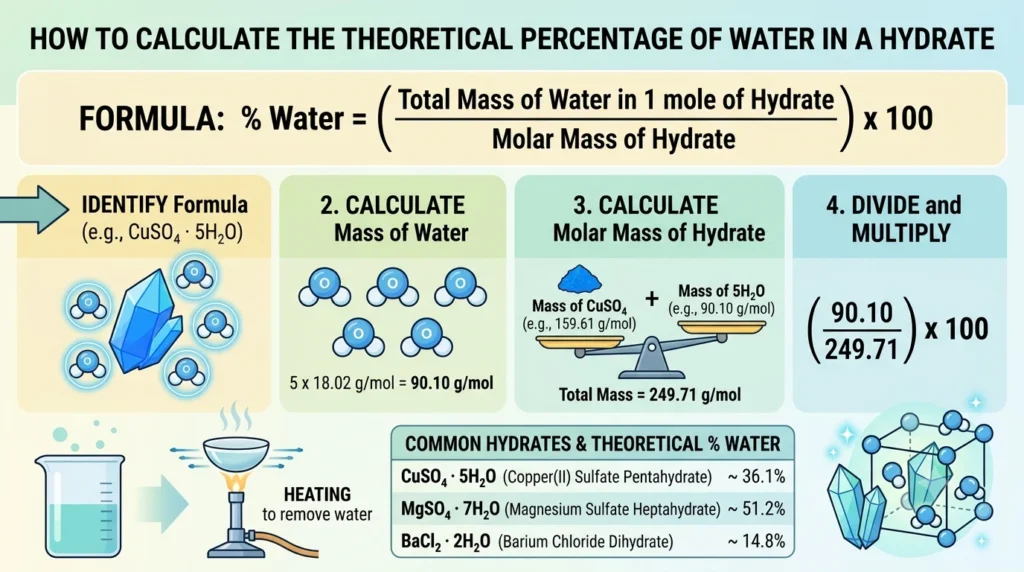
The basic formula is
Percentage of water = (Mass of water in one mole of hydrate ÷ Molar mass of hydrate) × 100
The calculation has three main parts:
- Determine the molar mass of the water.
- Determine the total molar mass of the hydrate.
- Divide the mass of water by the total mass and multiply by 100.
Because one mole of water (H₂O) has a molar mass of approximately 18.015 g/mol, the water portion can be calculated directly from the number of water molecules in the formula.
Formula for Calculating Water Percentage in a Hydrate
For a hydrate written as Salt · nH₂O
The theoretical percentage of water can be calculated using:
% H₂O = [n × 18.015 ÷ molar mass of hydrate] × 100
The exact value may vary slightly depending on the atomic masses used in the calculation. The most important point is that the denominator must represent the entire molar mass of the hydrate, not just the anhydrous salt.
How to Calculate the Theoretical Percentage of Water for Hydrates
Follow these steps for almost any hydrate problem.
Step 1: Identify the hydrate formula.
Look carefully at the chemical formula and identify the number of water molecules.
For example: CuSO₄ · 5H₂O
There are five water molecules.
Step 2: Calculate the mass of water
The molar mass of H₂O is approximately:
- Hydrogen = 1.008 g/mol
- Oxygen = 15.999 g/mol
Therefore:
H₂O = 2(1.008) + 15.999
H₂O ≈ 18.015 g/mol
For five water molecules:
5 × 18.015 = 90.075 g/mol
So, approximately 90.075 grams of every mole of CuSO₄ · 5H₂O is water.
Step 3: Calculate the molar mass of the anhydrous compound.
For CuSO₄:
- Cu ≈ 63.546
- S ≈ 32.065
- O₄ ≈ 63.996
Therefore: CuSO₄ ≈ 159.607 g/mol
Step 4: Calculate the molar mass of the complete hydrate.
Add the mass of the anhydrous compound and the water:
159.607 + 90.075 = 249.682 g/mol
Therefore, the molar mass of CuSO₄ · 5H₂O is approximately 249.682 g/mol.
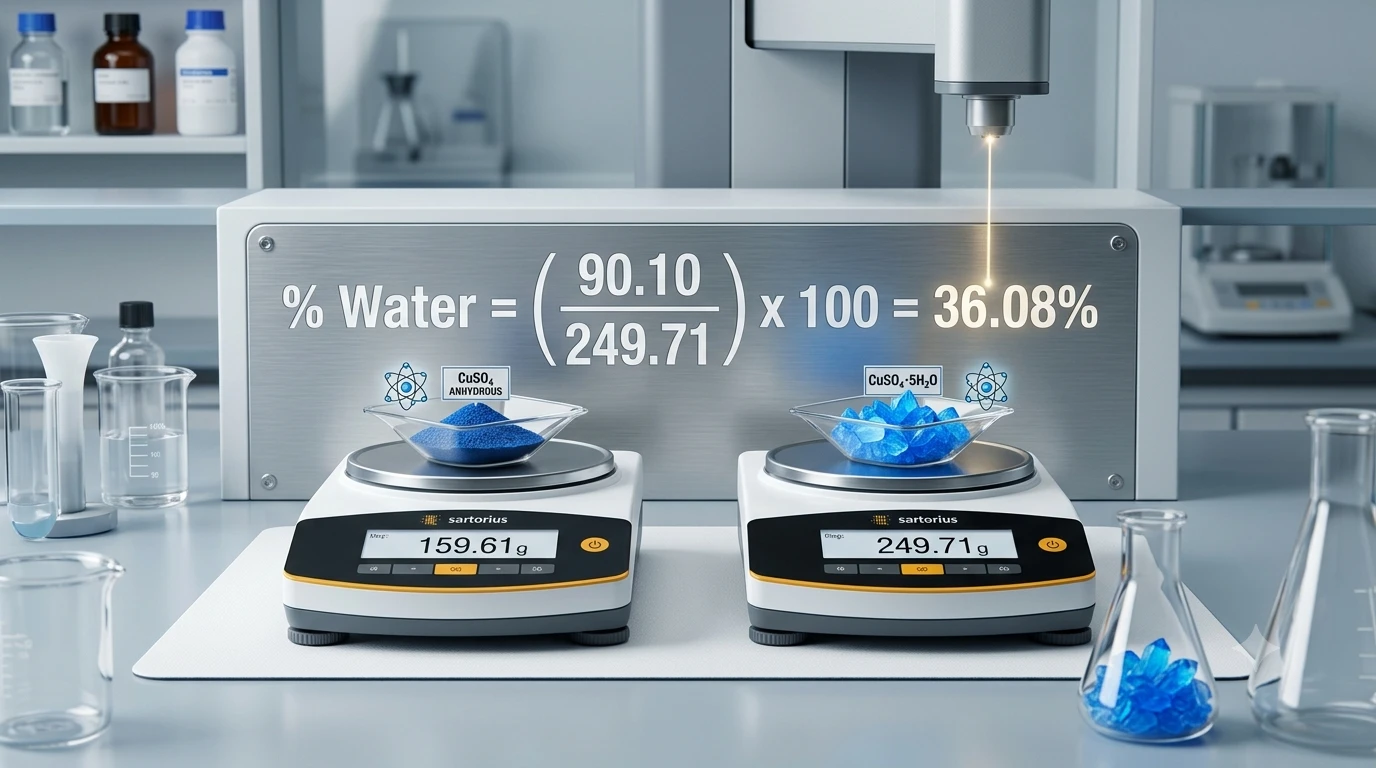
Step 5: Calculate the percentage of water.
Now use the percentage formula:
% H₂O = (90.075 ÷ 249.682) × 100
The result is approximately 36.08%.
Therefore, the theoretical water content of copper(II) sulfate pentahydrate is approximately 36.08% by mass.
Example 1: Calculate the Water Percentage of MgSO₄ · 7H₂O.
Let’s calculate another common hydrate.
The formula is MgSO₄ · 7H₂O.
First, calculate the molar mass of MgSO₄.
Approximate atomic masses:
- Mg = 24.305
- S = 32.065
- O₄ = 63.996
Therefore: MgSO₄ ≈ 120.366 g/mol
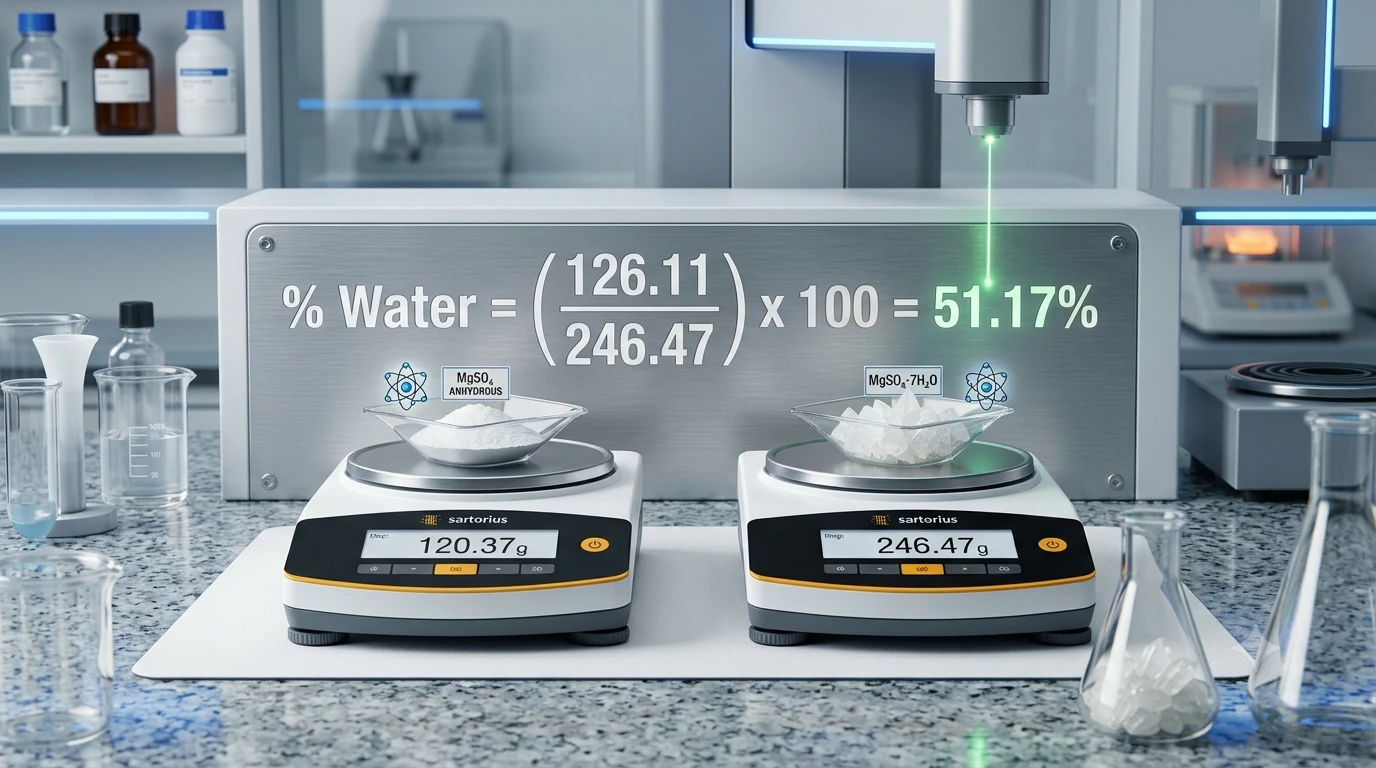
Now calculate the mass of seven water molecules: 7 × 18.015 = 126.105 g/mol
The complete hydrate has a molar mass of 120.366 + 126.105 = 246.471 g/mol
Now calculate the percentage: % H₂O = (126.105 ÷ 246.471) × 100
The theoretical percentage of water is approximately 51.16%.
This means that slightly more than half of the mass of magnesium sulfate heptahydrate is water.
Example 2: Calculate the Water Percentage of BaCl₂ · 2H₂O.
Consider barium chloride dihydrate:
BaCl₂ · 2H₂O
The approximate molar mass of BaCl₂ is
- Ba = 137.327
- Cl₂ = 70.90
So:
BaCl₂ ≈ 208.227 g/mol
The mass of two water molecules is 2 × 18.015 = 36.030 g/mol
Total hydrate mass: 208.227 + 36.030 = 244.257 g/mol
Now calculate: % H₂O = (36.030 ÷ 244.257) × 100
The theoretical water percentage is approximately 14.75%.
Therefore, barium chloride dihydrate contains approximately 14.75% water by mass according to its formula.
Example 3: Calculate the Water Percentage of Na₂CO₃ · 10H₂O.
Sodium carbonate decahydrate is written as Na₂CO₃ · 10H₂O
The approximate molar mass of Na₂CO₃ is
- Na₂ = 45.98
- C = 12.011
- O₃ = 47.997
Therefore: Na₂CO₃ ≈ 105.988 g/mol
The mass of ten water molecules is 10 × 18.015 = 180.150 g/mol
Total molar mass: 105.988 + 180.150 = 286.138 g/mol
Now: % H₂O = (180.150 ÷ 286.138) × 100
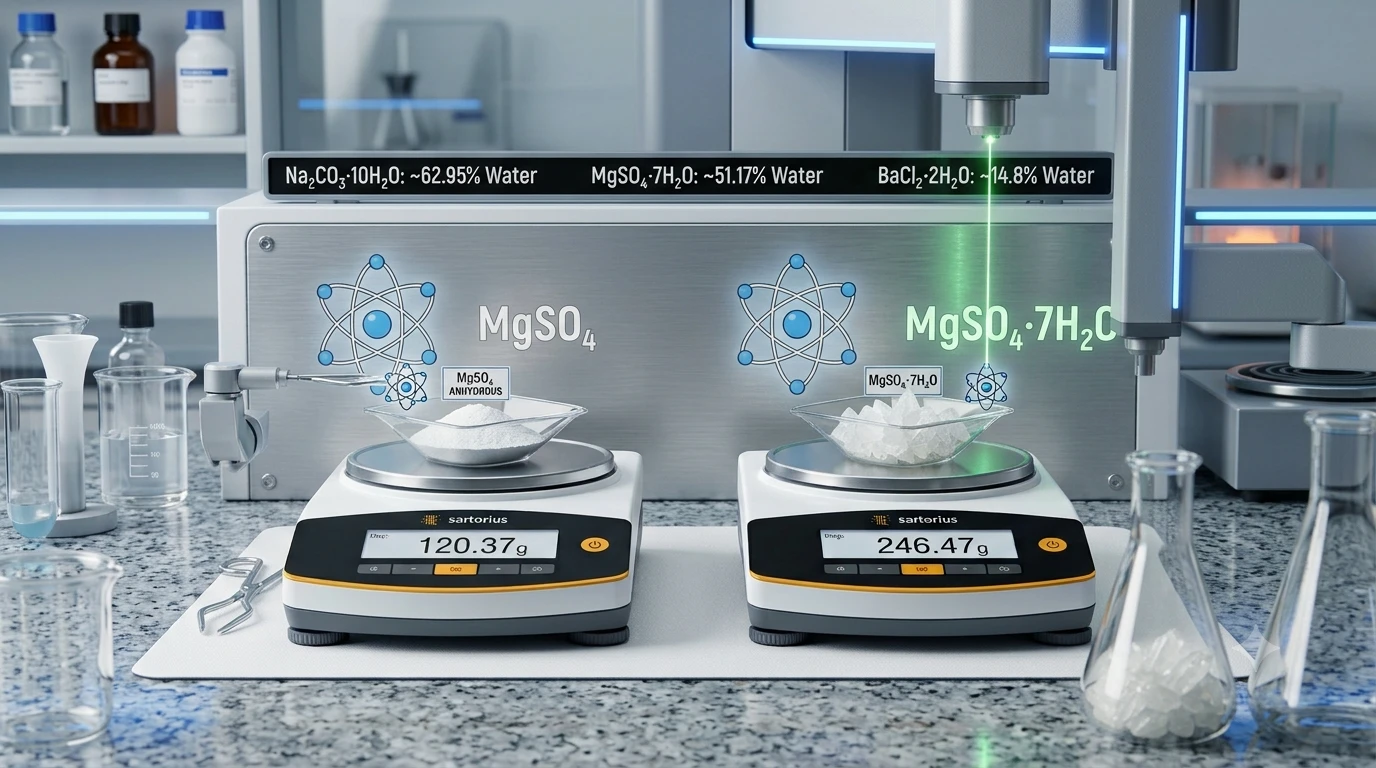
The result is approximately 62.95%
This example demonstrates why hydrates with a large number of water molecules can have a very high theoretical water percentage.
Why Is the Number of Water Molecules Important?
The coefficient before H₂O has a major effect on the theoretical water percentage.
Compare these two formulas: CuSO₄ · H₂O
and CuSO₄ · 5H₂O
The first contains only one water molecule, while the second contains five.
As the number of water molecules increases, the total mass contributed by water also increases. Consequently, the theoretical percentage of water generally increases as well, although the exact percentage depends on the mass of the anhydrous compound.
This is why it is essential to read the hydrate formula carefully before beginning the calculation.
Hydrate vs. Anhydrous Compound
A useful distinction in these problems is the difference between a hydrate and an anhydrous compound. A hydrate contains water molecules as part of its crystal structure.
An anhydrous compound does not contain those waters of crystallization.
For example, CuSO₄ · 5H₂O is a hydrate, while CuSO₄ is the corresponding anhydrous compound.
When a suitable hydrate is heated, some or all of its water of crystallization may be removed. In a laboratory setting, the mass loss can be used to estimate the water content experimentally.
The theoretical percentage, however, comes directly from the chemical formula.
Theoretical vs. Experimental Percentage of Water
It is important not to confuse theoretical and experimental values.
Theoretical percentage
The theoretical percentage is calculated using the known chemical formula and atomic masses.
For example:
Theoretical % H₂O = mass of water in the formula ÷ total molar mass × 100
Experimental percentage
An experimental value is determined from laboratory measurements.
For example, if a sample is weighed before and after heating, the difference in mass can be used to estimate the amount of water removed.
The experimental result may differ slightly from the theoretical value because of factors such as incomplete dehydration, sample impurities, measurement uncertainty, or loss of material during handling.
Common Mistakes When Calculating Hydrate Water Percentage
Several mistakes occur frequently in hydrate calculations.
1. Forgetting the coefficient before H₂O
In: MgSO₄ · 7H₂O
You must calculate the mass of seven water molecules, not one.
2. Using only the anhydrous molar mass
The denominator should be the molar mass of the complete hydrate.
Incorrect: mass of water ÷ mass of anhydrous salt
Correct: mass of water ÷ mass of complete hydrate
3. Forgetting to multiply by 100
The ratio gives a decimal fraction. To convert it to a percentage, multiply by 100.
4. Rounding too early
It is better to keep several decimal places during intermediate calculations and round the final answer.
5. Misreading the chemical formula
The dot in a hydrate formula is important.
For example, Na₂CO₃ · 10H₂O means ten water molecules are associated with one formula unit of sodium carbonate.
It does not mean that water is mixed with the compound in an arbitrary amount.
A Quick Method for Solving Hydrate Problems
For a hydrate: Compound · nH₂O
You can use this simple procedure:
1. Find the molar mass of the compound.
2. Calculate the mass of n water molecules.
3. Add the two masses to obtain the total hydrate molar mass.
4. Divide the water mass by the total hydrate mass.
5. Multiply by 100.
In compact form:
Theoretical % H₂O = [n × 18.015 ÷ (molar mass of salt + n × 18.015)] × 100
This method works for a wide range of standard hydrate calculations.
Why These Calculations Matter in Chemistry
Calculating water content is more than a classroom exercise. Hydrate calculations help students understand the relationship between chemical formulas, molar mass, mass percentages, and stoichiometry.
The same general concept of mass percentage is used in many areas of chemistry. Once you understand how to separate the water contribution from the rest of the compound, many hydrate problems become straightforward.
These calculations can also help when comparing theoretical values with laboratory results. A significant difference between experimental and theoretical values can provide useful information about the quality of a sample or the procedure used during an experiment.
Frequently Asked Questions
The formula is
% H₂O = (mass of water in one mole of hydrate ÷ molar mass of hydrate) × 100
Multiply the number of water molecules in the hydrate formula by the molar mass of H₂O, approximately 18.015 g/mol.
For example, five water molecules have a mass of
5 × 18.015 = 90.075 g/mol
Yes. The water molecules represented in the hydrate formula are included in the total molar mass.
The dot indicates that a specific number of water molecules are associated with the compound’s crystal structure.
For example, CuSO₄ · 5H₂O contains five waters of crystallization per formula unit.
No. The water is only one component of the total hydrate mass, so its theoretical percentage must be less than 100%.
Experimental results can differ because of incomplete heating, impurities, measurement limitations, moisture absorption, or material loss during the experiment.
Use the atomic masses provided by your textbook, instructor, periodic table, or calculator. Small differences in atomic masses can cause slight differences in the final percentage (62.95%).
Final Takeaway
To calculate the theoretical percentage of water for the following hydrates, first identify the number of H₂O molecules in the chemical formula. Then calculate the mass of those water molecules, find the total molar mass of the hydrate, and use the water mass as a percentage of the total.
The key formula is
Theoretical % H₂O = (Mass of H₂O ÷ Total mass of hydrate) × 100
Once you understand this process, you can apply it to hydrates such as CuSO₄ · 5H₂O, MgSO₄ · 7H₂O, BaCl₂ · 2H₂O, Na₂CO₃ · 10H₂O, and many others.
The most important thing is to read the hydrate formula carefully, include all water molecules in the molar mass, and perform the final percentage calculation using the complete hydrate mass.
References and Sources
- International Union of Pure and Applied Chemistry (IUPAC). Periodic Table of Elements and Standard Atomic Weights.
IUPAC Periodic Table of Elements - National Institute of Standards and Technology (NIST). NIST Chemistry WebBook: Water (H₂O).
NIST Chemistry WebBook – Water

Leave a Reply