
Calculate the enthalpy change for the complete combustion of ethene (C₂H₄).
Enter the standard enthalpies of formation (ΔHf°) for the reactants and products. Default values are provided for a common 298 K calculation.
To calculate the heat of combustion of ethene, you need the balanced combustion equation and the thermochemical data for the substances involved. The heat of combustion describes the enthalpy change that occurs when one mole of a substance undergoes complete combustion in oxygen under specified conditions.
Ethene, also known as ethylene, has the molecular formula C₂H₄. It is a hydrocarbon containing two carbon atoms and four hydrogen atoms. When ethene burns completely in oxygen, carbon dioxide and water are formed.
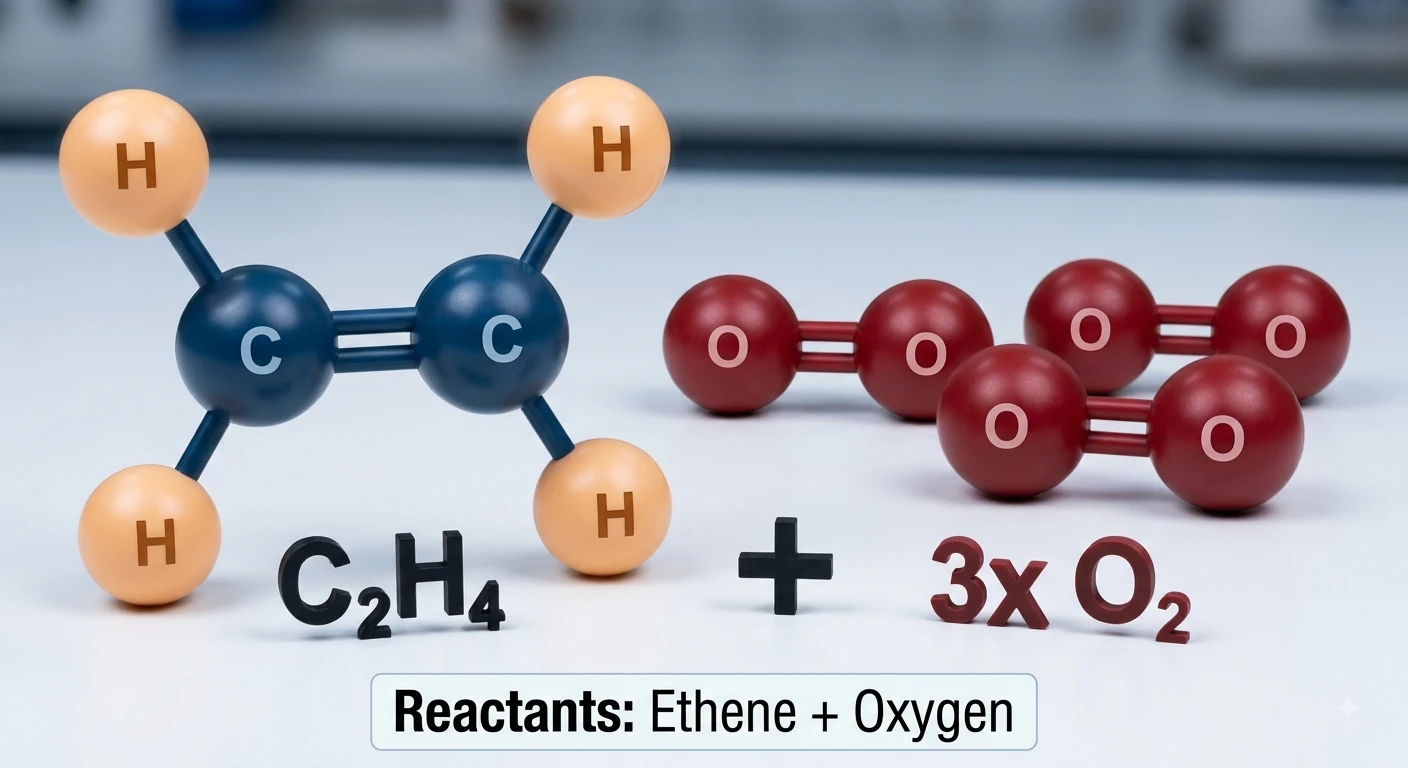
The balanced combustion equation is
C₂H₄(g) + 3O₂(g) → 2CO₂(g) + 2H₂O(l)
For a standard calculation using standard enthalpies of formation, the heat of combustion can be determined using Hess’s law.
Our Heat of Combustion of Ethene Calculator can also perform the calculation automatically and show the working steps.
Important: The numerical result depends on the thermochemical data used and, especially, on whether water is treated as a liquid or a gas.
The heat of combustion is the enthalpy change associated with the complete combustion of a substance in oxygen.
For ethene, complete combustion produces carbon dioxide and water:
C₂H₄(g) + 3O₂(g) → 2CO₂(g) + 2H₂O(l)
Because combustion releases energy, the enthalpy change is normally negative.
A negative value means that energy is released to the surroundings during the reaction.
The unit commonly used for the molar heat of combustion is
kJ/mol
This means the calculated value represents the energy change associated with the combustion of one mole of ethene under the specified conditions.
Before you calculate the heat of combustion, the chemical equation must be balanced.
Start with:
C₂H₄ + O₂ → CO₂ + H₂O
There are two carbon atoms in ethene, so we need two carbon dioxide molecules:
C₂H₄ + O₂ → 2CO₂ + H₂O
Ethene contains four hydrogen atoms, so two water molecules are required:
C₂H₄ + O₂ → 2CO₂ + 2H₂O
Now count the oxygen atoms on the right:
Therefore, we need three O₂ molecules:
C₂H₄(g) + 3O₂(g) → 2CO₂(g) + 2H₂O(l)
This is the balanced combustion equation used in the standard enthalpy-of-formation calculation.
One common method uses standard enthalpies of formation.
The general equation is
ΔH°reaction = Σ nΔHf°(products) − Σ nΔHf°(reactants)
For ethene combustion:
ΔH°comb = [2ΔHf°(CO₂) + 2ΔHf°(H₂O)] − [ΔHf°(C₂H₄) + 3ΔHf°(O₂)]
Here:
The coefficients are important. You cannot simply subtract the values for one molecule of each substance because the balanced equation contains different numbers of molecules.
For an example calculation, the calculator uses the following commonly used values in kJ/mol:
| Substance | ΔHf° (kJ/mol) |
|---|---|
| C₂H₄(g) | +52.47 |
| O₂(g) | 0 |
| CO₂(g) | −393.51 |
| H₂O(l) | −285.83 |
These values are provided as editable inputs in the calculator so that users can substitute the data required by their textbook, laboratory exercise, or specified temperature and conditions.
An important point is that O₂(g) has a standard enthalpy of formation of zero because it is an element in its standard state.
Let’s use the values above to calculate the heat of combustion of ethene.
C₂H₄(g) + 3O₂(g) → 2CO₂(g) + 2H₂O(l)
ΔH°comb = ΣΔHf° products − ΣΔHf° reactants
Therefore:
ΔH°comb = [2(ΔHf° CO₂) + 2(ΔHf° H₂O)] − [ΔHf° C₂H₄ + 3(ΔHf° O₂)]
Using:
We get:
ΔH°comb = [2(−393.51) + 2(−285.83)] − [(52.47) + 3(0)]
Calculate the products:
2(−393.51) = −787.02
and:
2(−285.83) = −571.66
Therefore:
Products = −787.02 − 571.66
Products = −1358.68 kJ/mol
Now calculate the reactants:
52.47 + 3(0) = 52.47 kJ/mol
Finally:
ΔH°comb = −1358.68 − 52.47
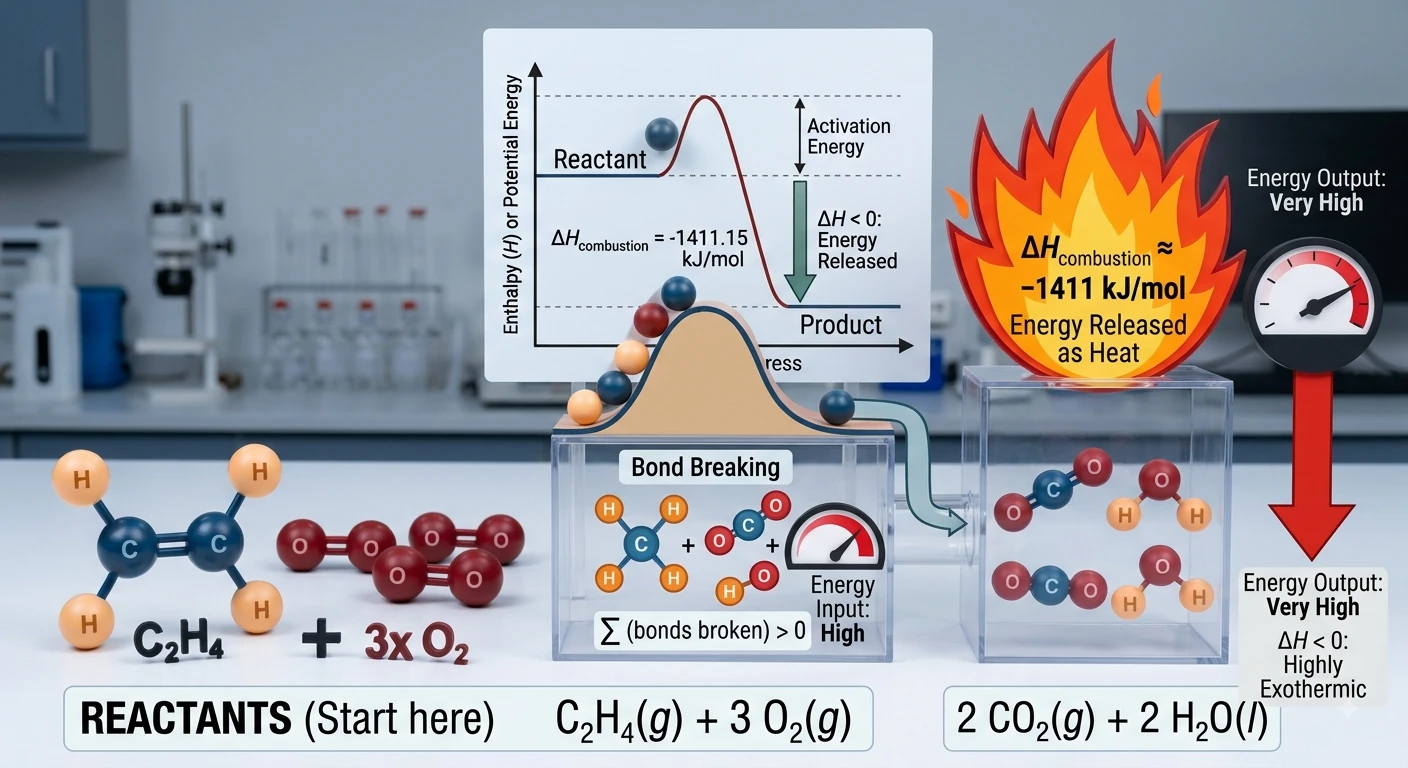
ΔH°comb = −1411.15 kJ/mol
So, using these input values, the calculated standard heat of combustion is approximately
The negative sign indicates that the combustion reaction releases energy.
Combustion is an exothermic process.
In an exothermic reaction, the products have lower enthalpy than the reactants, and the difference is released as energy.
That is why the calculated value is negative.
For example:
ΔH = −1411.15 kJ/mol
The negative sign does not mean that the reaction requires negative energy. Instead, it indicates a release of energy from the reacting system to the surroundings.
If a question asks for the amount of heat released, it may sometimes be appropriate to state the magnitude as
1411.15 kJ/mol released
But when reporting the enthalpy change of the reaction, the sign should remain negative.
One of the most important details when you calculate the heat of combustion of ethene is the physical state of water.
The combustion equation can be written with either liquid water or water vapor depending on the conditions and the data being used.
For example:
C₂H₄(g) + 3O₂(g) → 2CO₂(g) + 2H₂O(l)
is different thermochemically from:
C₂H₄(g) + 3O₂(g) → 2CO₂(g) + 2H₂O(g)
The enthalpy of formation of liquid water is different from the enthalpy of formation of gaseous water.
Consequently, the calculated heat of combustion will also be different.
This is why you should always check the physical states specified in the chemistry question before entering values into a calculator.
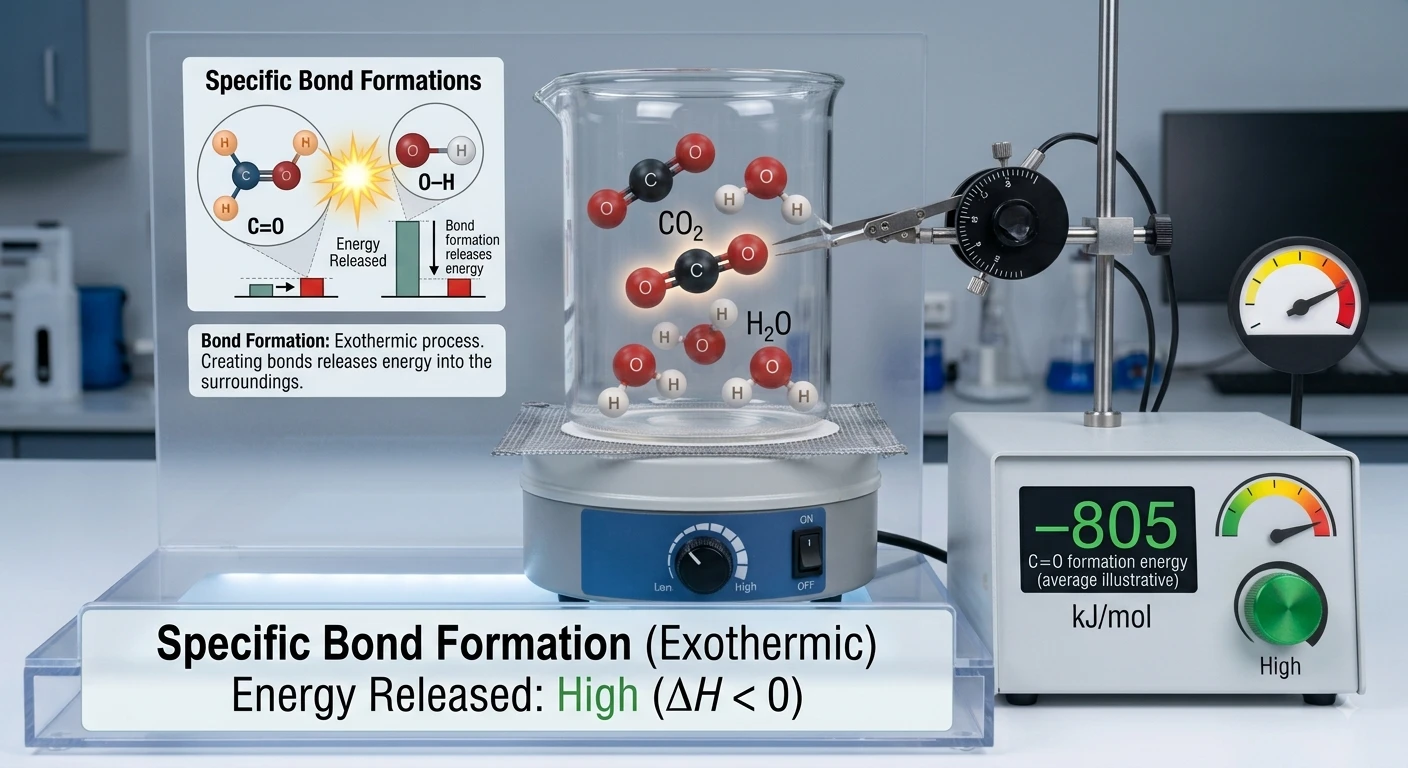
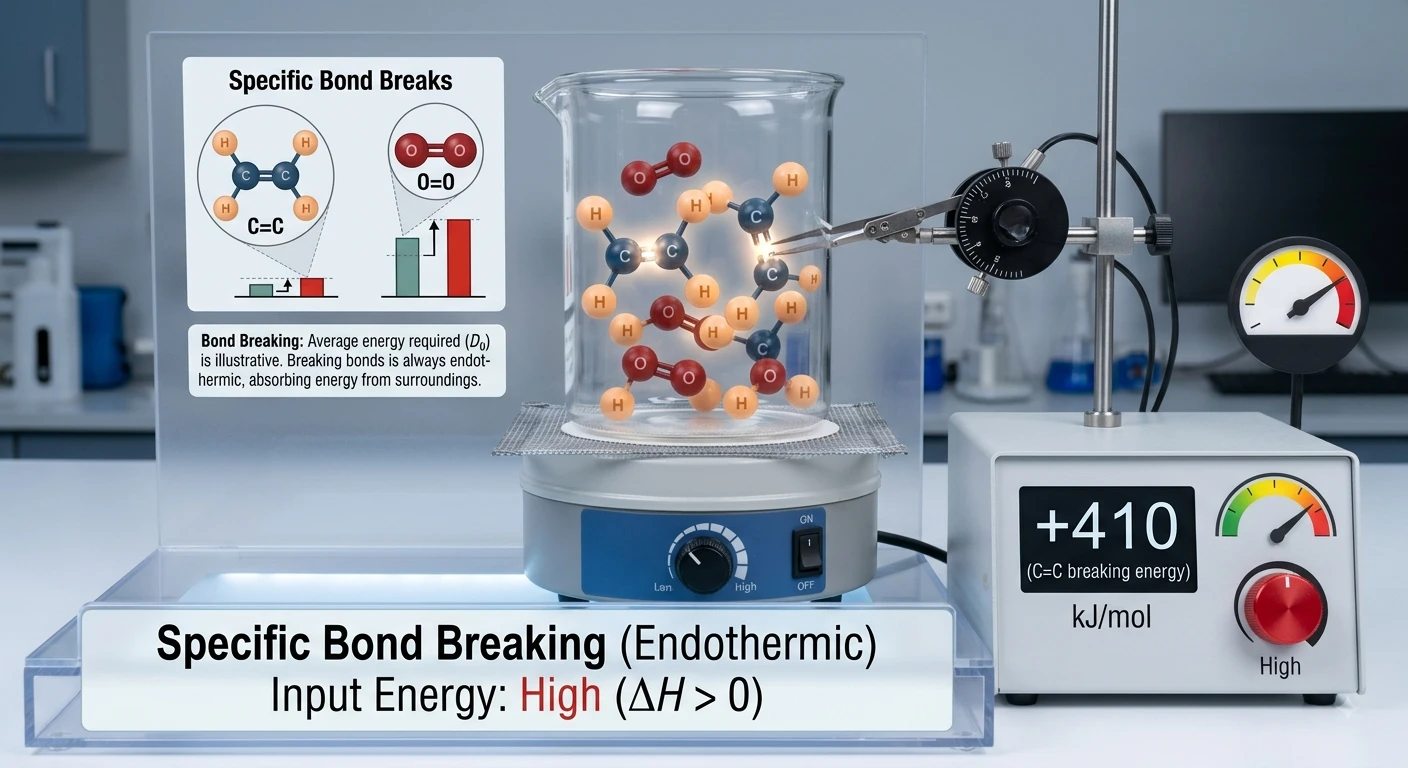
Another method for estimating the heat of combustion is the bond-energy method.
The basic equation is
ΔH ≈ Σ bond energies of bonds broken − Σ bond energies of bonds formed
For ethene combustion, bonds in the reactants are broken, and new bonds are formed in the products.
The calculator includes a separate Bond Energies mode where you can enter the average bond energies you have been given.
For the ethene combustion equation:
C₂H₄ + 3O₂ → 2CO₂ + 2H₂O
The bonds broken include:
The products involve:
The calculation therefore follows:
ΔH ≈ [C=C + 4(C–H) + 3(O=O)] − [4(C=O) + 4(O–H)]
Bond-energy calculations are estimates because tabulated bond energies are average values rather than exact values for every molecular environment.
For that reason, a bond-energy result may not exactly match a result obtained from standard enthalpies of formation.
Both methods can be useful, but they serve slightly different purposes.
This method uses experimentally determined or tabulated thermochemical data.
It is generally preferred when a question provides standard enthalpies of formation.
The equation is
ΔH° = ΣnΔHf°(products) − ΣnΔHf°(reactants)
This method uses average bond energies.
It is particularly useful when a chemistry exercise provides bond-energy values and asks you to estimate the enthalpy change.
The equation is
ΔH ≈ bonds broken − bonds formed
When solving a specific problem, use the method requested by the question.
Our calculator is designed to make the calculation easier while still showing the chemistry behind the result.
Select Enthalpy of Formation.
The calculator provides input fields for:
Enter the values from your question and select Calculate Heat of Combustion.
The calculator then displays:
This makes it easier to check each stage of your calculation.
Select Bond Energies.
Enter the bond-energy values required for:
Then select Estimate Using Bond Energies.
The calculator shows the bonds broken, bonds formed, and estimated enthalpy change.
Several mistakes can lead to an incorrect answer.
Never begin the enthalpy calculation with an unbalanced equation.
The coefficients determine how many times each enthalpy value must be used.
H₂O(l) and H₂O(g) have different enthalpy values.
Always use the state specified by the problem.
For two CO₂ molecules, you need:
2 × ΔHf°(CO₂)
not simply:
ΔHf°(CO₂)
Remember:
Products − Reactants
not:
Reactants − Products
Reversing the formula changes the sign of the answer.
If the question specifically asks for standard enthalpies of formation, use those values rather than substituting average bond energies.
Similarly, if the exercise specifically asks for a bond-energy estimate, use the provided bond energies.
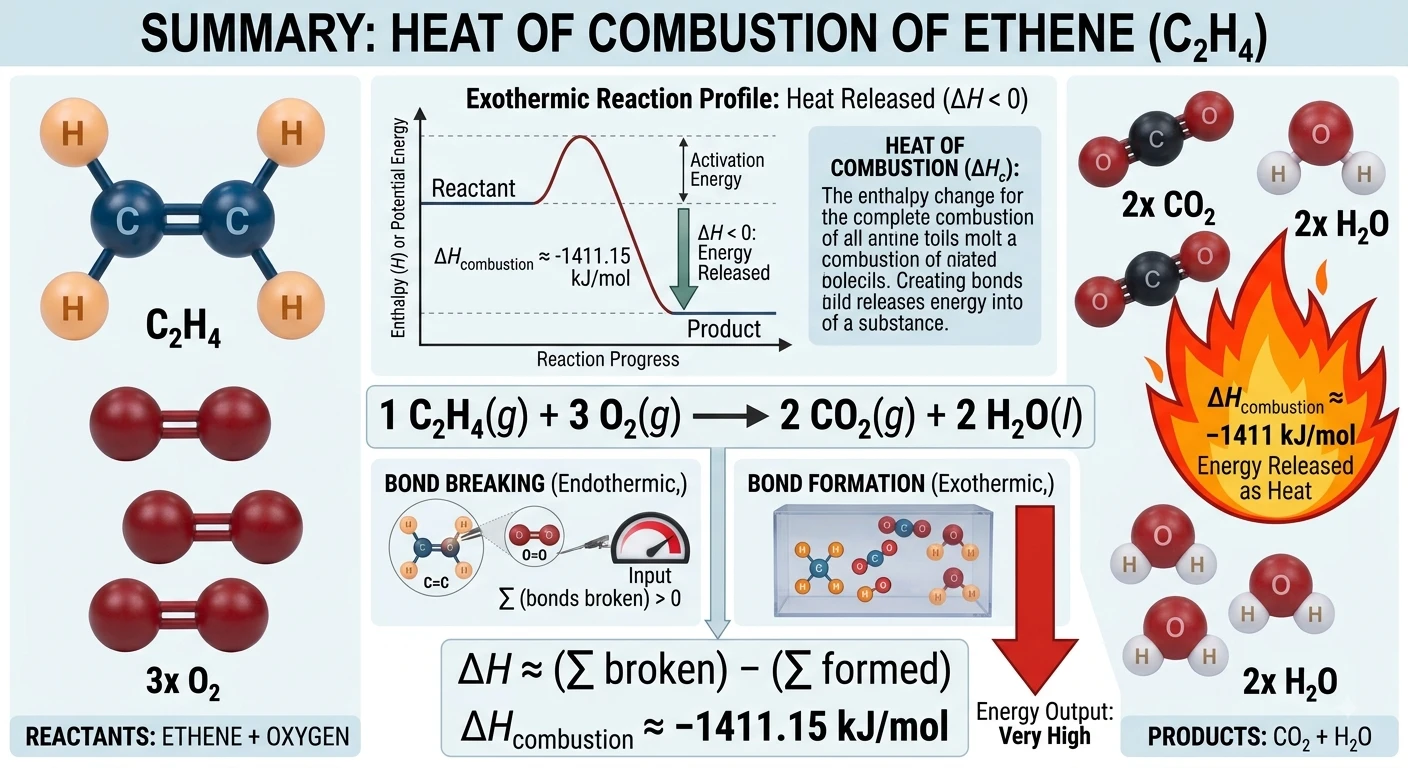
The balanced equation is
C₂H₄(g) + 3O₂(g) → 2CO₂(g) + 2H₂O(l)
When liquid water is specified as the product.
Using standard enthalpies of formation:
ΔH° = ΣnΔHf°(products) − ΣnΔHf°(reactants)
Oxygen gas is an element in its standard state, so its standard enthalpy of formation is defined as 0 kJ/mol.
Yes. Complete combustion releases energy, so the enthalpy change is negative when reported as ΔH.
Yes. You can estimate it using:
ΔH ≈ bonds broken − bonds formed
However, bond-energy results are approximate.
Differences can occur because of the thermochemical data used, temperature, physical state of water, and whether the calculation uses standard enthalpies of formation or average bond energies.
The molar heat of combustion is commonly expressed in kJ/mol.
To calculate the heat of combustion of ethene, first balance the combustion reaction:
C₂H₄(g) + 3O₂(g) → 2CO₂(g) + 2H₂O(l)
Then use the standard enthalpy-of-formation equation:
ΔH°comb = ΣnΔHf°(products) − ΣnΔHf°(reactants)
Using the example values in this guide gives approximately −1411.15 kJ/mol. The negative sign indicates that energy is released during combustion.
For problems based on bond energies, you can instead estimate the reaction enthalpy using the difference between the energy required to break bonds and the energy released when new bonds form.
The most important things to check are the balanced equation, stoichiometric coefficients, thermochemical values, and physical states. Once these are correct, the calculation becomes straightforward.
Hydrate Water Percentage Calculator
Math Calculators
Chemistry Calculators

Zain Bin Shabbir is a content creator and website publisher with 2 years of experience in SEO, web content, and practical online tools. He focuses on creating clear, useful, and user-friendly resources that simplify everyday calculations.
Guides that go deeper into this topic