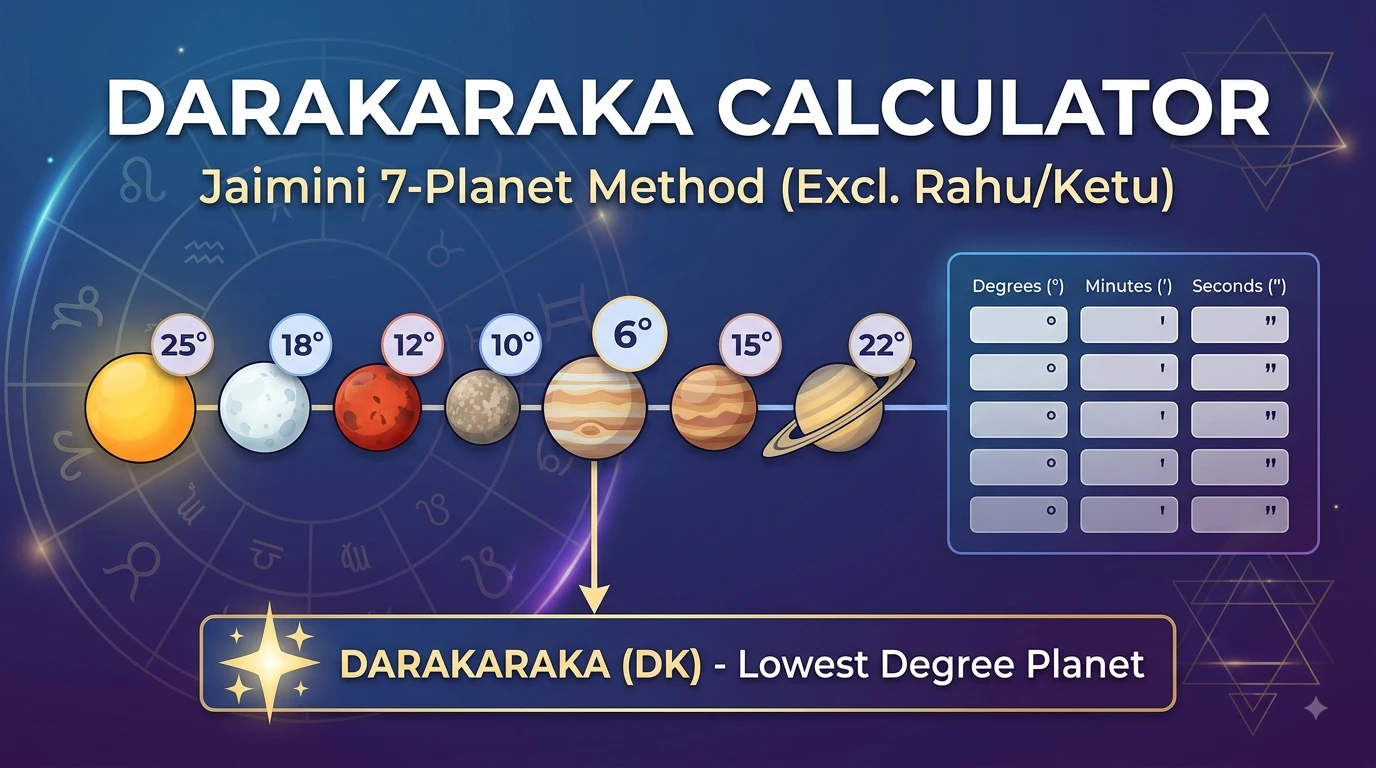
Find your Darakaraka by comparing the degrees of the seven classical planets within their signs.
Jaimini 7-Planet Method: The planet with the lowest degree within its sign is identified as the Darakaraka. Rahu and Ketu are excluded in this version.
Darakaraka Calculator: Find Your Darakaraka Using the Jaimini Method
If you are exploring Vedic astrology and Jaimini astrology, a Darakaraka Calculator can help you identify the planet that holds the lowest degree within its zodiac sign among the seven classical planets used in the traditional 7-planet approach.
In Jaimini astrology, planets can be assigned different Chara Karaka roles according to their degrees within their respective signs. The planet with the lowest degree is commonly identified as the Darakaraka, which is associated with spouse and partnership themes in this astrological system.
Our calculator uses the seven-planet method and considers the Sun, Moon, Mars, Mercury, Jupiter, Venus, and Saturn. This version excludes Rahu and Ketu.
This guide explains what Darakaraka means, how the calculation works, how to use the calculator, why degrees and minutes matter, and how to interpret the result traditionally.
Note: Astrology is a traditional belief system and is not scientifically established as a method for predicting personality, relationships, or future events. This calculator is provided for astrology-related informational and educational purposes.
darakaraka calculator
What Is Darakaraka?
Darakaraka, often abbreviated as DK, is one of the Chara Karakas used in Jaimini astrology.
The word is commonly associated with spouse- or partner-related themes. In the Jaimini Chara Karaka system, planets receive different roles according to their relative degrees within their signs. The planet with the lowest degree is assigned the Darakaraka role in the seven-planet approach.
Unlike fixed planetary significators, Chara Karakas can change from one birth chart to another because the assignments depend on the planetary positions in the individual chart.
For example, Venus may be the Darakaraka in one chart, while Mercury, Saturn, the Moon, or another planet may hold that role in another chart.
This means no single planet is always the Darakaraka for everyone.
What Is a Chara Karaka?
The term “Chara Karaka” refers to movable or variable significators in Jaimini astrology.
In the commonly used seven-planet system, the seven planets are ranked according to their degrees within their signs. The ranking produces seven different karaka roles.
The commonly described sequence is
Atmakaraka (AK)—highest degree
Amatyakaraka (AmK)—second highest
Bhratrukaraka (BK)—third highest
Matrukaraka (MK)—fourth highest
Putrakaraka (PK)—fifth highest
Gnatikaraka (GK)—sixth highest
Darakaraka (DK)—lowest degree
This ranking is based on the planets’ positions within their individual signs rather than simply comparing their absolute zodiac longitude.
The Darakaraka therefore appears at the bottom of the degree ranking.
Which Planets Are Used in This Calculator?
This Darakaraka Calculator uses seven classical planets:
Sun
Moon
Mars
Mercury
Jupiter
Venus
Saturn
Rahu and Ketu are not included.
This is important because different Jaimini astrology traditions and software implementations can use different Chara Karaka schemes. Some approaches use seven planets, while others include Rahu and use an eight-karaka system with special treatment of Rahu’s degree.
Therefore, always check which calculation method a particular calculator or astrology software is using before comparing results.
How Does the Darakaraka Calculation Work?
The basic calculation is simple.
Each of the seven planets has a position within a zodiac sign ranging from
0° 00′ 00″ to 29° 59′ 59″
The calculator compares these positions.
The planet with the smallest degree position becomes the Darakaraka in the seven-planet method.
For example, imagine the following simplified positions:
Planet
Position
Sun
18° 20′
Moon
7° 45′
Mars
22° 10′
Mercury
12° 30′
Jupiter
15° 05′
Venus
4° 50′
Saturn
26° 15′
Venus has the lowest degree:
4° 50′
Therefore, Venus is the Darakaraka in this example.
The zodiac signs themselves do not determine which planet is the Darakaraka in this basic degree-ranking calculation. The important value for the ranking is how far each planet has progressed through its current sign.
This allows the calculator to compare planetary positions numerically.
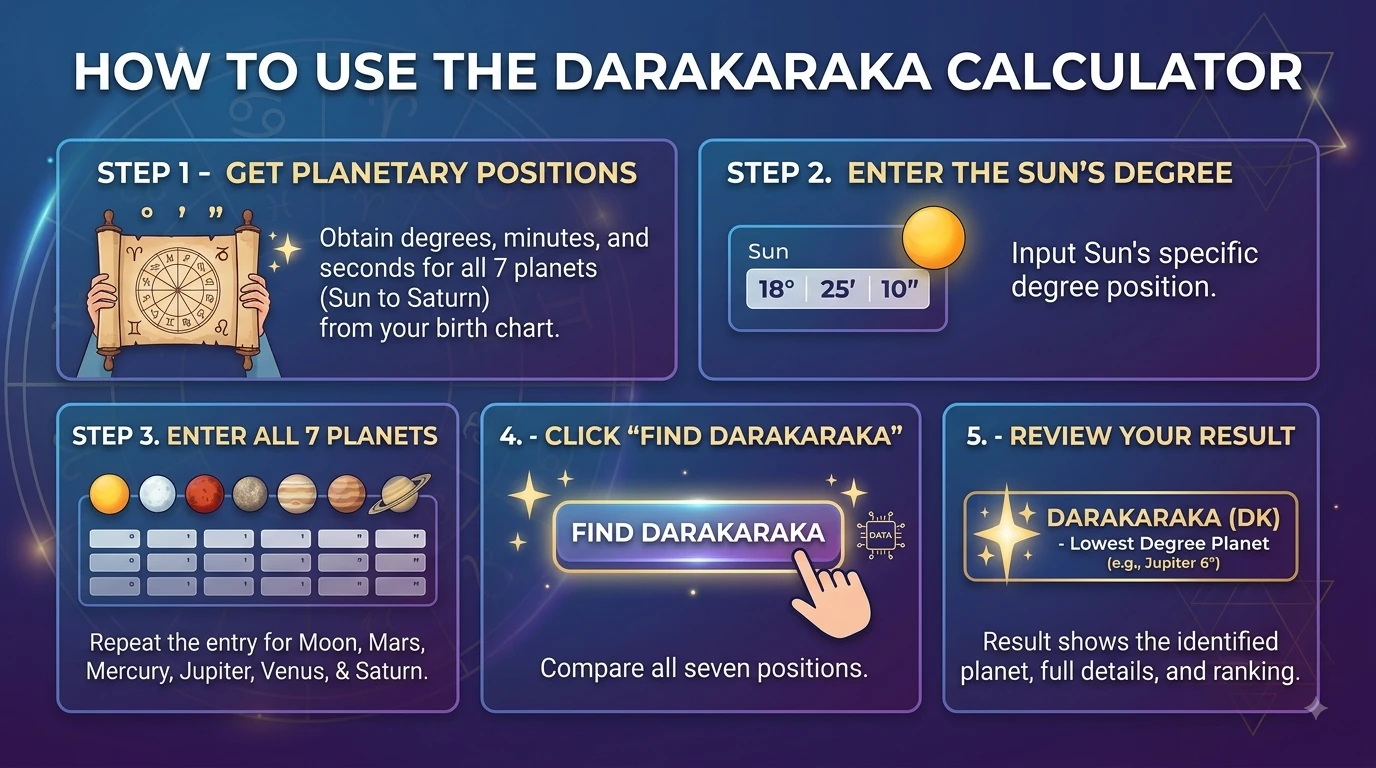
How to Use the Darakaraka Calculator
Using the calculator requires the planetary positions from a suitable birth chart.
Step 1: Find Your Planetary Positions
First, obtain the degrees of the seven planets from your Vedic astrology birth chart or astrology software.
You need the positions for:
Sun
Moon
Mars
Mercury
Jupiter
Venus
Saturn
Make sure the values are the positions within the signs, such as
Venus – 4° 32′ 15″
rather than only the full zodiac longitude.
Step 2: Enter the Sun Position
Enter the sun’s degree, minute, and second values.
For example:
18° 25′ 10″
Step 3: Enter the Other Six Planets
Repeat the process for:
Moon
Mars
Mercury
Jupiter
Venus
Saturn
All seven planets must have valid values.
Step 4: Click “Find Darakaraka.”
After entering all seven planetary positions, click:
Find Darakaraka.
The calculator compares the seven positions and identifies the planet with the lowest degree.
Step 5: Review the Result
The result displays:
Darakaraka planet
Its degree, minutes, and seconds
Decimal degree
Degree ranking of all seven planets
This makes it easier to verify how the result was obtained.
darakaraka calculator
Example Darakaraka Calculation
Consider this example:
Planet
Position
Sun
15° 20′ 10″
Moon
8° 42′ 30″
Mars
21° 05′ 00″
Mercury
12° 18′ 20″
Jupiter
6° 55′ 40″
Venus
18° 10′ 15″
Saturn
25° 30′ 00″
The lowest position is
Jupiter = 6° 55′ 40″
Therefore, Jupiter would be identified as the Darakaraka under this example.
The result does not mean Jupiter is always the Darakaraka. It is the Darakaraka only for the particular set of planetary positions entered into the calculation.
What Does the Darakaraka Traditionally Represent?
Within Jaimini astrology, Darakaraka is traditionally associated with spouse- or partner-related themes. Some astrology practitioners use it as one factor when interpreting relationships and partnership dynamics.
Do not treat the Darakaraka as a standalone prediction.
A complete astrological interpretation may consider many other factors, including the birth chart, planetary placements, signs, houses, aspects, divisional charts, and the specific astrological tradition being followed.
Therefore, identifying a Darakaraka is only one step in a broader astrological interpretation.
What Does Each Planet Mean as Darakaraka?
Astrology practitioners may traditionally associate different themes with each planet when it becomes Darakaraka.
Sun as Darakaraka
When the Sun is identified as Darakaraka, some astrologers associate it with themes such as confidence, individuality, authority, visibility, and independence in partnership interpretations.
These are traditional astrological interpretations, not scientifically established personality traits.
Moon as Darakaraka
Moon as Darakaraka may traditionally be associated with emotional sensitivity, nurturing qualities, adaptability, and feelings within relationship interpretations.
Mars as Darakaraka
Mars may be interpreted through themes such as energy, initiative, assertiveness, passion, and directness.
Mercury as Darakaraka
Mercury is traditionally associated with communication, learning, adaptability, reasoning, and intellectual interaction.
Jupiter as Darakaraka
Jupiter may represent wisdom, teaching, growth, ethics, guidance, and broader perspectives.
Venus as Darakaraka
Venus is commonly associated in astrology with relationships, attraction, aesthetics, harmony, affection, and pleasure.
Saturn as Darakaraka
Saturn may traditionally be interpreted through themes such as responsibility, discipline, patience, commitment, structure, and maturity.
These interpretations vary between astrologers and traditions. A planet’s Darakaraka status should not be interpreted as a guaranteed description of a future spouse or relationship.
Does Darakaraka Predict Your Future Spouse?
The Darakaraka is traditionally used as a significator associated with spouse or partnership themes in Jaimini astrology.
However, it should not be presented as a scientific method for identifying a specific future person.
It cannot scientifically determine:
who you will marry
exactly when you will marry
whether a relationship will succeed
the exact personality of a future partner
the appearance of a future spouse
guaranteed relationship outcomes
Some astrology practitioners may use Darakaraka alongside other chart factors for traditional interpretations, but those interpretations are part of astrology, not scientifically validated predictions.
Why Can Different Calculators Give Different Results?
Different Darakaraka calculators may use different calculation rules.
One important difference is whether Rahu is included.
The calculator on this page uses:
Seven planets: Sun, Moon, Mars, Mercury, Jupiter, Venus, and Saturn
and excludes:
Rahu and Ketu
Some other systems include Rahu in an eight-karaka approach and treat it with a special degree of care.
Another possible source of variation is the way planetary positions are calculated from birth data, including the chosen ayanamsa and astronomical calculation settings.
Therefore, if two calculators produce different results, check their methodology before assuming one is necessarily incorrect.
Seven-Planet vs. Eight-Karaka Approaches
The seven-planet system is a commonly described approach in which the seven classical planets are ranked by their degrees.
An alternative eight-karaka approach includes Rahu.
This distinction matters because including another body can change the ranking and therefore potentially change which planet receives a particular karaka role.
For this reason, a calculator should clearly state its method.
This calculator uses the seven-planet method and excludes Rahu and Ketu.
Keep that statement visible when using or sharing the result.
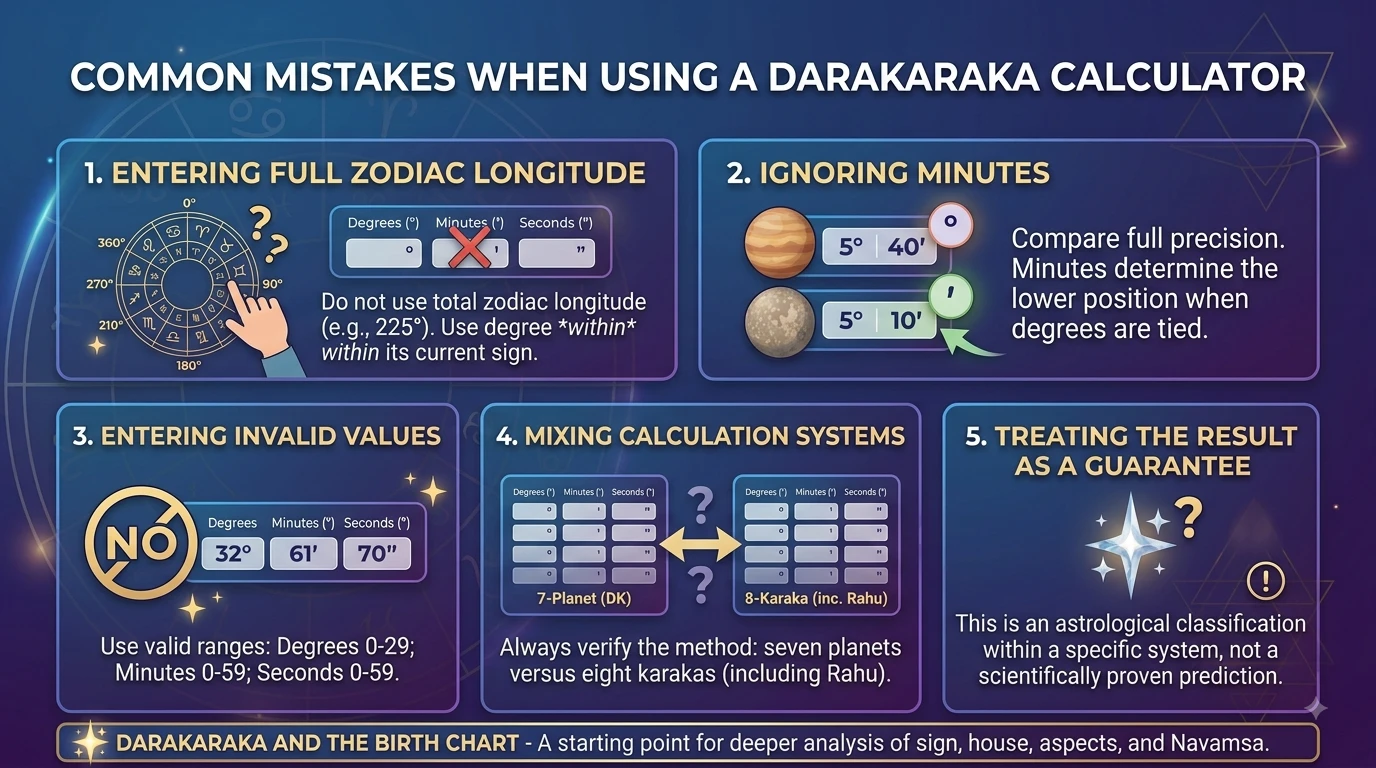
Common Mistakes When Using a Darakaraka Calculator
1. Entering Full Zodiac Longitude
Do not confuse a planet’s full zodiac longitude with its degree within the current sign.
For example, a planet may have a full longitude somewhere within the zodiac, but the Darakaraka comparison requires its position within its sign.
2. Ignoring Minutes
Two planets may both be listed at 5 degrees, but their minutes can determine which one has the lower position.
3. Entering Invalid Values
Degrees should be between:
0 and 29
Minutes should be between:
0 and 59
Seconds should be between:
0 and 59
4. Mixing Calculation Systems
If one calculator excludes Rahu while another includes it, their results may differ.
Always check the methodology.
5. Treating the Result as a Guaranteed Prediction
The Darakaraka result is an astrological classification within a particular traditional system.
It should not be presented as a scientifically proven prediction about your relationships or future.
Darakaraka and the Birth Chart
The Darakaraka does not exist independently of the birth chart.
Astrology practitioners may examine the Darakaraka’s sign, house, aspects, and other chart factors when developing a broader interpretation.
Some practitioners also examine the planet’s position in the Navamsa or other divisional charts.
These additional interpretations depend on the particular school of Vedic or Jaimini astrology being followed.
For that reason, a calculator that identifies the Darakaraka should be considered a starting point rather than a complete astrology reading.
darakaraka calculator
Frequently Asked Questions
What is a Darakaraka?
Darakaraka is a Chara Karaka in Jaimini astrology, traditionally associated with spouse and partnership themes. In the seven-planet method, it is the planet with the lowest degree within its sign.
Which planet is Darakaraka?
No single Darakaraka applies to everyone. The planet depends on the planetary positions in an individual’s birth chart.
How do I calculate Darakaraka?
Compare the degrees of the Sun, Moon, Mars, Mercury, Jupiter, Venus, and Saturn within their respective signs. The planet with the lowest degree is the Darakaraka under the seven-planet method.
Is Rahu included in this calculator?
No. This calculator uses the seven-planet approach and excludes Rahu and Ketu.
Can Venus be Darakaraka?
Yes. Any of the seven planets included in the calculation can become Darakaraka depending on its degree relative to the other planets.
Does “Darakaraka” mean “spouse”?
In Jaimini astrology, Darakaraka is traditionally associated with spouse or partner themes. Don’t interpret it as a guarantee about a specific person or relationship outcome.
Why are minutes and seconds needed?
Minutes and seconds provide a more precise comparison when two planets have similar degrees.
Can two planets have the same degree?
They can have very close positions. When positions are extremely close, the exact minutes and seconds matter. Different traditions may also have specific rules for ties or very close placements.
Why does my result differ from another Darakaraka calculator?
The calculators may use different methods, such as a seven-planet versus eight-karaka system, different treatment of Rahu, or different astronomical calculation settings.
Is Darakaraka scientifically proven?
No. Darakaraka is part of Jaimini astrology, a traditional astrological system. Astrology-based interpretations have not been scientifically established as reliable methods for predicting individual relationship outcomes.
Final Takeaway
A Darakaraka Calculator provides a convenient way to identify the Darakaraka using planetary degree positions.
Under the seven-planet method used by this calculator, compare:
Sun + Moon + Mars + Mercury + Jupiter + Venus + Saturn
The planet with the lowest degree in its sign is the Darakaraka.
For an accurate calculation, enter the degree, minute, and second values for all seven planets. The calculator converts the positions into decimal degrees, compares them, and displays the lowest-degree planet as the result.
Remember that different Jaimini astrology traditions can use different Chara Karaka schemes, particularly regarding Rahu. Therefore, always check the method being used before comparing results.
The Darakaraka can be explored as one component of traditional Jaimini astrology. Still, it should not be treated as a scientifically proven way to predict marriage, identify a future spouse, or guarantee relationship outcomes.
References and Sources
Astrologer. Darakaraka: The Jaimini Significator of Your Spouse. Official article
Vidhata. Darakaraka: The Jaimini Spouse Significator and What It Says About Marriage. Detailed guide
Disclaimer: This calculator and article are provided for general astrology-related informational and educational purposes. Astrology is a traditional belief system and is not scientifically established as a method for predicting future events, personality, marriage, or relationship outcomes.
Free & instant results
Written by
Zain Bin Shabbir
Zain Bin Shabbir is a content creator and website publisher with 2 years of experience in SEO, web content, and practical online tools. He focuses on creating clear, useful, and user-friendly resources that simplify everyday calculations.