Explore a fun, astrology-inspired estimate of whether your inputs lean more toward love marriage, arranged marriage, or a combination of both.
Marriage is an important personal decision, and people have different ideas about how they may meet or choose a future partner. Some people prefer choosing their own partner, while others value family involvement in the process. Many people are also comfortable with a combination of both approaches.
The Love or Arranged Marriage Calculator is a simple, entertainment-focused tool designed to help you explore these preferences easily and interactively.
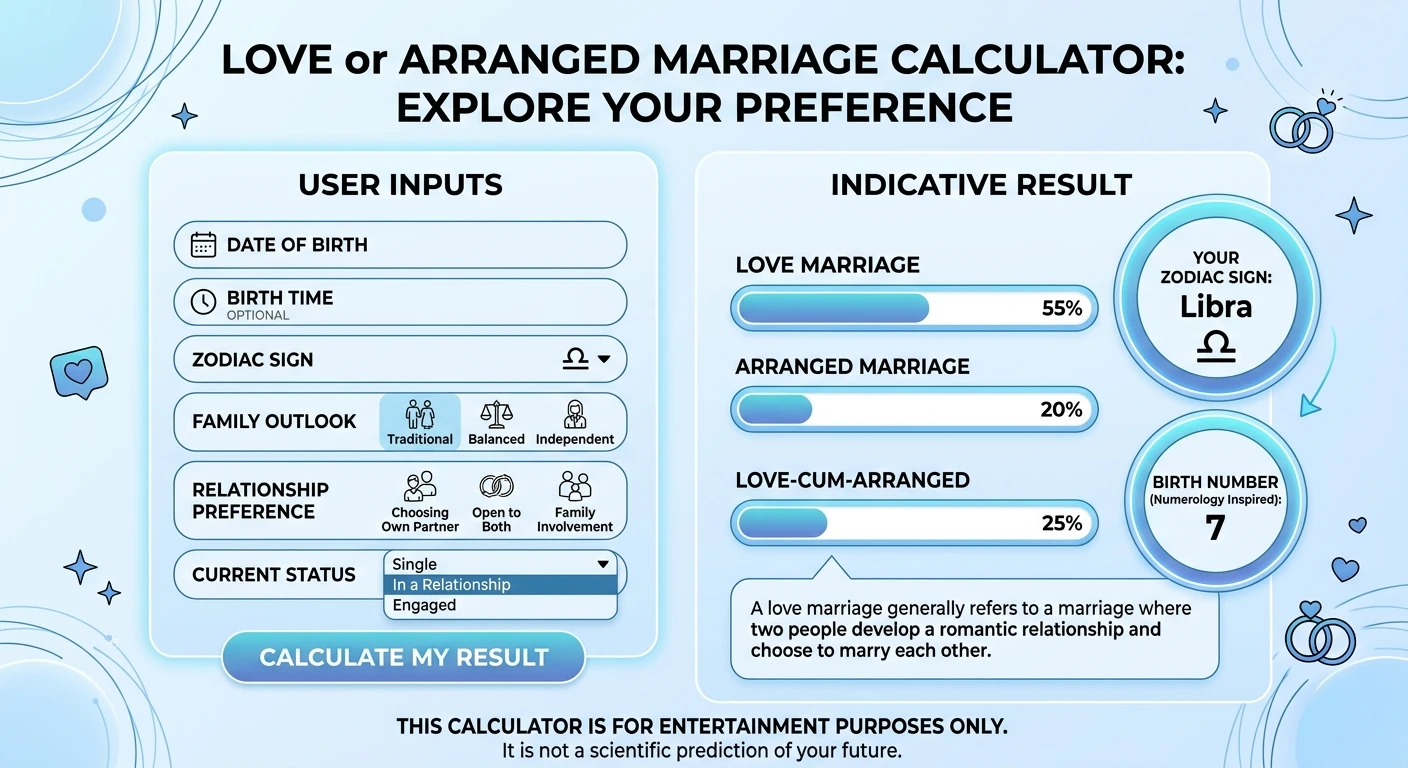
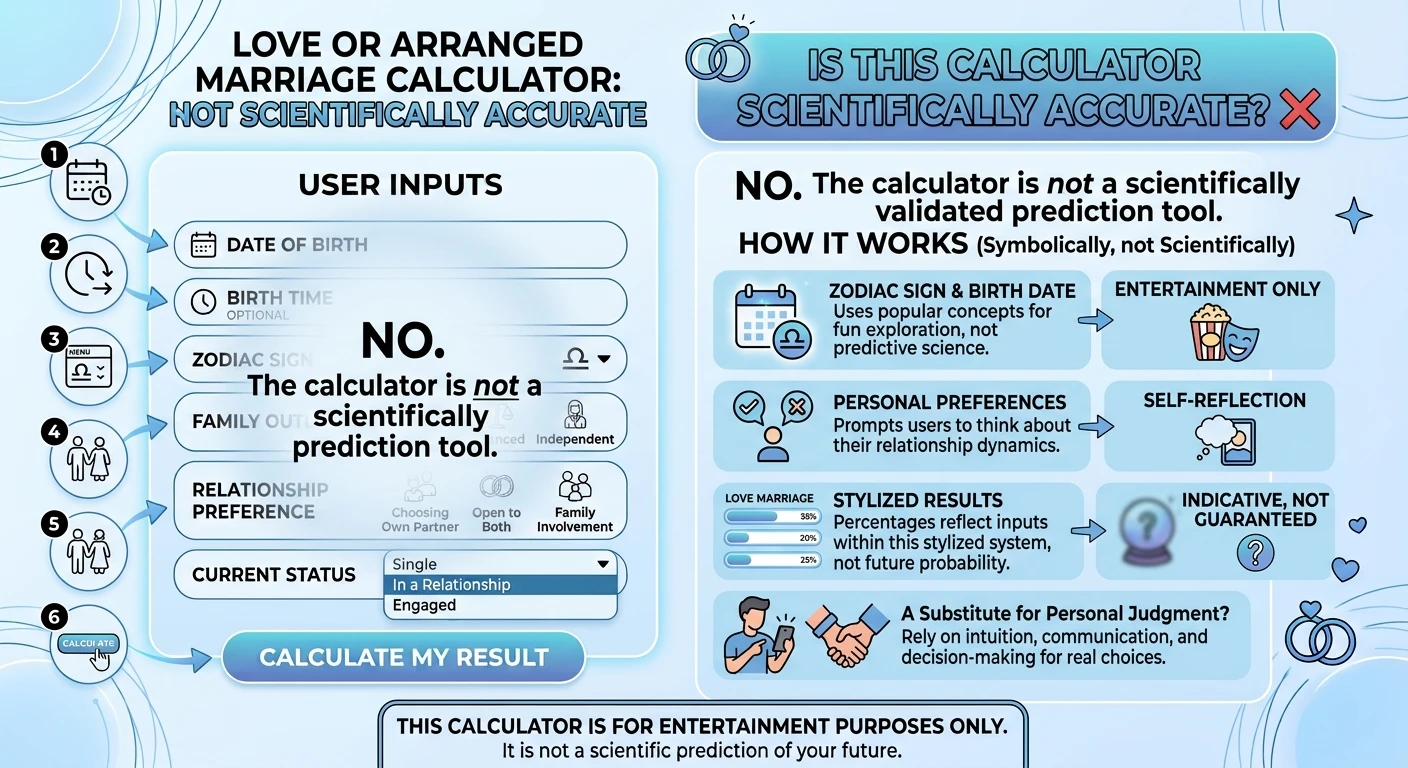
The calculator provides an indicative result based on the information you enter, including date of birth, zodiac sign, family outlook, and relationship preference. It draws on common astrology and numerology-style concepts, but you should not treat it as a scientific method for predicting the future.
Your actual marriage circumstances can depend on many factors, including personal choices, family circumstances, communication, compatibility, culture, timing, and individual priorities.
A Love or Arranged Marriage Calculator is an online tool that provides a fun estimate of whether your inputs lean more toward:
The calculator does not predict your future. Instead, it combines selected inputs to produce an entertainment-oriented result.
For example, someone who selects a preference for choosing their own partner and describes their family outlook as independent may receive a stronger love-marriage tendency.
Someone who selects family involvement as an important preference may receive a stronger arranged-marriage tendency.
Someone comfortable with both approaches may receive a love-cum-arranged result.
View the result as a reflection or entertainment feature, not a prediction.
The calculator uses several user inputs.
These include:
Not every input contributes to the final score in the same way.
The calculator primarily uses your date of birth and selected preferences to generate an indicative result.
The date of birth is used to calculate a simple birth-number or life-path-style value.
The calculator adds the digits from the entered date and reduces the resulting number according to its built-in calculation.
This uses a numerology-inspired approach rather than a scientific measurement.
The calculator also asks you to select your zodiac sign.
The zodiac sign appears in your result and adds an astrology-themed element to the tool.
The calculator does not calculate a complete astrological birth chart.
Family expectations can be an important consideration when people think about marriage.
The calculator provides three choices:
This input helps the calculator create an entertainment-style result based on the preferences selected.
Users can select one of three options:
This is particularly important because it reflects the user’s own stated preference rather than claiming to predict an unavoidable future event.
The calculator also allows users to indicate whether they are
This information provides context for the calculator interface but does not interpret the results as a guarantee of future marriage.
If you enjoy astrology-based calculators, you can also try our Darakaraka Calculator to find your Darakaraka using the seven-planet Jaimini method. You can also explore our other calculators for additional calculations.
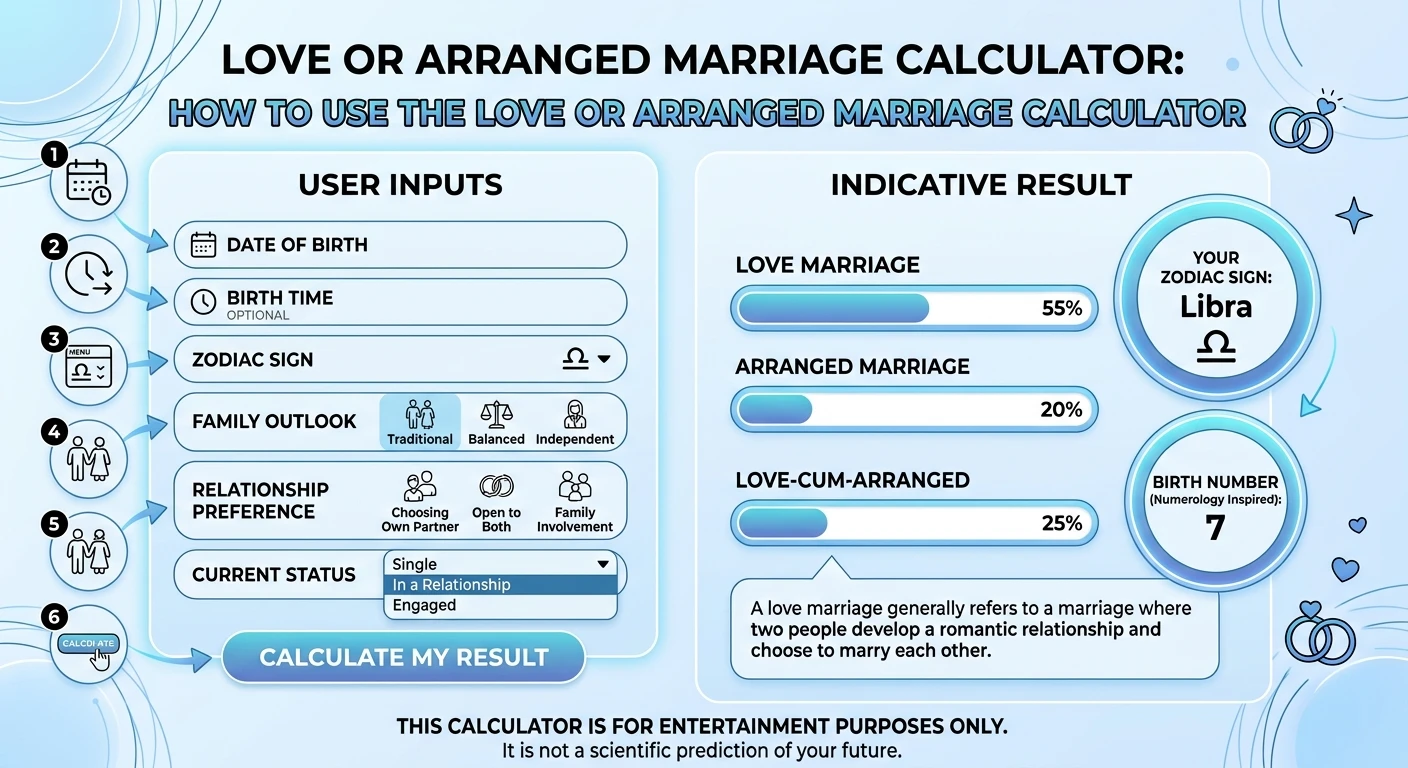
Using the calculator is straightforward.
Select your date of birth using the date field.
The calculator uses the date to generate its numerology-inspired number.
Birth time is optional.
You can leave this field blank if you do not know your exact birth time.
This matters because the calculator cannot generate a complete Vedic astrology chart without your birth time.
Choose your zodiac sign from the available list.
The calculator includes all 12 commonly used Western zodiac signs:
Choose the option that best represents your general preference:
Traditional / Family-Oriented
Choose this if family participation matters a lot to you.
Balanced
Choose this if you are comfortable considering both personal and family preferences.
Independent / Self-Choice
Choose this if you generally prefer making your own relationship decisions.
You can choose whether you:
Click Calculate My Result.
The calculator will display an indicative percentage for:
It will also show your calculated birth-number-style value and selected zodiac sign.
A love marriage generally refers to a marriage where two people develop a romantic relationship and choose to marry each other.
The couple may meet through education, work, social connections, hobbies, online platforms, mutual friends, or other circumstances.
The important point is that the relationship develops primarily through the individuals’ own connection and decision-making.
However, a love marriage can still involve families.
In many cultures, couples may choose each other first and later involve their families in the marriage process.
Therefore, the distinction between love and arranged marriage is not always completely separate.
An arranged marriage generally involves family members or other trusted individuals helping introduce potential partners.
The people involved may consider factors such as
However, an arranged marriage does not necessarily mean that the individuals have no choice.
In many modern arranged-marriage situations, both people meet, communicate, learn about each other, and make their own decision before agreeing to marry.
This is one reason why the category “love-cum-arranged marriage” can be useful.
A love-cum-arranged marriage combines elements of both approaches.
For example, two people may develop a relationship independently and later involve their families in the marriage process.
Another possibility is that families introduce two people who gradually develop a relationship and eventually decide to marry.
In both situations, personal choice and family involvement can coexist.
This type of marriage is common when individuals value both personal compatibility and family participation.
No.
The Love or Arranged Marriage Calculator should not be considered a scientifically validated prediction tool.
No reliable scientific method can take a person’s zodiac sign, date of birth, or personal preferences and guarantee whether they will have a love marriage or an arranged marriage.
The calculator is therefore designed for:
It should not be used as a substitute for personal judgment.
Google’s publisher policies emphasize avoiding misleading or deceptive claims. For that reason, the calculator and article should clearly explain what the tool does and should not suggest that its result is guaranteed or scientifically established.
People often use astrology as a traditional or spiritual system for interpreting personality, relationships, and life themes.
Different astrology traditions use different methods.
For example, some Vedic astrology practitioners may examine planetary positions, houses, aspects, and other chart factors when discussing relationships.
However, an online calculator that only asks for a few basic inputs does not perform the same analysis as a complete birth-chart interpretation.
Your calculator states that a complete Vedic astrology chart requires more detailed planetary and birth-location calculations.
Therefore, the result should be described as astrology-inspired, not as a definitive astrological prediction.
Marriage is influenced by real-life circumstances that cannot be reduced to a simple percentage.
For example, your future relationship choices can be affected by:
People also change their preferences over time.
Someone who prefers an arranged marriage today may later choose a partner independently. Similarly, someone who prefers a love marriage may become comfortable with family involvement.
This is why the calculator provides an indicative result rather than a prediction.
There is no universally correct choice between love and arranged marriage.
The experience can differ greatly for each person and family.
| Factor | Love Marriage | Arranged Marriage |
|---|---|---|
| Partner selection | Usually initiated by individuals | Often involves family or introductions |
| Family involvement | May happen later | Often involved earlier |
| Relationship before marriage | Often established first | May develop after introduction |
| Personal choice | Usually central | Can also be central |
| Compatibility | Developed through relationship | May be evaluated during the process |
| Final decision | Depends on the couple | Depends on the individuals and circumstances |
These are general descriptions, not strict definitions. Real-life relationships can combine characteristics of both.
No matter how two people meet, mutual agreement and informed decision-making are key parts of a healthy relationship.
An online calculator cannot determine whether someone is the right partner for you.
Instead of relying on a percentage generated by a website, people considering marriage may find it more useful to discuss topics such as
These conversations can provide much more meaningful information than an entertainment calculator.
Suppose the calculator produces the following result:
Love Marriage—55%
Arranged Marriage — 20%
Love-Cum-Arranged—25%
This does not mean that you have a 55% probability of having a love marriage.
Instead, it means that the inputs entered into this particular entertainment calculation produced a stronger love-marriage tendency.
Similarly, don’t interpret an arranged-marriage score as a prediction that a person will definitely have an arranged marriage.
Think of the percentages as a fun way to explore the selected inputs.
The middle ground between love and arranged marriage is especially interesting because modern relationships do not always fit into a single category.
A couple may meet independently, develop a relationship, and then seek family approval.
Alternatively, families may introduce two people who decide to continue getting to know each other and eventually develop a strong relationship.
In both situations, the final marriage can involve both personal choice and family participation.
This is why the calculator includes Love-Cum-Arranged Marriage as a separate category.
If you provide the calculator for free on your website, visitors can use it without paying a fee. The calculator is intended for entertainment and self-reflection.
No. It provides an indicative result based on the inputs you provide. It cannot reliably predict future events.
No. Birth time is optional in this calculator.
A complete astrological chart would require more detailed information and calculations than this tool performs.
No. The calculator uses astrology- and numerology-inspired concepts for entertainment. It is not a scientifically validated prediction method.
Yes. If you enter different preference information, the result can change. Your real-life preferences can also change over time.
It generally describes a marriage where personal choice and family involvement both play a role.
No. Major relationship decisions should be based on communication, personal judgment, compatibility, mutual consent, and relevant real-life circumstances rather than an online calculator.
No reliable scientific evidence establishes that a zodiac sign determines whether someone will have a love or arranged marriage.
The zodiac element in this calculator is included for entertainment and astrology-themed exploration.
Family outlook is included because family involvement can be an important consideration in how people think about marriage. In the calculator, it contributes to the entertainment-style scoring system.
This calculator is provided for entertainment and informational purposes only.
The result is not a scientific prediction, professional relationship assessment, or guarantee of future marriage circumstances.
Marriage decisions should not be made solely based on an online calculator, zodiac sign, numerology-style number, or astrology-inspired result.
Personal choices, communication, compatibility, mutual consent, family circumstances, and other real-life factors can have a much greater influence on relationships.
The Love or Arranged Marriage Calculator offers a simple and entertaining way to explore how your selected preferences and astrology-inspired inputs combine into a result.
Whether you receive a love-marriage tendency, arranged-marriage tendency, or love-cum-arranged result, remember that the percentage is not a prediction of your future.
Real relationships are much more complex than a calculator can represent.
If you are thinking seriously about marriage, focus on understanding yourself and communicating openly with the other person. Discuss important expectations, values, family responsibilities, finances, career plans, and future goals.
The calculator can be a fun starting point for conversation, but your actual decisions should remain your own.
Important: These sources provide background information only. The Love or Arranged Marriage Calculator is an entertainment/astrology-inspired tool, and its percentage results should not be interpreted as scientifically validated predictions of marriage outcomes.

Zain Bin Shabbir is a content creator and website publisher with 2 years of experience in SEO, web content, and practical online tools. He focuses on creating clear, useful, and user-friendly resources that simplify everyday calculations.
Guides that go deeper into this topic