Use our free Land Portion Calculator to divide land among multiple owners based on percentage shares. Enter the total land area, choose a measurement unit, add the owners, and calculate each owner’s exact land portion.
Calculate each owner’s share of land by percentage.
Use our Land Portion Calculator to divide a total piece of land into individual portions based on ownership percentages. Enter the total land area, choose the measurement unit, and add the percentage share for each owner to calculate the corresponding land portion.
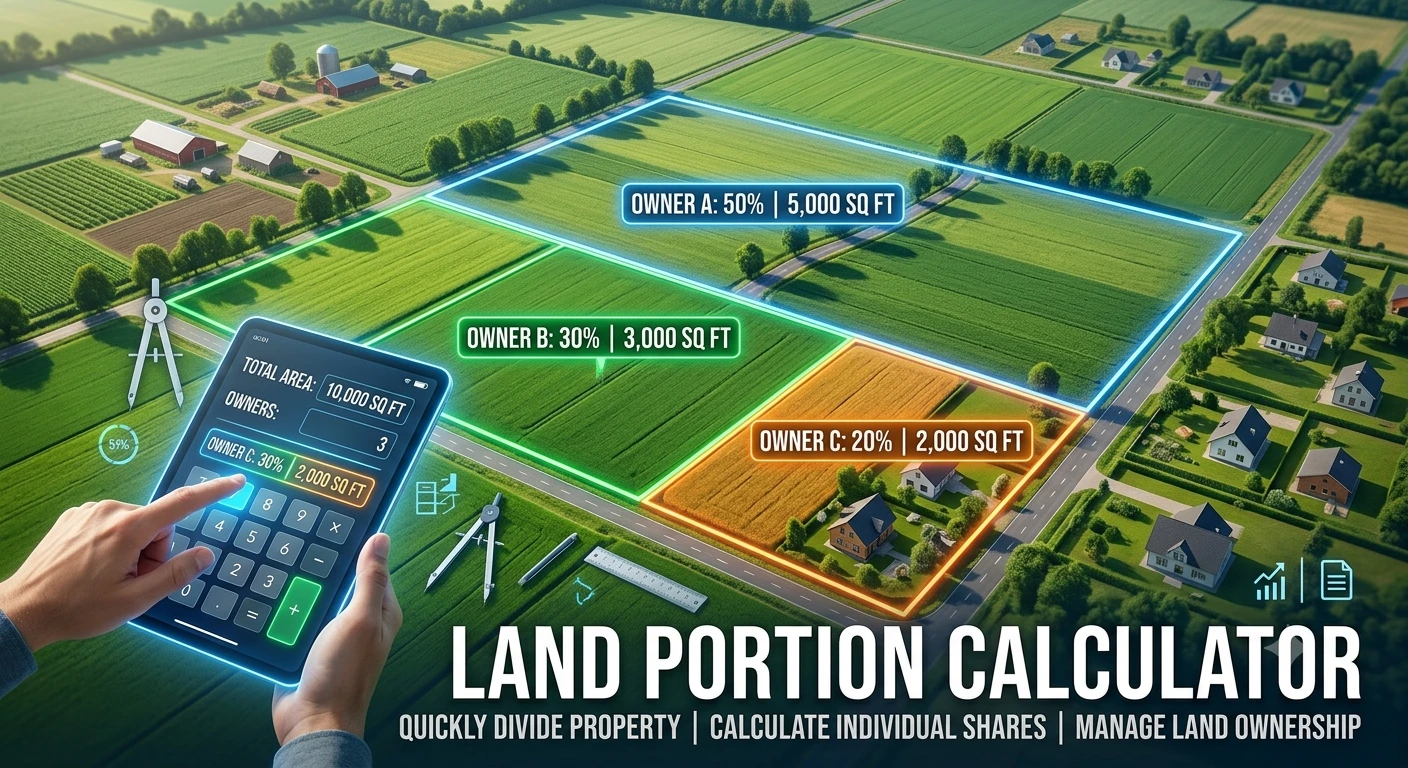
This calculator is useful for quickly estimating land shares when a property or plot is divided between multiple owners.
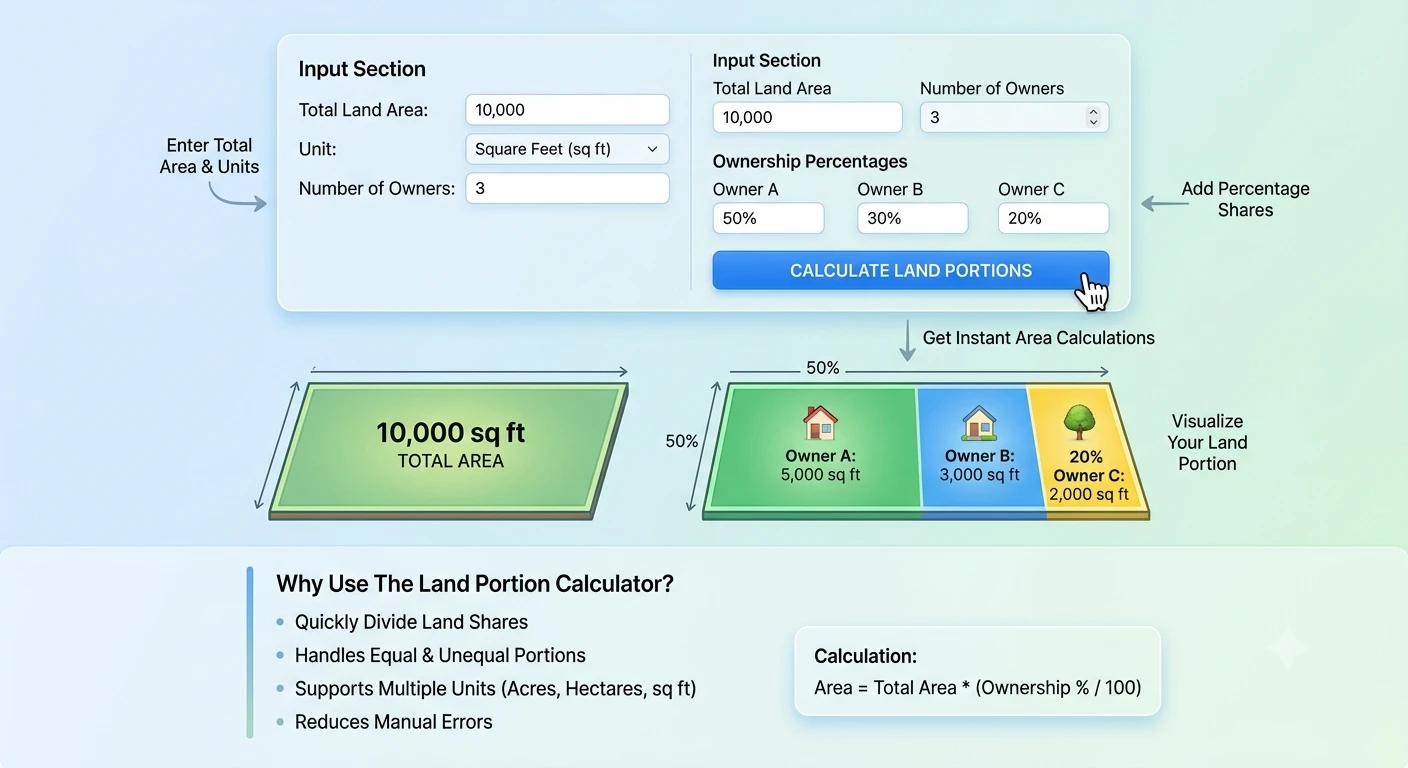
Using the calculator is straightforward:
Suppose you have 10,000 square feet of land and three owners:
The portions are
The total is
5,000 + 3,000 + 2,000 = 10,000 sq ft
So the complete land area has been divided between the three ownership shares.
If you are calculating ownership shares for a building or other real estate, you can also calculate property ownership portions using our Property Portion Calculator.
The basic formula is
Land Portion = Total Land Area × Ownership Percentage ÷ 100
For example, if the total land area is 20,000 square feet and an owner has a 25% share:
20,000 × 25 ÷ 100 = 5,000 square feet
The owner’s calculated portion is therefore 5,000 square feet.
A land ownership percentage represents the share of the total land assigned to an owner.
For example:
| Owner | Share | Land Portion |
|---|---|---|
| Owner A | 40% | 4,000 sq ft |
| Owner B | 35% | 3,500 sq ft |
| Owner C | 25% | 2,500 sq ft |
| Total | 100% | 10,000 sq ft |
The calculator converts each percentage into an estimated area based on the total land size.
Land can also be divided into equal portions.
For example, if 4 people equally own a 12,000-square-foot plot, each person has a 25% share.
12,000 ÷ 4 = 3,000 square feet
Each owner therefore has an estimated portion of 3,000 square feet.
Not every ownership arrangement is equal.
Suppose a 50,000-square-foot plot is divided as
The calculated portions are
Together, these portions equal the original 50,000 square feet.
Land can be measured using different units depending on the location and purpose.
Common units include
The important thing is to use the same unit for the total area and the calculated portions unless you are deliberately converting between units.
For example, if the total land area is entered in square meters, the resulting portion will also be expressed in square meters.
For a complete division of the entire land area, ownership percentages should normally add up to 100%.
For example:
50% + 30% + 20% = 100%
is a complete allocation.
But:
50% + 30% = 80%
means 20% remains unallocated.
Similarly:
50% + 35% + 25% = 110%
is greater than the total land ownership.
Always check the percentages before using the result for planning or documentation.
An important distinction is that a mathematical land portion is not necessarily the same as a physically separated plot.
For example, a person may mathematically own 25% of a large property. That does not automatically mean they own a specific rectangular section representing exactly 25% of the land.
Physical subdivision can involve:
The calculator only determines the mathematical area corresponding to the entered percentage.
Manually calculating several ownership portions can be time-consuming, especially when percentages are different.
A land portion calculator can help you:
It can be particularly useful when preparing preliminary estimates before discussing the details with a surveyor, property professional, or other qualified professional.
If the land is being valued and you need to divide the monetary amount between owners, you can calculate monetary portions separately.
Consider a plot of 2 acres with three owners:
The mathematical shares are
Together:
1 + 0.6 + 0.4 = 2 acres
This demonstrates how the same formula works regardless of the area unit being used.
A percentage-based calculation tells you the area associated with a share, but it does not determine whether a physical subdivision is legally or practically possible.
Before physically dividing land, you may need to consider:
For an official subdivision or legal ownership decision, consult the relevant local authority or a qualified professional.
If you first need to work out the percentages, use our tool to calculate ownership percentages before entering them into the land calculator.
A land portion is the amount of land corresponding to a particular ownership share of a larger property or plot.
Multiply the total land area by your ownership percentage and divide by 100.
Formula:
Total Land Area × Ownership Percentage ÷ 100
25% of one acre is 0.25 acre.
The exact equivalent in another unit depends on the unit conversion being used.
Divide the total land area by the number of equal owners.
For example, if 4 owners share 20,000 square feet equally:
20,000 ÷ 4 = 5,000 square feet per owner.
Yes. Enter the individual ownership percentage for each owner. The calculator can determine the corresponding portion for each percentage.
If you are dividing the entire property among all owners, the ownership percentages should normally total 100%.
No. It calculates the mathematical area corresponding to each percentage. It does not create legal property boundaries or determine where a physical boundary should be placed.
Yes, provided the calculator supports the unit you need. The calculation itself is based on the total area and percentage.
No. A calculator provides a mathematical estimate. Legal ownership and physical subdivision depend on official documents, applicable laws, surveys, and local regulations.
It can be used for mathematical calculations of land shares when the relevant percentages are already known. It does not determine what percentage a person is legally entitled to receive under inheritance law.
The Land Portion Calculator is intended for general mathematical and estimation purposes. It does not determine legal ownership, property boundaries, inheritance rights, zoning compliance, or whether a particular land subdivision is permitted.
For official land subdivision, surveying, ownership, inheritance, or legal decisions, consult the appropriate local authority or a qualified professional.
For excavation, soil, mulch, or other volume estimates, you can also calculate cubic yard volume using our Cubic Yard Calculator.

Zain Bin Shabbir is a content creator and website publisher with 2 years of experience in SEO, web content, and practical online tools. He focuses on creating clear, useful, and user-friendly resources that simplify everyday calculations.
Guides that go deeper into this topic