
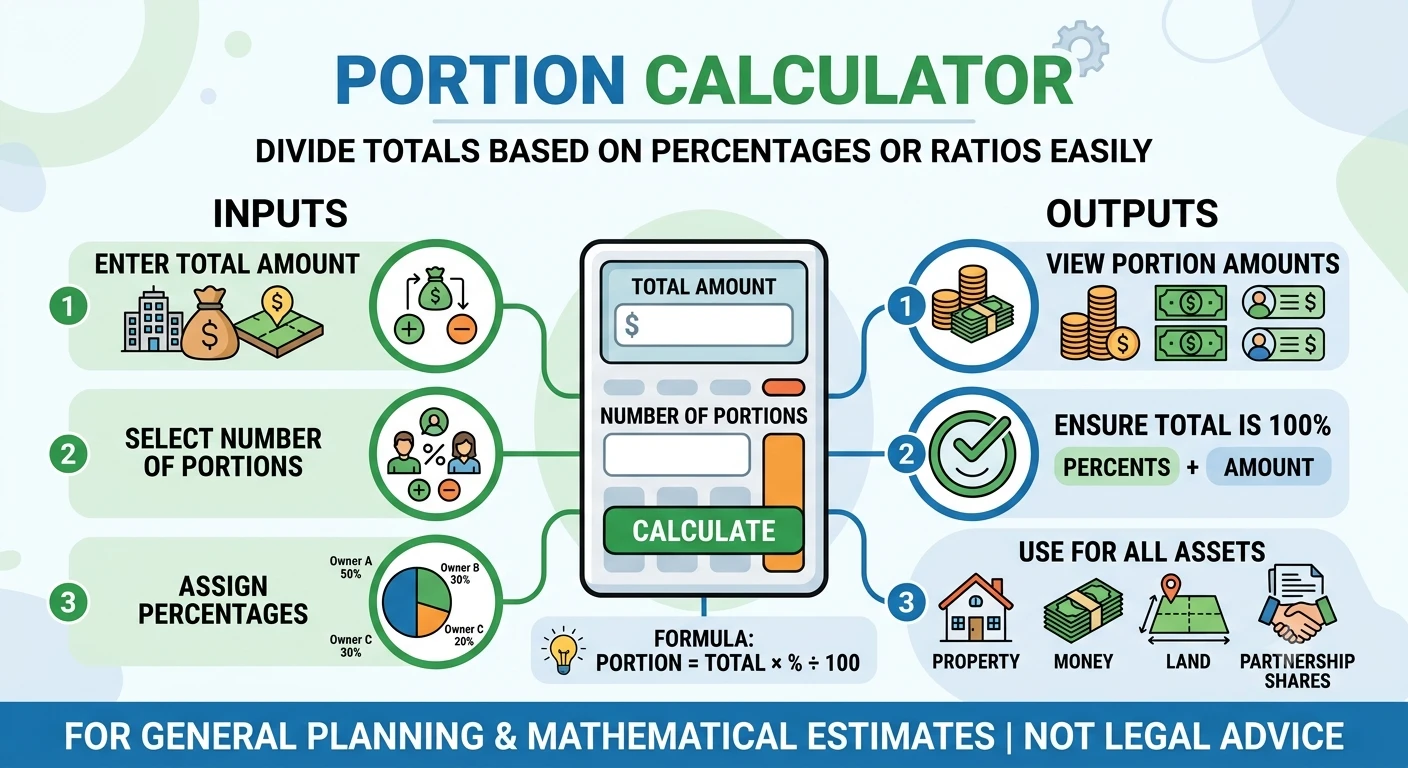
Use our free Portion Calculator to divide any amount or value into multiple portions based on percentage shares. Enter the total value, choose a currency or unit, add your portions, and instantly calculate each share.
Divide any total amount or value into portions based on percentages.
A portion calculator helps you divide a total amount among different people, owners, partners, or beneficiaries based on their assigned percentages or ratios.
Whether you’re dividing property, money, land, assets, or another total amount, a portion calculator can make the calculation easier and reduce manual arithmetic errors.
Enter the total value, choose the number of portions, and enter each person’s percentage or share. The calculator then determines the amount belonging to each portion.
Note: This calculator is intended for general mathematical and planning purposes. It does not determine legal ownership, inheritance rights, or legally enforceable property shares.
A portion calculator is an online tool used to divide a total amount into smaller portions.
For example, if a property is worth $200,000 and one owner has a 25% share, the owner’s portion is
$200,000 × 25% = portion
The remaining value can then be distributed among the other owners according to their percentages.
A portion calculator can be useful for:
The calculator uses the total amount and each person’s percentage to determine their individual portion.
The basic formula is the portion.
Portion Amount = Total Amount × Percentage ÷ 100
Suppose the total property value is
$300,000
and an owner has:
20%
The calculation is
$300,000 × 20 ÷ 100 = $60,000
Therefore, the owner’s portion is $60,000.
Using an online portion calculator is simple.
Enter the total property value, money amount, land value, or other amount you want to divide.
Choose how many people or portions are involved.
Enter the percentage assigned to each owner.
For example:
Click the calculate button.
The calculator determines the corresponding amount for each owner.
The percentages should normally add up to 100% when you are dividing the entire amount.
The standard formula is
Portion = Total Value × Share Percentage ÷ 100
For example:
Total value = $500,000
Share = 15%
Therefore:
$500,000 × 15 ÷ 100 = $75,000
The portion is $75,000.
Suppose a property has a total value of
$400,000
There are four owners:
| Owner | Share | Portion |
|---|---|---|
| Owner 1 | 40% | $160,000 |
| Owner 2 | 30% | $120,000 |
| Owner 3 | 20% | $80,000 |
| Owner 4 | 10% | $40,000 |
| Total | 100% | $400,000 |
Each portion is calculated by multiplying the portion’s total property value by the owner’s percentage.
A portion calculator can be used to estimate the monetary value of different ownership percentages in a property.
For example, suppose a property is valued at
$750,000
and an owner owns:
35%
The estimated value of that share is
$750,000 × 35% = $262,500
The result represents the mathematical value of the percentage, not necessarily the legal process for transferring or selling ownership.
For legal ownership questions, consult the relevant property records, agreements, and a qualified professional.
The calculator can also be used to divide money among multiple people.
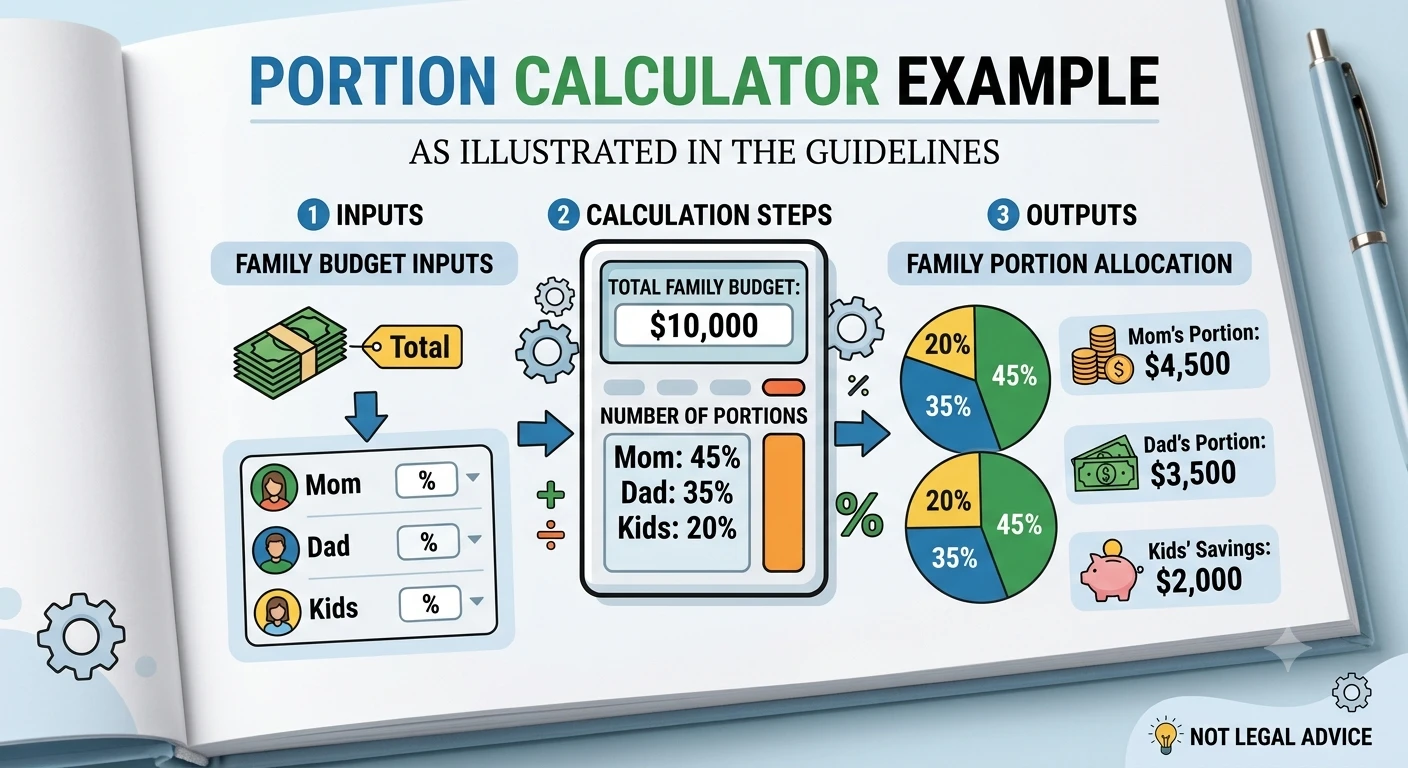
For example, if $10,000 needs to be divided:
The portions are
Total:
$5,000 + $3,000 + $2,000 = $10,000
Land ownership can also be expressed using percentages.
Suppose a parcel has a total assessed value of $200,000 and an ownership share is 25%.
The mathematical value of the share is
$200,000 × 25% = $50,000
However, the actual physical area represented by a percentage depends on the property’s legal boundaries, survey, title documents, and ownership arrangement.
For land measurement and division, you may also use a Land Portion Calculator.
A percentage and a portion are related but different.
A percentage describes how much of the whole belongs to someone.
A portion is the actual amount represented by that percentage.
For example:
Total = $100,000
Share = 25%
Portion = $25,000
So:
25% → percentage share
$25,000 → monetary portion
If the percentages are intended to represent the entire amount, they should normally total:
100%
For example:
25% + 25% + 25% + 25% = 100%
If the total is only 80%, then 20% remains unallocated.
If the total is 120%, the entered shares exceed the total amount.
Before relying on a calculation, check that the percentages reflect the intended ownership or allocation arrangement.
Sometimes everyone receives an equal share.
The formula is
Equal portion = Total Amount ÷ Number of People
Total amount:
$120,000
Number of owners:
4
Therefore:
$120,000 ÷ 4 = $30,000
Each person receives a mathematical portion of:
$30,000
This is equivalent to
25% per owner
Not every distribution is equal.
For example:
The percentages total:
100%
If the total amount is $200,000:
The calculator can perform these calculations automatically.
Some agreements describe shares using ratios instead of percentages.
For example:
2:3:5
The total number of ratio parts is
2 + 3 + 5 = 10
Therefore:
If the total amount is $100,000:
A portion calculator can support multiple owners when the total is divided according to individual percentages.
For example:
| Owner | Percentage |
|---|---|
| Owner 1 | 30% |
| Owner 2 | 25% |
| Owner 3 | 20% |
| Owner 4 | 15% |
| Owner 5 | 10% |
| Total | 100% |
The same calculation can be applied to any total value.
The mathematical calculation does not depend on the currency.
For example, if the total value is
€100,000
and the share is
20%
then:
€100,000 × 20% = €20,000
The same calculation works with:
The currency symbol changes the presentation, while the percentage calculation remains the same.
Always check the total percentage when dividing an entire asset.
A 20% share is not the same as a $20 share.
A percentage only becomes a monetary amount after applying it to the total.
Rounding individual portions before completing the calculation can sometimes cause small differences.
A 25% ownership interest does not automatically mean a person can physically occupy 25% of a property.
An online portion calculator can help you:
It is particularly useful when dealing with multiple percentages and a large total value.
A portion calculator determines how much of a total amount corresponds to a specific percentage or share.
Use:
Portion = Total Amount × Percentage ÷ 100
Multiply the total amount by 0.25.
For example:
$100,000 × 0.25 = $25,000
If the percentages represent the complete ownership of an asset, they generally should total 100%.
Yes. You can calculate the mathematical value of a property share based on the property’s total value and ownership percentage.
Yes. Enter the total amount and assign a percentage to each person.
Yes. Divide the total amount by the number of people.
Yes. The underlying calculation is the same regardless of currency. Only the displayed currency changes.
Yes, but a ratio should first be converted into proportional shares. For example, 1:2:3 represents 16.67%, 33.33%, and 50%.
Not necessarily. A percentage ownership interest and physical subdivision of property are different concepts and may be governed by legal documents and local regulations.
No. The calculator provides mathematical estimates. It does not establish legal ownership or determine inheritance rights.
The Portion Calculator is provided for general informational, educational, and mathematical purposes. Results are calculations based on the values entered by the user and should not be considered legal, financial, tax, inheritance, or property advice.
Property ownership, inheritance, partnership interests, and asset distribution can be subject to contracts, title documents, local laws, court orders, and other legal requirements.
Always verify important ownership or financial decisions with the appropriate qualified professional.
If you need to divide a property, you can use our Property Portion Calculator, while the Money Portion Calculator can help calculate percentage-based monetary shares.

Zain Bin Shabbir is a content creator and website publisher with 2 years of experience in SEO, web content, and practical online tools. He focuses on creating clear, useful, and user-friendly resources that simplify everyday calculations.
Guides that go deeper into this topic