
Calculate an estimated JEE Advanced 2026 Paper 1 or Paper 2 score using the official 2026 section-wise marking rules.
The JEE Advanced 2026 Score Calculator is a simple tool for students who want to estimate their marks in Paper 1 or Paper 2 using their response details and the applicable marking scheme. JEE Advanced is one of India’s most competitive engineering entrance exams, and understanding how marks are calculated can help candidates review their performance after the exam.
The calculator on this page is designed to make score estimation easier. Instead of manually adding positive and negative marks from different question types, you can enter the number of correct, partially correct, incorrect, and unanswered responses and receive an estimated paper score.
However, an online calculator is only an estimation tool. The official examination authority determines the final marks using the responses recorded during the examination and the final answer key.
According to the official JEE Advanced website, Paper 1 and Paper 2 are both compulsory, and both papers are used for evaluation and rank-list preparation.
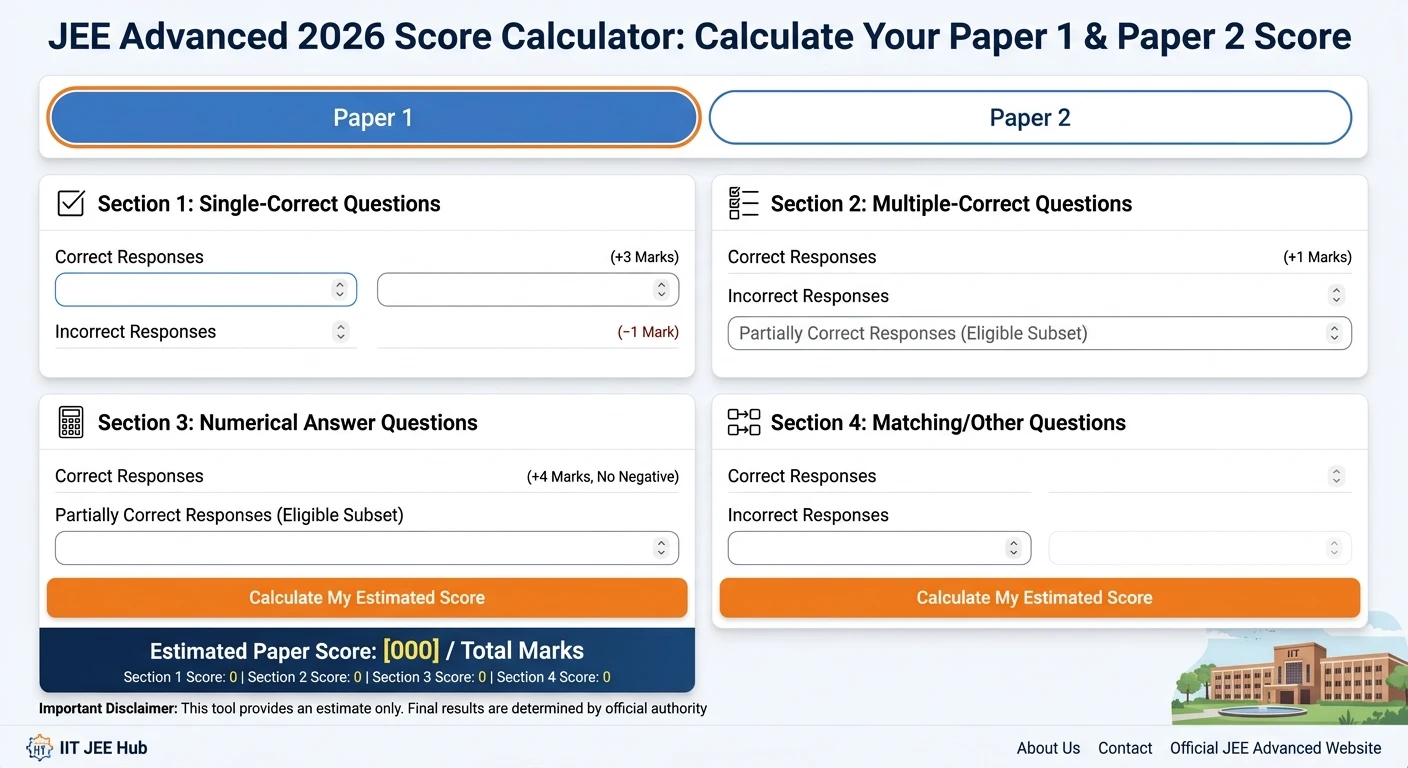
The JEE Advanced 2026 Score Calculator is an online marks-estimation tool that helps candidates estimate their score based on their question-wise performance.
JEE Advanced does not use one single marking rule for every question. Different sections can have different positive marks, partial marks, and negative marks. Therefore, multiplying the number of correct answers by a single fixed value may not produce an accurate estimate.
The calculator is useful because it separates the calculation into different sections. You can enter the number of responses by question type and then calculate the estimated marks.
For example, a question that awards +3 for a correct response and −1 for an incorrect response can be calculated as
Score = (Correct Answers × 3) − (Incorrect Answers × 1)
Other sections can involve partial marks or different negative-marking rules.
The official JEE Advanced 2026 brochure states that negative marks may be awarded for incorrect answers in some questions and that detailed marking instructions are provided with the question paper.
Using the calculator is straightforward.
The calculator provides options for:
JEE Advanced 2026 has two compulsory papers. Candidates must appear in both papers to be considered for evaluation and rank-list preparation.
Depending on the section, enter the number of correct, incorrect, partially correct, or other applicable responses.
Use your official response sheet rather than relying only on memory.
The calculator separates the paper into different question types. This matters because each section can have its own marking rules.
After entering the required information, select Calculate Score.
The calculator adds the marks from each section and displays an estimated paper score.
Always compare your entries with the official response sheet and final answer key. Treat the final result published by JEE Advanced as authoritative.

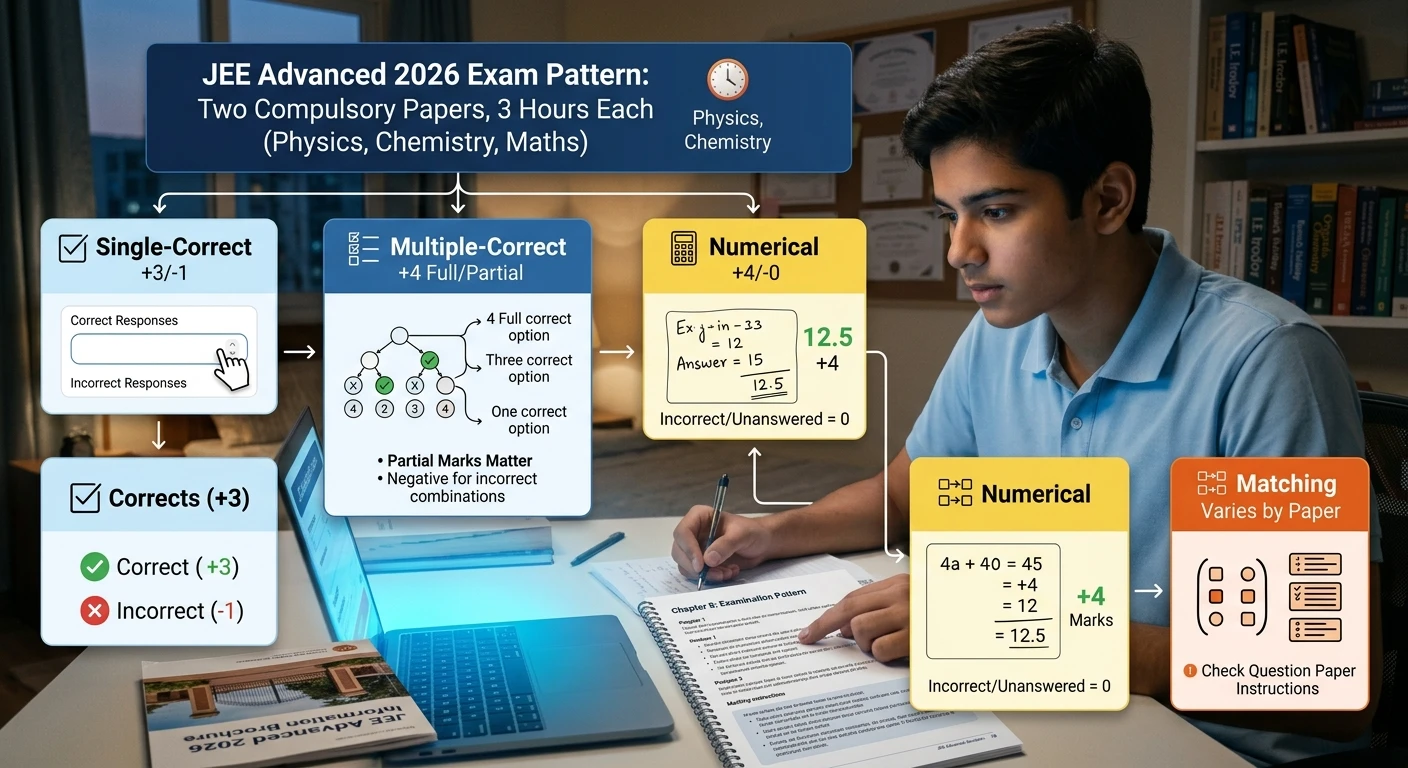
JEE Advanced 2026 consists of two question papers. According to the official Information Brochure, each paper is three hours long, and candidates must appear for both Paper 1 and Paper 2. Each paper contains physics, chemistry, and mathematics sections.
The official JEE Advanced website also states that the 2026 examination pattern remains consistent with previous JEE Advanced examinations and that the relevant details are published in the 2026 Information Brochure.
For score calculation, the key point is that questions can use different marking schemes.
| Question type | Typical scoring used in 2026 |
|---|---|
| Single-correct MCQ | +3 correct, −1 incorrect |
| Multiple-correct | +4 full, partial marks possible |
| Numerical answer | +4 correct, generally no negative mark |
| Matching/other section | Depends on the paper and section |
Candidates should always check the instructions printed with the relevant question paper, as the examination authority may specify precise marking conditions for each section.
Single-correct questions require the candidate to select the one correct option.
For the 2026 examination, the marking pattern used for this section awards +3 marks for the correct option, while an incorrect attempt can receive −1 mark and an unanswered question receives zero.
Therefore, the basic calculation is
Section Score = Correct × 3 − Incorrect × 1
Suppose a student has:
The estimated score would be
8 × 3 − 3 × 1 = 21 marks
This is why you should consider negative marking when estimating a JEE Advanced score.
Multiple-correct questions require candidates to identify one or more correct options.
This section is more complicated because it awards partial marks.
The 2026 marking instructions include:
The official 2026 question-paper material gives the detailed partial-marking conditions.
This means that students should not treat every incorrect multiple-correct attempt as simply −1.
For this reason, your calculator should use the official negative-mark value for the relevant 2026 section, rather than applying a generic value.
Consider a question where four options are correct.
If the candidate selects all four correctly, they may receive full marks.
If an eligible subset of correct options is selected, partial marks may be awarded.
However, selecting an incorrect combination can result in negative marks.
This makes Section 2 more difficult to calculate manually and is one of the main reasons an automated score calculator can be useful.
Numerical-answer questions require candidates to enter a numerical response rather than selecting a traditional multiple-choice option.
For the relevant 2026 section, a correct response can receive +4 marks, while an incorrect or unanswered response receives zero rather than a negative mark.
For example:
Estimated score:
5 × 4 = 20 marks
The two incorrect responses do not reduce this particular section’s score when the applicable rule is zero for incorrect responses.
This difference between sections is important when calculating your overall score.
The final section can use a different question format and therefore should not be calculated using the same formula as Section 1.
The 2026 examination materials show that Section 4 marking depends on the specific paper and question type. For this reason, candidates should carefully check the instructions accompanying their actual question paper.
This is also an important point for your website calculator.
Do not assume that Paper 1 and Paper 2 have identical Section 4 rules.
The official JEE Advanced materials state that the question paper includes detailed marking instructions.
The final JEE Advanced performance is not based on one isolated question type.
Candidates receive marks from different sections of Paper 1 and Paper 2.
A simple conceptual formula is
Paper Score = Section 1 + Section 2 + Section 3 + Section 4
Then the marks from the compulsory papers are considered according to the official examination and rank-list rules.
The JEE Advanced 2026 examination consists of two papers, and both are compulsory. The official FAQ specifically states that a result will not be prepared or declared if a candidate is absent from one of the papers.
Therefore, calculating only Paper 1 does not represent the candidate’s complete JEE Advanced performance.
An online calculator can provide a useful estimate, but it should not be treated as the official result.
The accuracy of the calculation depends on:
The official JEE Advanced website makes the final answer keys available after the examination. The 2026 final answer keys were released on June 1, 2026.
For the most reliable calculation, candidates should compare their response sheet with the final answer key and then apply the official marking instructions.
It is normal for an unofficial calculation to differ from the final result.
One reason is that candidates may remember an answer incorrectly.
Another possibility is that a question may be dropped or modified according to the official process. The 2026 Information Brochure states that if a question needs to be dropped, all candidates receive full marks for that question, regardless of whether it had negative marking.
The final answer key therefore matters significantly.
Students should avoid relying on unofficial answer keys when making important decisions about their expected result.
A very important distinction is the difference between score and rank.
A score calculator estimates marks. It does not automatically determine a candidate’s official rank.
Rank depends on the official evaluation process, qualifying requirements, candidate performance, tie-breaking rules, and other applicable conditions.
Therefore, a student should not interpret an estimated score as a guaranteed chance of IIT admission.
Use the calculator on this page for educational and planning purposes only.
If you are using the calculator after a practice test, the score breakdown can be more useful than the total score alone.
For example, if your Section 1 score is strong but your multiple-correct section is weak, you may want to practice multi-option questions.
Similarly, if negative marks are significantly reducing your score, review your approach to uncertain questions.
Useful areas to review include:
Focus on reducing avoidable mistakes.
You don’t need to attempt every question immediately. Good question selection can help manage time and reduce unnecessary negative marks.
Practice identifying all valid options rather than selecting options based on partial confidence.
Work on calculation accuracy and understanding the required answer format.
JEE Advanced requires candidates to manage two lengthy papers. Practicing complete papers under timed conditions can help identify weaknesses.
Both papers are important.
According to the official schedule, JEE Advanced 2026 was conducted on May 17, 2026, with Paper 1 from 9:00 AM to 12:00 PM IST and Paper 2 from 2:30 PM to 5:30 PM IST.
The official website subsequently published the 2026 question papers and final answer keys.
Students checking their marks should therefore use the actual 2026 response sheet and official answer key whenever possible.
This calculator can be useful for:
It saves time because users don’t need to manually calculate every section.
However, users should remember that it is an estimate, not an official JEE Advanced result calculator.
It is an online tool that estimates a candidate’s JEE Advanced Paper 1 or Paper 2 score based on the number and type of responses entered.
No. An independent website calculator is not an official JEE Advanced result tool. Candidates should use the official JEE Advanced website and final answer key for authoritative information.
Yes. Candidates must appear in both Paper 1 and Paper 2 for evaluation and rank-list preparation.
Yes. Some question types have negative marking, while others may not. The exact marking instructions are provided with the relevant question paper.
The applicable numerical-answer section in the 2026 pattern awards marks for correct answers and zero for incorrect/unanswered responses. Candidates should still verify the instructions for the exact paper and section.
No. The calculator estimates marks only. It does not guarantee or predict an official rank.
Yes. You can use a score calculator to estimate each paper separately, provided you apply the correct marking scheme.
Differences can occur because of incorrect response entries, answer-key changes, dropped questions, or incorrect application of the section-wise marking scheme. The final answer key and official result are always authoritative.
The official JEE Advanced website provides the Information Brochure, question papers, answer keys, important dates, eligibility information, and other examination resources.
This JEE Advanced 2026 Score Calculator is provided for educational and informational purposes only. It is not affiliated with, endorsed by, or operated by the official JEE Advanced examination authority.
Estimated marks may differ from the official score because of answer-key changes, dropped questions, response-sheet differences, or other official evaluation procedures.
Students should verify their responses and calculations using the official JEE Advanced response sheet, question paper, final answer key, and Information Brochure.
JEE (Advanced) 2026 Official Website
JEE (Advanced) 2026 Information Brochure
Students can also use our Percentage Calculator to calculate percentages quickly or try the SRM GPA Calculator for GPA-related calculations.

Zain Bin Shabbir is a content creator and website publisher with 2 years of experience in SEO, web content, and practical online tools. He focuses on creating clear, useful, and user-friendly resources that simplify everyday calculations.
Guides that go deeper into this topic