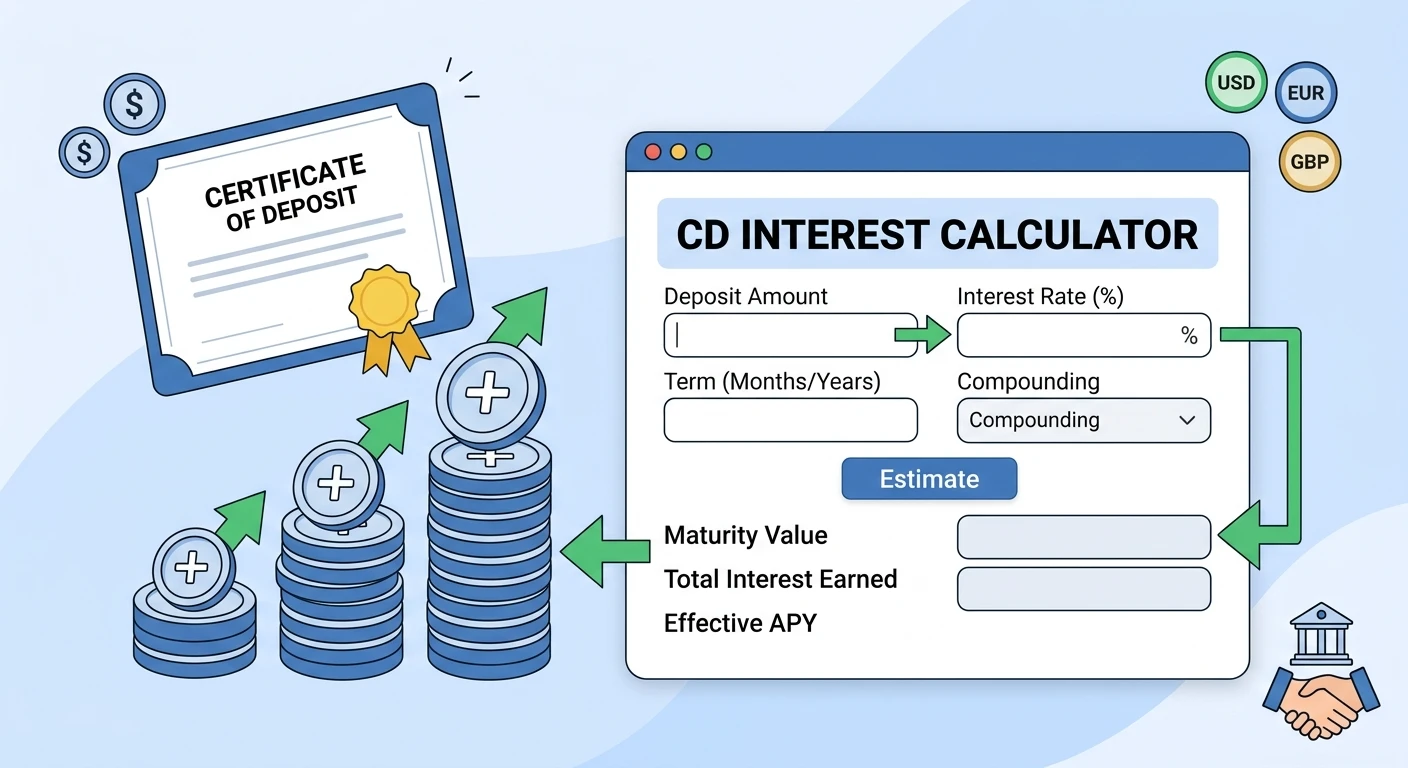
Estimate your Certificate of Deposit maturity value, total interest earned, and effective APY based on your deposit, nominal interest rate, term, and compounding frequency.
A certificate of deposit, commonly called a CD, is a deposit account in which you keep money with a financial institution for a specified period in exchange for interest. Before opening a CD, it can be useful to estimate how much your deposit could grow by the maturity date.
Our CD Interest Calculator helps estimate the maturity value, total interest earned, and effective annual percentage yield (APY) based on the information you enter. Enter your initial deposit, annual interest rate, CD term, and compounding frequency.
This calculator is an educational estimation tool. Actual earnings can differ from the estimate because financial institutions may use different compounding, crediting, day-count, rounding, withdrawal, renewal, and account-specific rules.
According to the Consumer Financial Protection Bureau (CFPB), annual percentage yield reflects the interest earned based on the interest rate and compounding frequency.
A Certificate of Deposit (CD) is a deposit product offered by banks and other financial institutions. A CD normally has a specified term, such as several months or several years.
The customer deposits money into the account and generally agrees to leave the funds there until maturity. In return, the account pays interest according to its terms.
CDs can have different:
Because these details vary by institution and account, read the account agreement before depositing.
The CFPB’s deposit-account disclosure rules address items such as the annual percentage yield, interest rate, maturity, early withdrawal penalties, and renewal policies.
A CD interest calculator estimates how much a deposit may be worth at the end of a selected term.
The calculator on this page asks for several inputs:
After you enter these values, the calculator estimates:
This can make it easier to compare different hypothetical CD scenarios.
For example, you might compare a shorter-term CD with a longer-term CD or compare different compounding frequencies using the same starting deposit.
Using the calculator is simple.
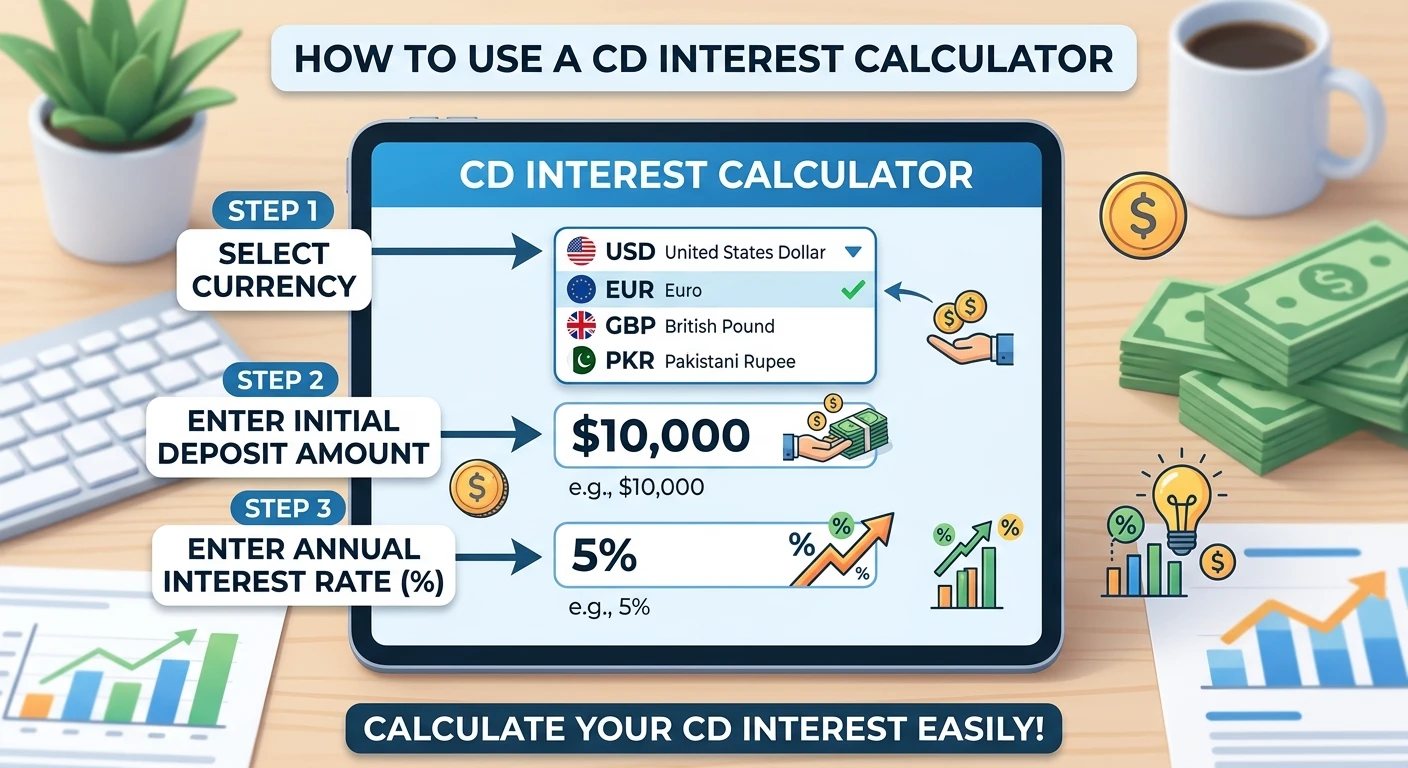
Select the currency you want to use.
The calculator includes several currencies, including.
The currency selection changes the way the estimated amounts are displayed. It does not convert money from one currency to another.
For example, selecting PKR does not convert a USD deposit into Pakistani rupees. It simply displays the calculation using the selected currency symbol.
Enter the amount you plan to place into the CD.
For example:
Initial deposit = $10,000
This is the starting principal used in the calculation.
Enter the annual interest rate provided by the financial institution.
For example:
Annual interest rate = 5%
An important distinction is that an interest rate and APY are not always the same thing.
Your calculator asks for the nominal annual interest rate because it then applies the selected compounding frequency.
If a bank gives you an APY instead of a nominal rate, you should not automatically enter the APY into the interest-rate field.
One of the most important concepts when comparing deposit accounts is the difference between the stated interest rate and annual percentage yield (APY).
The interest rate describes how interest is calculated.
APY incorporates the effect of compounding and expresses the annualized yield.
The CFPB explains that APY reflects the relationship between interest earned and principal and accounts for compounding frequency.
This means two accounts with the same stated interest rate can have different effective yields if their compounding or account terms differ.
For this reason, consumers should pay attention to both the stated interest rate and APY when comparing deposit products.
Compound interest occurs when interest earned is added to the balance, and future interest calculations are based on the increased balance.
A standard compound-interest formula is
A = P(1 + r/n)^(nt)
Where:
For example, if the principal is $10,000, the annual rate is 5%, and interest compounds monthly, the calculation uses 12 compounding periods per year.
Your calculator applies this general compound-interest approach.
However, banks may use account-specific methods. The CFPB’s official APY rules, for example, address actual days in a term and different account calculation circumstances.
Compounding frequency describes how often interest is added to the balance to calculate subsequent interest.
Common frequencies include:
For example, monthly compounding uses 12 compounding periods per year.
Daily compounding uses more periods.
When all other assumptions are identical, more frequent compounding can increase the calculated amount because interest is added to the balance more often.
However, the actual result depends on the financial institution’s account terms.
The CFPB’s deposit-account guidance specifically recognizes that institutions can have different compounding and crediting frequencies.
The maturity value is the estimated amount available at the end of the CD term, based on the calculator’s assumptions.
It generally includes:
Initial Deposit + Interest Earned
For example, if you start with $10,000 and the estimated interest is $500, the estimated maturity value would be:
$10,000 + $500 = $10,500
This is an example for explanation only. The actual amount depends on the rate, term, compounding method, and account conditions.
Total interest earned represents the difference between the estimated maturity value and the original deposit.
The basic relationship is
Interest = Maturity Value − Initial Deposit
If your initial deposit is $10,000 and the estimated maturity value is $10,500:
Interest = $10,500 − $10,000 = $500
The CD Interest Calculator displays this amount separately so that users can easily see how much of the final balance represents estimated interest.
Ohio Income Tax Calculator 2026
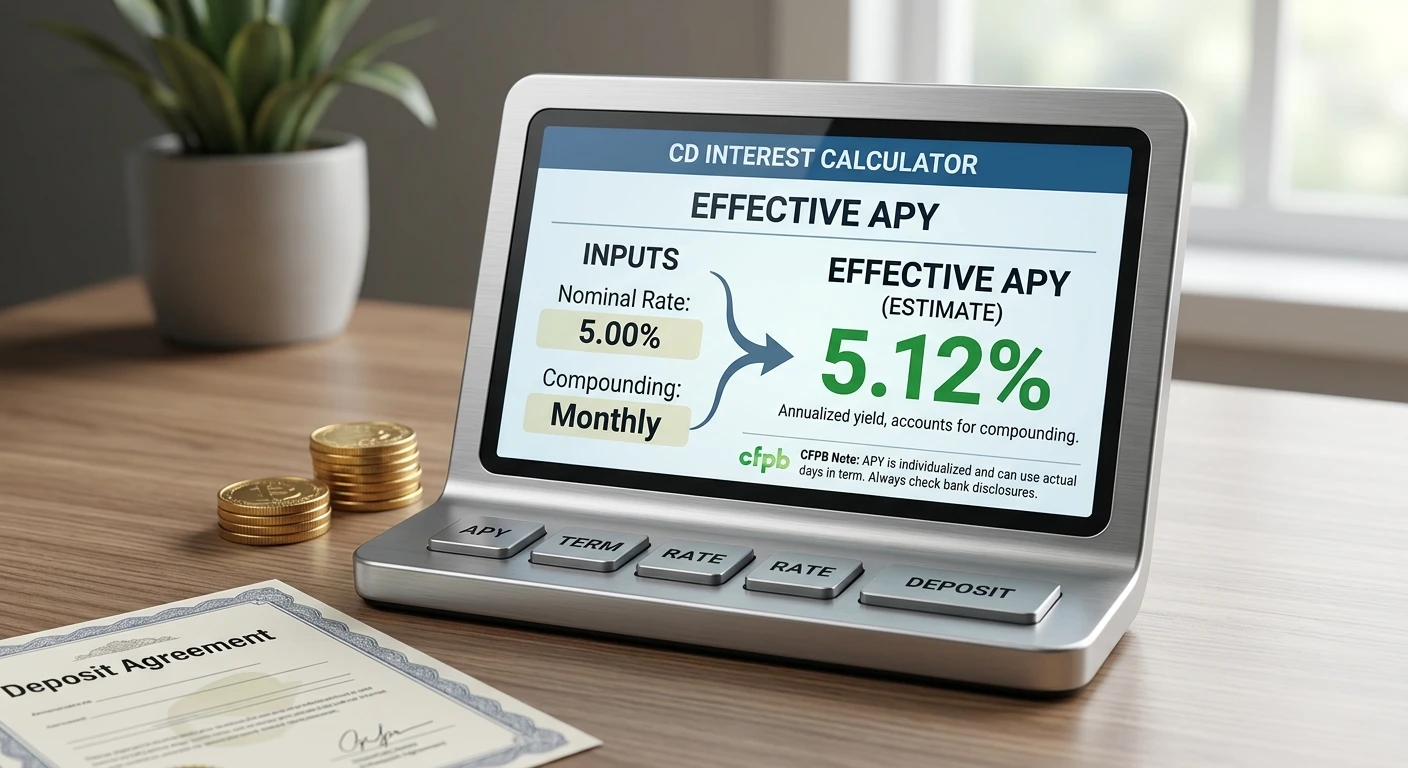
Effective APY is an annualized yield that accounts for compounding.
For a standard compound-interest assumption, the calculator uses:
APY = (1 + r/n)^n − 1
where:
For example, if an account has a 5% nominal rate compounded monthly, the effective annual yield will be slightly higher than 5% under this simplified compounding assumption.
However, a bank may calculate the APY shown according to applicable disclosure rules and account-specific assumptions.
The CFPB states that APY is generally annualized and that official APY calculations can involve the actual number of days in the account term.
Therefore, the calculator’s APY should be considered an estimate, not a replacement for the APY the financial institution discloses.
A CD term is how long the deposit is intended to remain in the account.
The calculator allows you to enter the term in:
For example:
6 months
or
2 years
The calculator converts months into years for its compound-interest calculation.
Actual CD maturity dates can depend on the account’s specific terms and calendar dates. Financial institutions may also have specific rules concerning maturity and renewal.
The CFPB’s deposit-account rules require disclosure of certain maturity and renewal information for applicable accounts.
A CD is generally designed to keep money deposited for the agreed term.
If you withdraw funds before maturity, the institution may impose an early withdrawal penalty, depending on the account terms.
That penalty can reduce the amount you ultimately receive.
The calculator does not include early-withdrawal penalties because they vary by institution and product.
Before opening a CD, check:
These details can meaningfully affect the outcome.
Suppose you want to estimate a hypothetical CD with:
The calculator applies the compound-interest formula using:
P = $10,000
r = 0.05
n = 12
t = 1
The estimated final value is then compared with the original $10,000 deposit to determine the estimated interest.
The exact output depends on the inputs you enter.
This type of calculation is useful when you want to understand how the starting deposit, interest rate, term, and compounding frequency interact.
Not necessarily.
A higher advertised rate may be attractive, but you should also consider the overall account terms.
For example, two CDs could have different:
The APY can also provide a more useful comparison because it incorporates the effect of compounding.
When comparing deposit accounts, review the full account disclosure rather than focusing on a single number.
The outcome at maturity depends on the account agreement.
Some CDs may automatically renew for another term if the customer does not take action during the applicable period.
Other accounts may transfer funds or interest under different terms.
The CFPB’s account-disclosure requirements include information about renewal policies for applicable time accounts.
Before the maturity date, check your bank’s instructions so you understand what will happen to your deposit.
No.
This calculator is an educational estimation tool. It does not recommend a particular bank, CD, interest rate, investment strategy, or financial product.
The calculator also does not consider every possible account feature.
For example, it does not automatically include:
For a real deposit, use the official disclosure supplied by the financial institution.
Your actual earnings may differ from the calculator’s estimate for several reasons.
The institution may compound interest differently from the assumptions entered into the calculator.
Interest may compound at one frequency and be credited at another, depending on the account structure. The CFPB specifically recognizes that compounding and crediting can have separate schedules.
Some calculations may use the actual number of days in the term.
Financial institutions may apply specific rounding procedures.
Taking money out before maturity can change your earnings and may trigger a penalty.
Interest income may have tax consequences depending on the user’s country and individual circumstances.
A CD may automatically renew under the institution’s renewal terms.
These factors are why you should not consider an online estimate a guaranteed payout.
A CD, or Certificate of Deposit, is a deposit product that generally holds money for a specified term while paying interest according to the account’s terms.
It uses your initial deposit, annual interest rate, term, and compounding frequency to estimate the maturity value and interest earned.
You generally need the starting deposit, annual interest rate, CD term, and compounding frequency.
This calculator is designed for a nominal annual interest rate, not an already-calculated APY. APY incorporates the effect of compounding.
APY stands for Annual Percentage Yield. It expresses an annualized yield while accounting for compounding.
Under the same nominal rate and other identical assumptions, more frequent compounding can increase the mathematical compound-interest result. Check actual account terms before making comparisons.
No. Tax treatment depends on your circumstances and applicable laws.
No. Early withdrawal penalties vary by financial institution and account.
Yes. The calculator provides several currency-display options. The currency selection changes the displayed currency; it does not convert currencies.
No. It is an estimate based on the assumptions the user enters.
This CD Interest Calculator is provided for general educational and informational purposes only. It does not constitute financial, investment, tax, or legal advice.
The calculation uses a standard compound-interest model and may not exactly match the calculation used by a particular financial institution. Actual interest may vary because of account terms, compounding and crediting methods, day-count conventions, rounding, early withdrawal penalties, taxes, fees, renewal terms, or other conditions.
Always review the official account disclosure and terms the financial institution provides before opening a CD or making a financial decision.
Official source: Consumer Financial Protection Bureau—APY Calculation

Zain Bin Shabbir is a content creator and website publisher with 2 years of experience in SEO, web content, and practical online tools. He focuses on creating clear, useful, and user-friendly resources that simplify everyday calculations.
Guides that go deeper into this topic