Estimate the potential value of an employee share incentive plan based on
your contributions, employer matching, share price and estimated growth.
1. Employee Contribution
2. Employer Matching
Example: 1 means 1 matching share for every 1 employee share.
100% means the employer matches up to the full employee contribution.
3. Share Price & Growth
This is an estimate and is not a guaranteed investment return.
Optional estimate. Dividends are assumed to be received in cash.
Important:
This calculator provides a general estimate only. Actual employee share
plans can have specific contribution limits, matching rules, holding
periods, withdrawal conditions, share prices and tax treatment.
Share Incentive Plan Calculator: Estimate Employee Share Plan Value
Employee share plans can be an important part of workplace compensation. Depending on the plan, an employer may provide shares, let employees purchase shares with their salary, or provide additional matching shares. Because the rules can vary considerably between employers and jurisdictions, it can be difficult to estimate what a plan might be worth over several years.
The Share Incentive Plan Calculator provides a simple, illustrative estimate based on the information you enter. It considers employee contributions, contribution frequency, employer matching, the current share price, an estimated annual share-price growth rate, and an optional dividend yield. The calculator’s inputs and outputs are specifically structured around these factors.
Important: This calculator is an educational estimation tool. It does not guarantee investment returns, predict future share prices, or determine the tax treatment of an individual employee share plan.
Share Incentive Plan Calculator
What Is a Share Incentive Plan?
A Share Incentive Plan, commonly abbreviated as SIP, is an employee share ownership arrangement that allows eligible employees to receive or purchase shares in their employer.
The exact structure depends on the employer and the applicable rules. In the UK, for example, HM Revenue & Customs describes four types of shares that can be included in an approved SIP: free shares, partnership shares, matching shares, and dividend shares.
This is important because the phrase “share incentive plan” does not necessarily mean every employer offers the same benefits.
Some plans may allow employees to purchase shares from salary, while an employer may provide matching shares subject to specific limits. Other plans may provide free shares or allow dividends to be reinvested.
Therefore, before using an online calculator to decide, employees should check their employer’s official plan documents.
What Does the Share Incentive Plan Calculator Do?
The calculator provides an estimate based on several user inputs:
Employee contribution
Contribution frequency
Plan duration
Employer matching ratio
Employer matching cap
Current share price
Expected annual share-price growth
Annual dividend yield
Currency
The calculator supports several currencies, including GBP, USD, EUR, CAD, AUD, INR, PKR, AED, and SAR.
After calculation, it displays an estimated plan value, employee contributions, employer matching value, estimated shares acquired, future share price, estimated future share value, dividend estimate, estimated gain, and estimated return.
Treat the result as a scenario rather than a prediction.
How to Use the Share Incentive Plan Calculator
Using the calculator is straightforward. Enter the information available from your employer’s share plan documents and then select Calculate Share Plan Value.
Share Incentive Plan Calculator
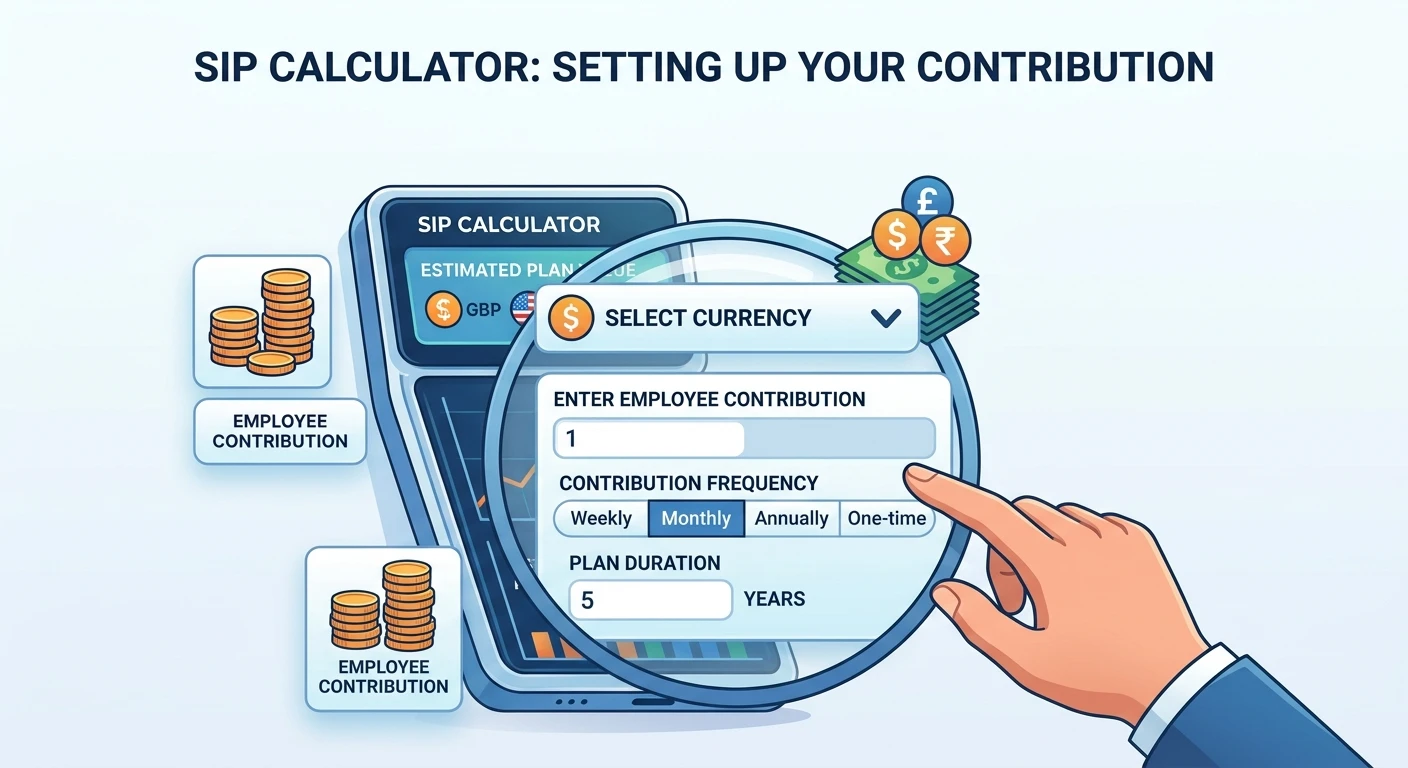
1. Select Your Currency
Choose the currency that matches the monetary figures you want to use.
For example, you can select:
GBP — British Pound
USD — US Dollar
EUR — Euro
CAD — Canadian Dollar
AUD — Australian Dollar
INR — Indian Rupee
PKR — Pakistani Rupee
AED — UAE Dirham
SAR — Saudi Riyal
The currency selection changes how the calculator displays monetary values; it does not convert currencies.
2. Enter Your Employee Contribution
Enter the amount you contribute to the plan.
The calculator allows you to choose between:
Monthly
Weekly
Annually
One-time
For recurring contributions, the calculator estimates the total employee contribution over the selected plan duration.
For example, if you contribute £100 every month for five years, the basic contribution amount would be:
£100 × 12 × 5 = £6,000
This is the employee contribution before considering employer matching or share price changes.
Understanding Employer Matching
Employer matching is one of the most important variables in an employee share plan.
The calculator includes an Employer Matching Ratio and an Employer Matching Cap.
Suppose an employer provides a matching ratio of 1:1. In a simplified example, an employee contribution of £100 could be matched with another £100, subject to the plan’s rules and any applicable cap.
However, employer matching isn’t the same in every plan.
Some employer schemes can have:
Matching limits
Maximum contribution amounts
Eligibility requirements
Waiting periods
Holding requirements
Specific matching ratios
Conditions for receiving or retaining matching shares
In the UK, HMRC explains that approved SIPs can include matching shares, and the rules can permit an employer to match partnership shares subject to statutory limits.
For this reason, always use the matching ratio and cap stated in your actual plan documentation rather than assuming a particular employer contribution.
What Is the Employer Matching Cap?
The Employer Matching Cap (%) limits the maximum matching value the calculator will include.
For example, a 100% cap means that the employer matching amount cannot exceed the employee contribution under the calculator’s simplified methodology. The calculator specifically describes 100% as matching up to the full employee contribution.
The calculator applies the cap after calculating the potential employer match. This means that if the theoretical matching amount is greater than the permitted cap, the calculator uses the lower capped amount.
This is a useful way to model a plan, but the employer’s official rules should always take priority.
How Share Price Affects the Result
The number of shares you can acquire depends on the share price.
In a simplified calculation:
Number of Shares = Amount Used to Purchase Shares ÷ Share Price
For example, if £1,000 is available for share purchases and the share price is £10, the calculation would be:
£1,000 ÷ £10 = 100 shares
The calculator applies this concept separately to employee contributions and employer matching before calculating the total number of shares.
A lower share price means that the same amount of money can purchase more shares. A higher share price means you can buy fewer shares.
However, the number of shares alone does not determine whether an investment will make money. The future market value of those shares depends on their future price.
Understanding Expected Share Price Growth
The calculator includes an Expected Annual Share Price Growth (%) field. This is an assumption you provide, not a guaranteed rate of return. The calculator itself warns that expected growth is not a guaranteed investment return.
The simplified future-price calculation is based on compound growth:
For example, if the current share price is £10 and you assume 5% annual growth for five years:
Future Share Price ≈ £10 × (1.05)⁵
This produces an illustrative future price, not a forecast.
Actual share prices can move significantly in either direction. Investor.gov notes that stock prices can rise or fall and that investors can lose money because there is no guarantee that a company will grow or perform well.
For that reason, it can be useful to run several scenarios instead of relying on a single growth assumption.
Example scenarios
You could test:
0% annual growth
3% annual growth
5% annual growth
8% annual growth
A negative-growth scenario
Comparing multiple scenarios can help you understand how sensitive the estimated result is to the share-price assumption.
How Dividends Are Included
Some companies pay dividends to shareholders.
A dividend is a payment a company makes to shareholders, although companies are not required to maintain a particular dividend and dividend payments can change.
The calculator includes an optional Annual Dividend Yield (%) input. The calculator assumes the dividends are received in cash rather than automatically reinvested.
The calculator then provides a simplified dividend estimate based on the estimated share holdings and future share value.
This is an important limitation because real dividend calculations can depend on:
Dividend payment dates
Number of shares held at each payment date
Changes in dividend rates
Tax treatment
Whether dividends are reinvested
Employer plan rules
Therefore, treat the dividend figure as an illustrative estimate rather than an expected payment.
Example of Using the Calculator
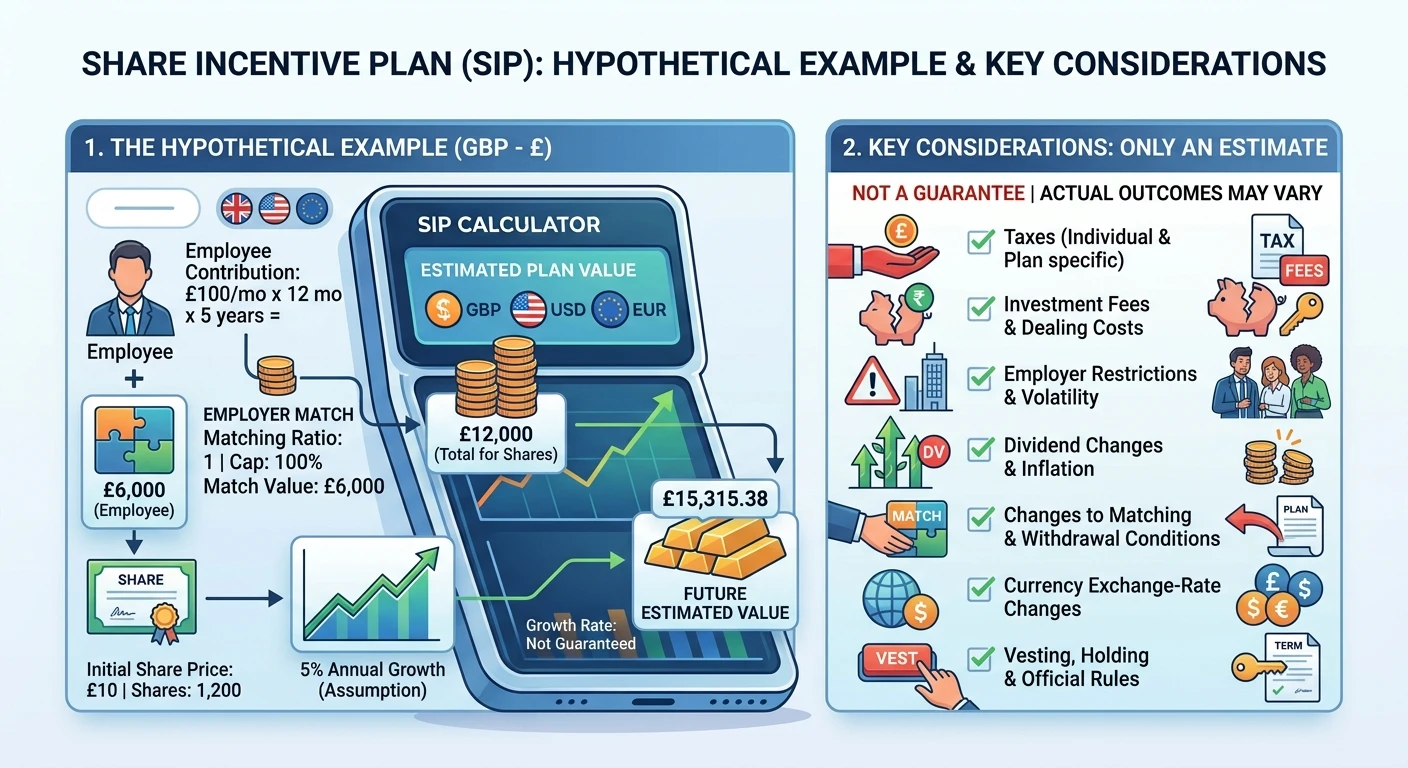
Consider a hypothetical employee who enters:
Employee contribution: £100 per month
Duration: 5 years
Matching ratio: 1
Matching cap: 100%
Share price: £10
Expected annual growth: 5%
Dividend yield: 0%
The employee’s basic contributions would be:
£100 × 12 × 5 = £6,000
Under the calculator’s simplified matching assumptions, the employer matching value could also be £6,000, subject to the 100% cap.
That would give:
Total amount used for shares = £6,000 + £6,000 = £12,000
At an initial share price of £10, the simplified number of shares would be:
£12,000 ÷ £10 = 1,200 shares
The calculator then applies the assumed annual growth rate to estimate a future share price and uses that price to estimate the future value of the shares.
This example is hypothetical. Your actual employer plan may use different contribution limits, matching rules, share prices, vesting conditions, holding periods, or tax arrangements.
Share Incentive Plan Calculator
Why the Calculator Is Only an Estimate
There are several reasons why the result should not be interpreted as a guaranteed investment outcome.
The calculator itself states that actual plans can have specific contribution limits, matching rules, holding periods, withdrawal conditions, share prices, and tax treatment.
In addition, the calculator does not account for every possible real-world factor.
For example, the result does not automatically include:
Taxes
Investment fees
Dealing costs
Employer-specific restrictions
Share-price volatility
Changes in dividend payments
Inflation
Currency exchange-rate changes
Changes to employer matching
Early withdrawal conditions
The output therefore works best as a planning and educational scenario calculator.
Tax Considerations for Share Incentive Plans
Tax treatment matters because employee share schemes can have specific rules.
For example, HM Revenue & Customs explains that UK Share Incentive Plans can have tax and National Insurance advantages when certain conditions are met. The treatment depends on the type of shares and how long they remain in the plan.
HMRC’s employee guidance also explains that approved SIPs can involve free, partnership, matching, and dividend shares, with different rules applying to each type.
Tax rules can change, and rules that apply in one country may not apply in another.
Therefore:
Do not use the calculator’s estimated gain as your after-tax profit.
If you are participating in an employee share plan, review the plan’s official documentation and, where necessary, obtain advice from an appropriately qualified tax or financial professional.
Share Investment Risk
Employee share plans can provide an opportunity to participate in the success of your employer, but they also create investment risk.
When you own shares in one company, your investment is exposed to that company’s performance. Investor.gov explains that stock prices can fluctuate and that investors can lose money.
This can be particularly relevant with employee share ownership because your employment income and investment may both be connected to the same company.
For example, if a company experiences financial difficulties, an employee could potentially face both employment uncertainty and a decline in the value of company shares.
Diversification is one commonly discussed approach to managing investment concentration. Investor.gov explains that diversification involves spreading investments across different assets rather than relying on a single investment.
This does not mean that diversification eliminates risk, but it can reduce the impact of poor performance from one investment.
Advantages of Using a Share Incentive Plan Calculator
A calculator can be useful because it allows you to explore different assumptions quickly.
It can help you understand contribution totals
You can see how regular contributions accumulate over several years.
It can illustrate employer matching.
You can model how an employer contribution could affect the total amount invested.
It can show the effect of share-price assumptions.
Changing the growth rate can demonstrate how strongly the final estimate depends on future share performance.
It can compare different scenarios.
You can test different contribution levels, plan durations, matching assumptions, and growth rates.
It can provide an easy starting point.
Instead of manually performing several calculations, the calculator combines the inputs into one illustrative estimate.
Limitations You Should Understand
An online calculator should never replace the official rules of your employee share plan.
Before relying on a result, check:
Your employer’s plan documentation.
Your contribution limits.
The employer matching formula.
Any matching cap.
Share purchase price or valuation rules.
Holding or vesting requirements.
Withdrawal conditions.
Dividend rules.
Applicable taxes.
Fees and dealing costs.
The calculator’s own disclaimer emphasizes that actual share prices, matching conditions, taxes, fees, and other plan rules can affect the outcome.
Frequently Asked Questions
What is a Share Incentive Plan Calculator?
A Share Incentive Plan Calculator is an online tool that estimates the potential value of an employee share plan using inputs such as employee contributions, employer matching, share price, estimated growth, and dividend yield.
Is the calculator’s result guaranteed?
No. The result is an illustrative estimate. Future share prices, dividends, employer matching, taxes, and other factors can differ from the assumptions entered.
Does employer matching increase my investment?
Potentially, yes. If your employer provides matching shares or matching contributions, they can increase the amount of shares associated with your plan. However, the exact benefit depends on your employer’s rules.
What does a 1:1 matching ratio mean?
In the calculator’s simplified model, a 1:1 matching ratio means one matching unit for every one employee unit, subject to the matching cap and plan conditions.
Can share prices go down?
Yes. Stocks can rise or fall, and there is no guarantee of a positive return.
Does the calculator include taxes?
No. Tax treatment is not included in the estimated result. The actual tax consequences depend on the plan, country, individual circumstances, and applicable rules.
Does the calculator include dividends?
Yes, if you enter an annual dividend yield above zero. However, the calculator uses a simplified estimate and assumes you receive dividends in cash.
Can I use this calculator for any employee share scheme?
You can use it as a general scenario calculator, but you should not assume that every employer’s scheme follows the same rules. Compare the calculator inputs with your actual plan documentation.
Is a Share Incentive Plan the same in every country?
No. Employee share-plan structures and tax rules differ by jurisdiction. For example, UK-approved SIPs have specific rules administered under UK legislation and HMRC guidance.
Should I make an investment decision based only on this calculator?
No. Use the calculator as an educational planning tool. Consider the official plan documents, your financial circumstances, investment risk, taxes, and other relevant factors before making financial decisions.
Final Thoughts
A Share Incentive Plan can be an interesting way for employees to participate in company ownership, particularly where an employer provides matching or other share-related benefits. However, the plan’s potential value depends on much more than the amount contributed.
The Share Incentive Plan Calculator provides a convenient way to explore different scenarios by combining employee contributions, employer matching, share price, estimated growth, and dividend assumptions.
The most important point is to treat the result as an estimate, not a promise of future value. Share prices can decline, dividends can change, employer rules can differ, and tax treatment can affect the amount you ultimately receive.
Before making a financial decision, check your employer’s official share-plan documents and use current information from the relevant tax authority. In the UK, HMRC provides specific guidance on share incentive plans, including different share types and their tax treatment.
Disclaimer
This calculator and article are provided for general educational and informational purposes only. The results are illustrative estimates and do not guarantee investment returns, provide financial advice, offer tax advice, or recommend buying, selling, or holding shares. Actual employee share plans may have different contribution limits, matching rules, holding periods, fees, taxes, share prices, dividend policies, and withdrawal conditions. Investment values can rise or fall, and you may lose money. Always review your employer’s official plan documentation and consider seeking advice from a qualified financial or tax professional where appropriate.
Employees can use the Share Incentive Plan Calculator to estimate contributions, employer matching, share value, and potential returns. When working with contribution percentages or employer matching rates, our Percentage Calculator can also be useful. For comparing other savings and investment calculations, you can use the CD Interest Calculator.
Free & instant results
Written by
Zain Bin Shabbir
Zain Bin Shabbir is a content creator and website publisher with 2 years of experience in SEO, web content, and practical online tools. He focuses on creating clear, useful, and user-friendly resources that simplify everyday calculations.