
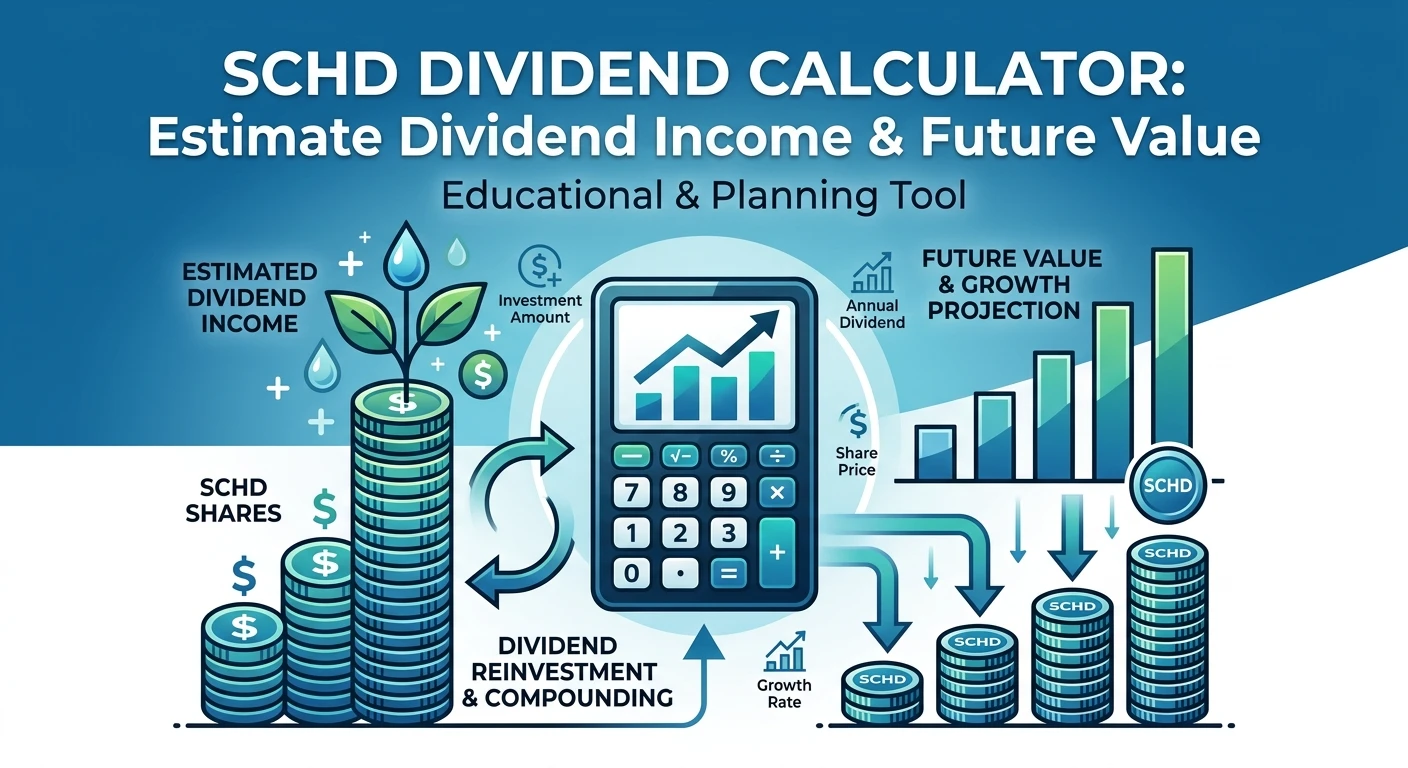
Estimate SCHD dividend income from your investment, share price, dividend per share, dividend growth, and optional dividend reinvestment.
If you are considering an investment in the Schwab U.S. Dividend Equity ETF (SCHD) and want to estimate how much dividend income your investment could generate, a dividend calculator can make the calculation much easier.
Our SCHD Dividend Calculator allows you to enter an investment amount, SCHD share price, annual dividend per share, dividend growth rate, investment period, monthly contributions, dividend reinvestment, and estimated share-price growth. It then estimates first-year dividend income, dividend yield, total contributions, projected dividends, ending shares, and estimated ending value.
The calculator is designed for educational and planning purposes. It does not predict future SCHD distributions or guarantee investment returns. Actual results can differ because ETF prices, distributions, expenses, taxes, and market conditions change over time.
SCHD is the ticker symbol for the Schwab U.S. Dividend Equity ETF, an exchange-traded fund managed by Schwab Asset Management.
According to Schwab, the fund’s objective is to track, before fees and expenses, as closely as possible the total return of the Dow Jones U.S. Dividend 100 Index. Schwab also describes SCHD as a fund focused on dividend quality and sustainability and notes that it can be used as part of a diversified portfolio.
Because SCHD is an ETF, investors purchase shares through a brokerage account rather than purchasing individual holdings directly from the fund.
The SEC explains that ETFs can provide exposure to a portfolio of investments and that ETF shares generally trade on an exchange throughout the trading day at market prices. The market price can differ from the fund’s net asset value (NAV).
This distinction is important when using an SCHD dividend calculator because the share price you enter is an assumption, not a permanently fixed value.
An SCHD dividend calculator estimates potential dividend income based on the information you provide.
The calculator on this page uses these primary inputs:
The calculator then estimates:
Treat the results as projections, not promises.
Using the calculator is straightforward. You only need to enter the assumptions you want to use for your calculation.
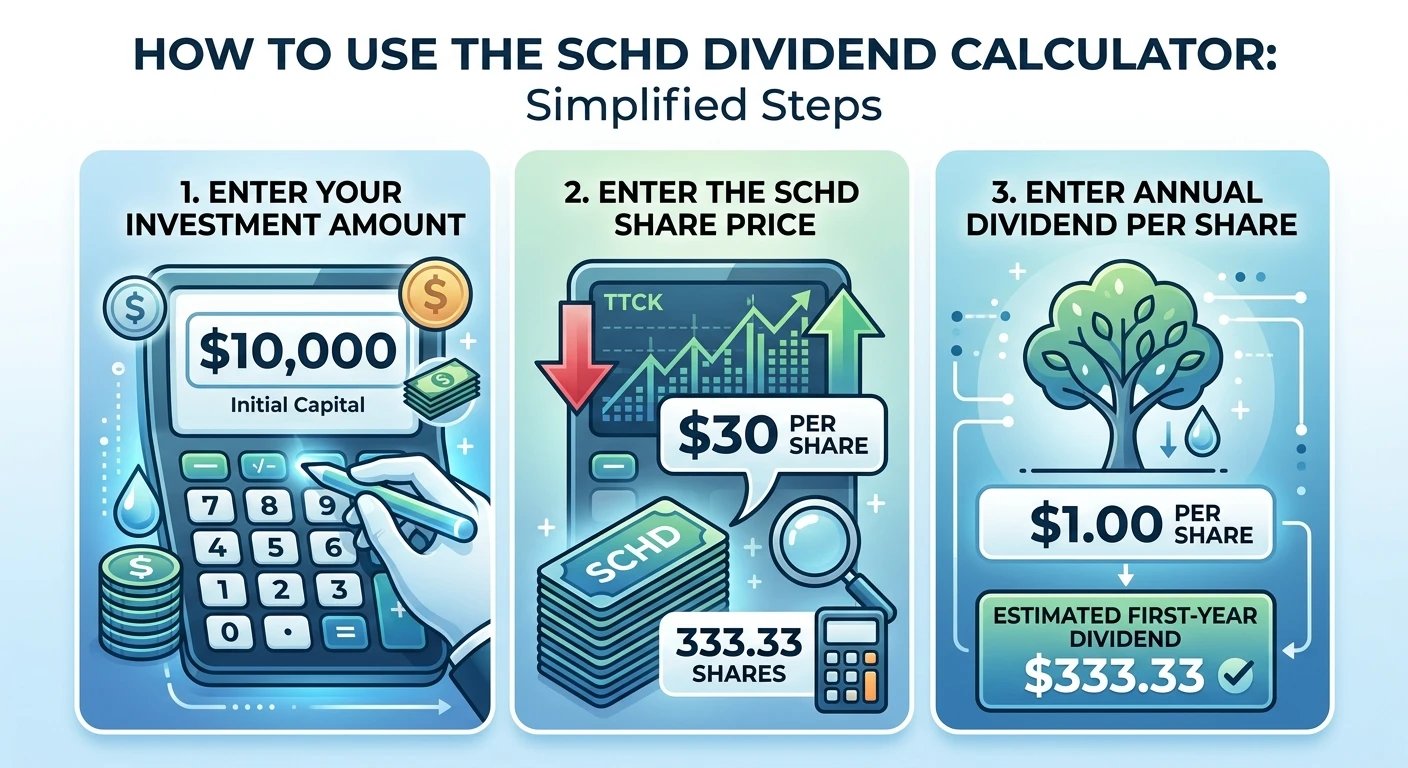
Start by entering the amount you plan to invest in SCHD.
For example, suppose you enter: $10,000
This represents the initial amount invested before considering future contributions or investment returns.
The calculator uses this amount to determine how many SCHD shares you could buy based on the share price you enter.
Next, enter the SCHD share price you want to use.
For example:
$30 per share
The calculator estimates the initial number of shares using:
Initial Shares = Investment Amount ÷ Share Price
So, if the investment is $10,000 and the assumed share price is $30:
$10,000 ÷ $30 = 333.33 shares
This estimate is based on the values entered.
Actual purchases may differ because of the market price at the time of the transaction, brokerage rules, and whether fractional shares are available.
Next, enter the annual dividend per share.
For example, if you use
$1.00 per share
The calculator estimates dividend income based on that amount.
The basic first-year dividend calculation is
First-year dividend = Number of Shares × Annual Dividend Per Share
Using the example above:
333.33 × $1.00 = approximately $333.33
This is a simplified estimate.
SCHD distributions can change over time, so the dividend amount you enter should be treated as an assumption rather than a guaranteed future payment.
Schwab publishes SCHD’s distribution information on its official fund page, where investors can review historical and current distribution data.
Dividend yield is another useful figure when evaluating dividend-paying investments.
The simplified yield calculation used by the calculator is
Dividend Yield = Annual Dividend Per Share ÷ Share Price × 100
For example, if the annual dividend is $1 and the share price is $30:
$1 ÷ $30 × 100 = 3.33%
This produces an estimated dividend yield of approximately 3.33%.
However, dividend yield can change even when the dividend itself does not.
For example:
Therefore, don’t view dividend yield in isolation from the fund’s price, distributions, expenses, and overall investment performance.
The calculator also estimates the first-year monthly dividend amount.
It calculates this by dividing the estimated first-year dividend by 12:
Estimated Monthly Dividend = Annual Dividend Income ÷ 12
For example, if estimated annual dividend income is $600:
$600 ÷ 12 = $50
This does not mean SCHD necessarily pays the same amount every month.
The monthly figure is simply an annualized estimate divided by 12. Actual ETF distributions may be paid according to the fund’s distribution schedule and may vary from one payment to another.
Schwab provides official distribution information and dates for SCHD on its fund page.
The calculator includes an optional dividend growth rate.
This allows you to model a hypothetical situation where the dividend per share increases over time.
For example, you might enter:
5% annual dividend growth
The calculator then increases the dividend assumption for future projection years.
A simplified calculation is
Future Dividend = Current Dividend × (1 + Growth Rate)
If the current dividend assumption is $1.00 and the assumed growth rate is 5%:
$1.00 × 1.05 = $1.05
After another year, the model would apply the same growth assumption again.
However, this is only a mathematical projection. Past dividend growth does not guarantee future dividend growth.
Actual distributions depend on the fund’s underlying investments, income, expenses, market conditions, and other factors.
For this reason, users should run multiple scenarios rather than rely on one growth assumption.
The calculator allows you to enter an additional monthly investment.
For example, suppose you invest:
Your total contributions would be
$10,000 + ($200 × 12 × 5)
= $22,000
The calculator uses the monthly contribution to estimate additional shares over the projection period.
This can help people model a regular investment strategy rather than a single lump sum.
However, the actual number of shares purchased each month can vary because the SCHD market price changes.
One of the most important options in the calculator is dividend reinvestment.
When dividend reinvestment is enabled, the calculator assumes that estimated dividend income is used to purchase additional shares.
This creates the possibility of compounding.
For example:
This process can increase your share count over time.
However, actual dividend reinvestment depends on your brokerage account and the reinvestment settings available to you. The SEC notes that reinvesting ETF distributions can involve additional considerations and that investors should check with their ETF or investment professional.
The calculator therefore treats reinvestment as a modeling assumption.
The calculator also includes an optional Estimated Share Price Growth field.
This allows you to model a hypothetical annual change in SCHD’s share price.
For example, you could enter:
4% annual share-price growth
The calculator then increases the assumed share price during the projection.
Dividend income and share-price appreciation are different components of investment returns.
An ETF investment can potentially produce:
The SEC explains that ETF investors can potentially earn returns from distributions and changes in the market price of the ETF, while also noting that ETF shares trade at market prices that can differ from NAV.
Therefore, an estimated share-price growth rate should never be interpreted as a guaranteed return.
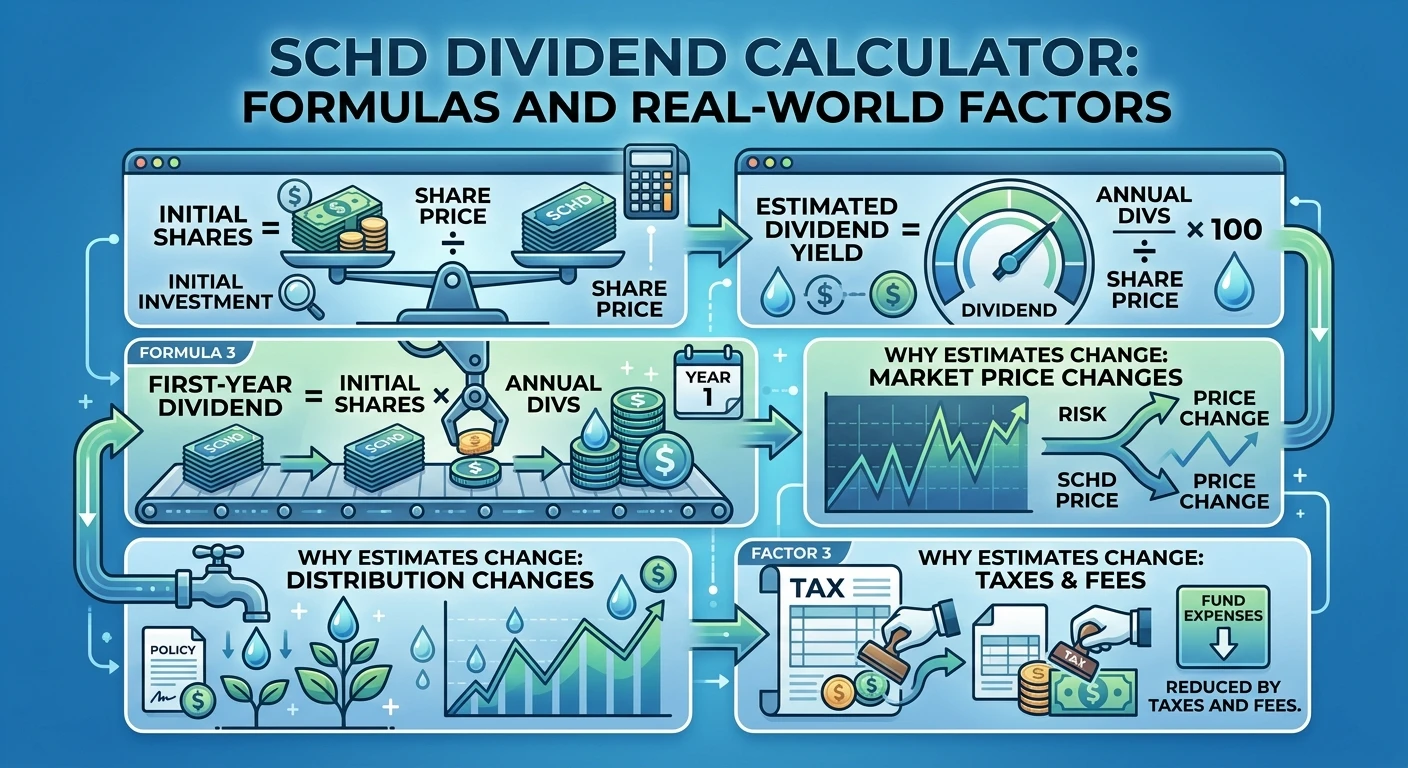
The calculator uses several simplified calculations.
Initial Shares = Initial Investment ÷ Share Price
Dividend Yield = Annual Dividend Per Share ÷ Share Price × 100
First-year dividend = Initial Shares × Annual Dividend Per Share
Monthly Dividend = First-Year Dividend ÷ 12
For the calculator’s growth assumption:
Future Dividend = Previous Dividend × (1 + Dividend Growth Rate)
Total Contributions = Initial Investment + Monthly Contributions
These formulas help create estimates, but they don’t capture every real-world factor affecting an ETF investment.
A calculator can provide a useful estimate, but it cannot know the future.
Several factors can cause actual results to differ.
SCHD’s market price can rise or fall.
If the price changes, the value of your holdings changes as well.
Dividend distributions are not guaranteed to remain constant.
The amount distributed can vary over time.
A calculator using a 5% growth assumption does not mean the actual dividend will grow by 5%.
The assumption shows a possible scenario.
Taxes can affect how much an investor ultimately keeps.
Tax treatment can depend on factors such as account type, jurisdiction, investor circumstances, and how distributions are classified.
Schwab provides distribution and tax-related documents for its ETFs, including SCHD, which investors can consult for official information.
ETFs have expenses associated with operating the fund.
The SEC explains that fund fees and expenses reduce investment returns and recommends reviewing the fund’s prospectus and fee information.
Don’t confuse dividend investing with guaranteed income.
SCHD is an equity ETF. Its underlying investments can fluctuate in value, and the ETF’s market price can change.
The SEC specifically advises investors to review an ETF’s available information, including its prospectus and recent shareholder reports, before investing.
Therefore, use the SCHD Dividend Calculator as an educational planning tool, not a guarantee of future income.
Instead of entering only one optimistic scenario, consider creating several scenarios.
Use:
Use:
Use:
Comparing scenarios can demonstrate how sensitive the estimated outcome is to your assumptions.
It is generally more informative than relying on a single projected number.
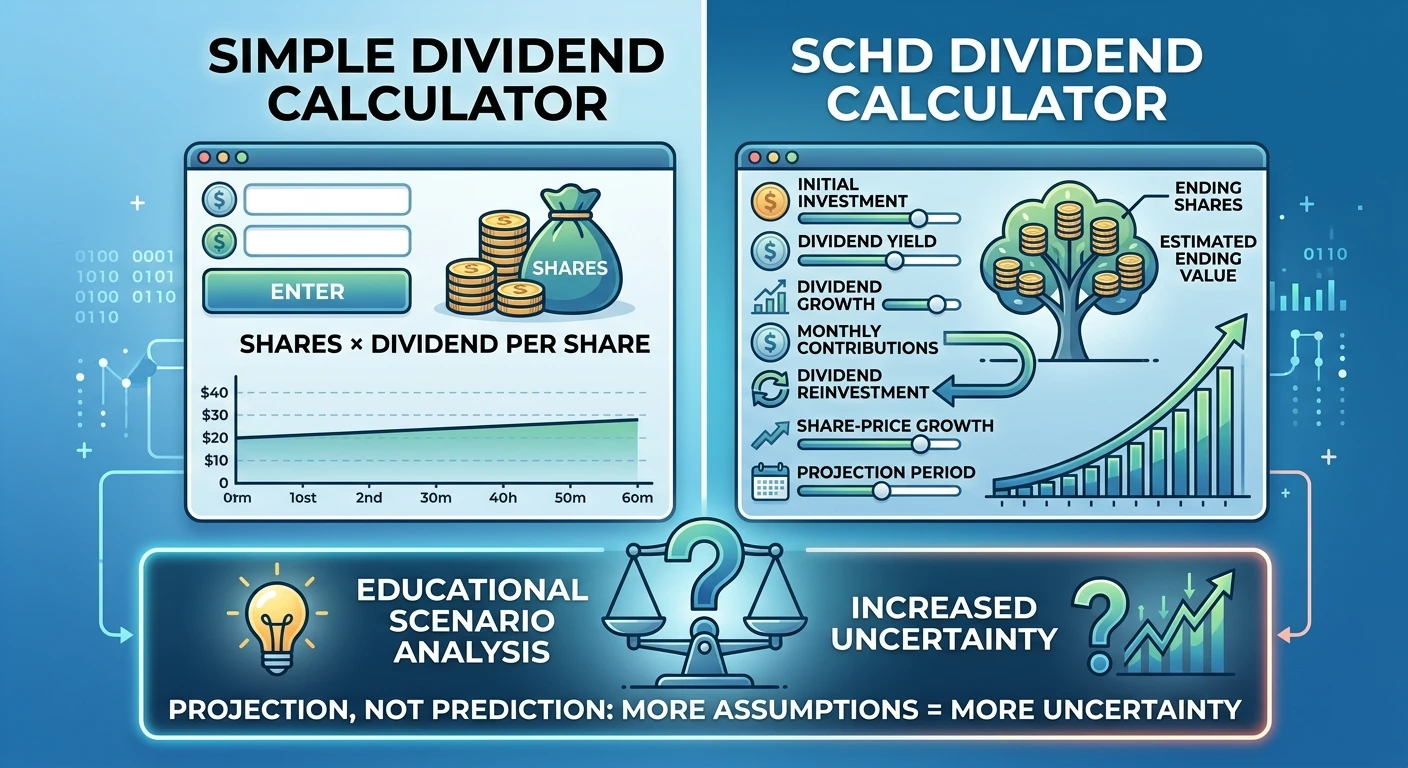
A basic dividend calculator may only calculate:
Shares × Dividend Per Share
The SCHD Dividend Calculator goes further by allowing users to model:
That makes it useful for educational long-term scenario analysis.
However, additional assumptions also mean additional uncertainty.
The more assumptions you add, the more important it becomes to remember that the result is a projection rather than a prediction.
Before making an investment decision based on dividend projections, consider reviewing the fund’s official information.
Schwab provides SCHD’s prospectus, reports, fact sheet, portfolio holdings, distribution information, and other documents through its official fund resources.
The SEC also recommends reviewing an ETF’s prospectus and shareholder reports and considering whether an ETF fits your overall financial situation.
Investors should also consider:
An SCHD Dividend Calculator estimates potential dividend income from an SCHD investment based on inputs such as investment amount, share price, annual dividend per share, and dividend growth assumptions.
A simple calculation is
Number of Shares × Annual Dividend Per Share = Estimated Annual Dividend
For example, if you own 100 shares and assume an annual dividend of $1 per share, the estimated annual dividend would be $100.
No. SCHD is an equity ETF, and its distributions can change. Historical distributions should not be treated as a guarantee of future payments.
A simplified dividend-yield calculation is
Annual Dividend Per Share ÷ Share Price × 100
The resulting percentage changes when either the dividend assumption or share price changes.
Yes. The calculator includes an optional monthly investment field to estimate the effect of regular contributions over a selected projection period.
Yes. You can select whether dividends are modeled as cash or reinvested into additional shares.
No. The results are estimates based on the assumptions you enter.
No. The calculation does not include taxes. Actual tax treatment can vary depending on your circumstances and jurisdiction.
The calculator does not separately model all fund expenses, brokerage costs, or other transaction-related costs. Investors should review the fund’s official expense information before making decisions.
The most reliable source for current fund information is Schwab Asset Management’s official SCHD page and its related fund documents. Schwab publishes distribution information and regulatory documents for the ETF.
You can also explore other calculators on our website for financial and planning calculations:
These calculators make common calculations easier while clearly showing the assumptions used.
This SCHD Dividend Calculator is provided for educational and informational purposes only. It is not financial, investment, tax, or legal advice.
The calculations are estimates based on the information and assumptions the user enters; distributions, market prices, dividend growth, and investment returns can change. Past performance or dividend growth does not guarantee future results.
The calculator does not account for every possible factor, including taxes, brokerage commissions, bid-ask spreads, fund expenses, account-specific costs, inflation, or changes in distribution policy.
Before making an investment decision, review current information from the fund sponsor and official regulatory sources and consider your own financial circumstances. The SEC recommends that investors review an ETF’s prospectus and shareholder reports before investing.

Zain Bin Shabbir is a content creator and website publisher with 2 years of experience in SEO, web content, and practical online tools. He focuses on creating clear, useful, and user-friendly resources that simplify everyday calculations.
Guides that go deeper into this topic