
Use our free Money Portion Calculator to divide a total amount among multiple people based on percentage shares. Enter the amount, select a currency, add each person’s share, and instantly calculate their money portion.
Calculate each person’s share of a money amount by percentage.
Use our Money Portion Calculator to divide a total amount of money into different portions based on percentages. Enter the total amount, choose the currency, and add the percentage for each person or portion to quickly calculate how much each share is worth.
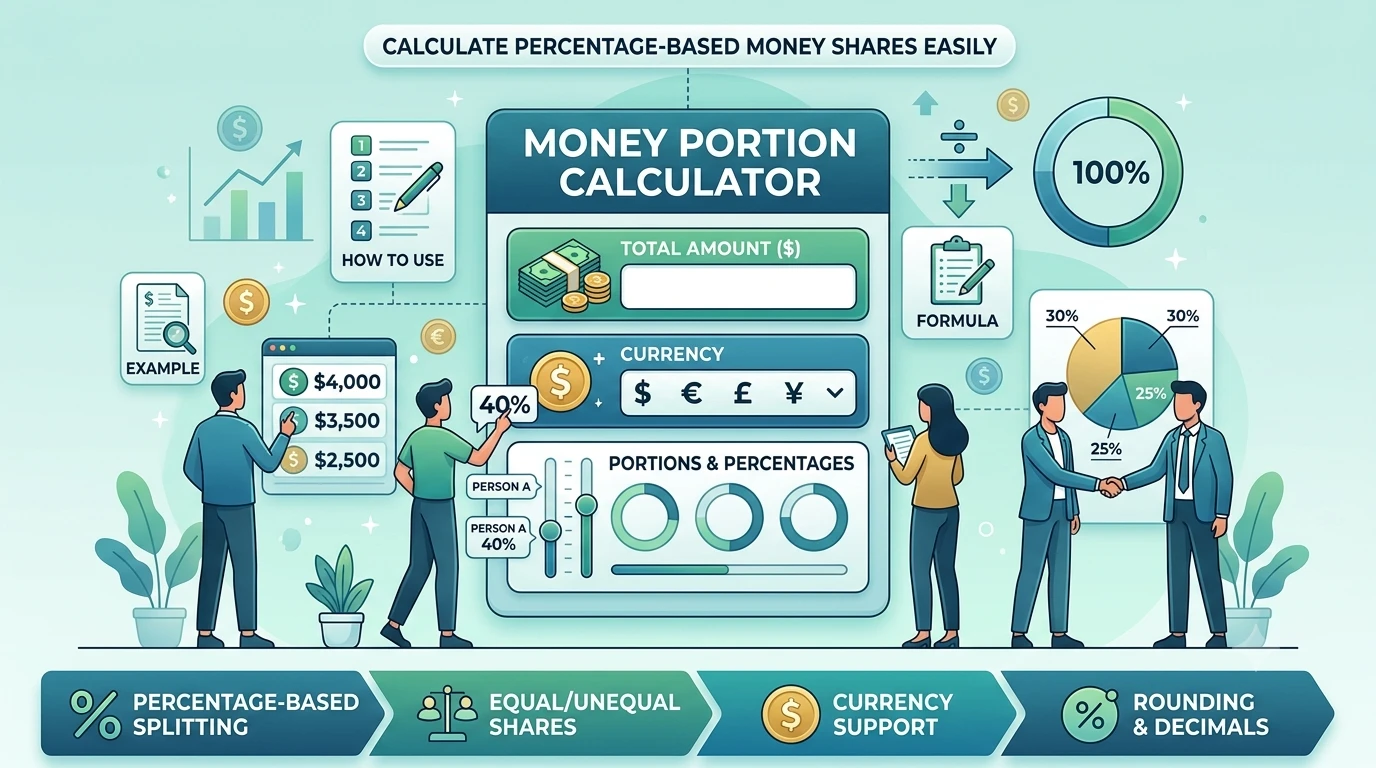
This calculator helps split money between multiple people, calculate percentage-based shares, and check whether different portions add up to the total amount.
Using the calculator is simple:
Suppose you have $10,000 and want to divide it between three people:
The calculations are
Total:
$5,000 + $3,000 + $2,000 = $10,000
You can therefore calculate each person’s share directly from their percentage.
The basic formula is
Money Portion = Total Amount × Percentage ÷ 100
For example, if the total amount is $5,000 and the required portion is 25%:
$5,000 × 25 ÷ 100 = $1,250
The calculated portion is $1,250.
A percentage represents a fraction of the total amount.
For example:
| Person | Share | Amount |
|---|---|---|
| Person A | 40% | $4,000 |
| Person B | 35% | $3,500 |
| Person C | 25% | $2,500 |
| Total | 100% | $10,000 |
The percentage determines how much of the total amount each person receives.
For percentage-based land divisions, use our tool to calculate land shares.
If everyone should receive an equal share, you don’t need different percentages.
For example, if 5 people need to divide $5,000 equally:
$5,000 ÷ 5 = $1,000
Each person receives a mathematical share of $1,000, equivalent to 20%.
Money can also be divided into different percentages.
For example, $20,000 may be divided as
The calculated amounts are
The portions total:
$9,000 + $6,000 + $3,000 + $2,000 = $20,000
If you are dividing the entire amount, the percentages should normally add up to 100%.
For example:
50% + 30% + 20% = 100%
is a complete division.
But:
50% + 30% = 80%
means 20% of the total amount is unallocated.
If the percentages add up to more than 100%, the calculated portions will exceed the original amount.
For example:
50% + 35% + 25% = 110%
This indicates that the percentages should be reviewed.
A percentage-based division and an equal split are related but not always the same.
If three people split $9,000 equally:
$9,000 ÷ 3 = $3,000 each
Each person has approximately 33.33%.
If the same $9,000 is divided into 50%, 30%, and 20%, the amounts become:
So the correct method depends on whether the shares are equal or based on specific percentages.
If the amount relates to an inheritance, our inheritance shares calculator can help with the math once the applicable shares are known.
Calculating multiple percentage-based shares manually can be inconvenient, especially when working with several people or different percentages.
A money portion calculator can help you:
It is useful for everyday calculations and preliminary financial planning.
The mathematical formula for calculating a portion is the same regardless of currency.
For example:
€8,000 × 25% = €2,000
Likewise:
£8,000 × 25% = £2,000
The currency symbol does not change the percentage calculation.
However, this calculator does not automatically determine currency exchange rates. If you are converting between currencies, use an appropriate exchange-rate source or currency converter first.
Some percentage calculations may produce decimal values.
For example:
$100 × 33.33% = $33.33
When dividing actual money, rounding may occasionally cause the individual portions to differ slightly from the original total.
For transactions involving actual payments, use the appropriate currency’s rounding rules and make sure the final amounts reconcile with the total.
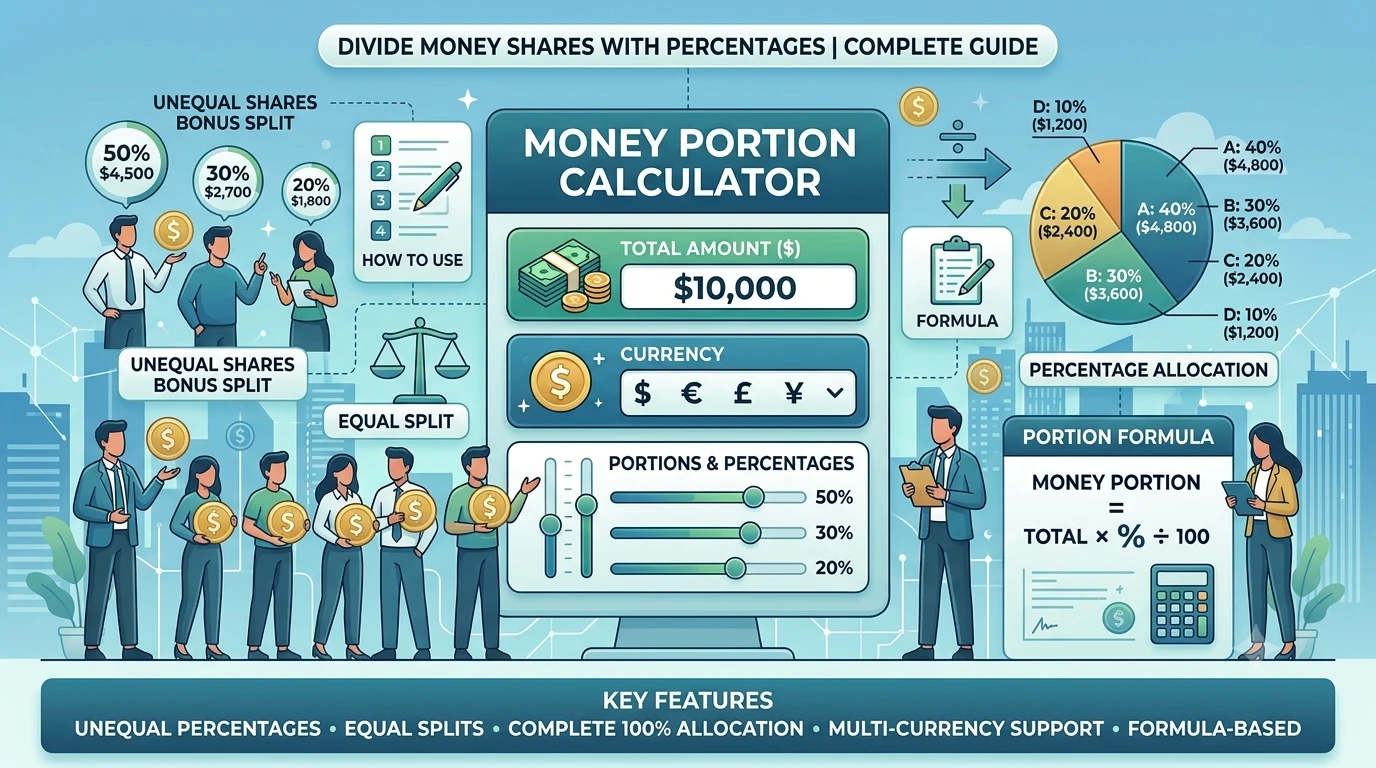
Suppose a team receives a $12,000 bonus and the amount is allocated according to predetermined percentages:
The calculated portions are
The total is
$4,800 + $3,600 + $2,400 + $1,200 = $12,000
This illustrates how percentage allocations can be converted into actual monetary amounts.
A percentage calculator provides a mathematical result based on the information entered. It does not determine whether a particular payment arrangement, profit-sharing agreement, compensation arrangement, or financial distribution is legally or contractually valid.
For financial decisions involving contracts, taxes, investments, debts, inheritance, or legal obligations, consult an appropriately qualified professional.
If the money represents ownership of real estate, you can also calculate property shares using our Property Portion Calculator.
A money portion is a specific share of a total amount of money. You can represent it as a percentage and convert it into a monetary amount.
Multiply the total amount by the percentage and divide by 100.
Formula:
Total Amount × Percentage ÷ 100
25% of $10,000 is $2,500.
Divide the total amount by the number of people.
For example, $6,000 divided equally between 3 people is
$6,000 ÷ 3 = $2,000 each.
Yes. Enter the percentage assigned to each person or portion. If you are dividing the complete amount, the percentages should normally total 100%.
Yes. The percentage calculation works with any currency because the underlying mathematical formula is the same. Currency conversion is a separate calculation.
A portion of the original amount remains unallocated.
For example, if the percentages total 80%, then 20% of the original amount is unassigned.
The allocated portions will exceed the original amount. Review the percentages to make sure they are correct.
You can use it to calculate percentage-based shares. However, the calculator does not determine whether a particular profit-sharing arrangement is legally or contractually appropriate.
No. The basic calculation uses the total amount and percentage entered. You must calculate taxes, fees, deductions, and other adjustments separately.
The Money Portion Calculator is a general mathematical tool. Results are based entirely on the total amount and percentages the user enters.
For actual financial transactions, contracts, taxes, investments, inheritance, compensation, or other regulated financial matters, verify the calculation and consult a qualified professional where appropriate.
If you need to determine the percentage before dividing an amount, use our calculate percentages tool.

Zain Bin Shabbir is a content creator and website publisher with 2 years of experience in SEO, web content, and practical online tools. He focuses on creating clear, useful, and user-friendly resources that simplify everyday calculations.
Guides that go deeper into this topic