

Use our Cubic Yard Calculator to quickly calculate the volume of gravel, mulch, soil, sand, concrete, dirt, and other bulk materials. Enter the length, width, and depth of your project to estimate the required cubic yards.
Calculate cubic yards from length, width, and height measurements.
Based on the dimensions you entered.
For irregular areas, calculate separate sections and add their cubic-yard results together. Results are approximate and intended for general estimating.
Use our Cubic Yard Calculator to calculate the volume of materials in cubic yards. It is useful for estimating concrete, gravel, sand, soil, mulch, dirt, landscaping materials, and other bulk materials sold by volume.
Instead of manually converting measurements and calculating volume, you can enter the length, width, and depth of an area to estimate how many cubic yards of material you need quickly.
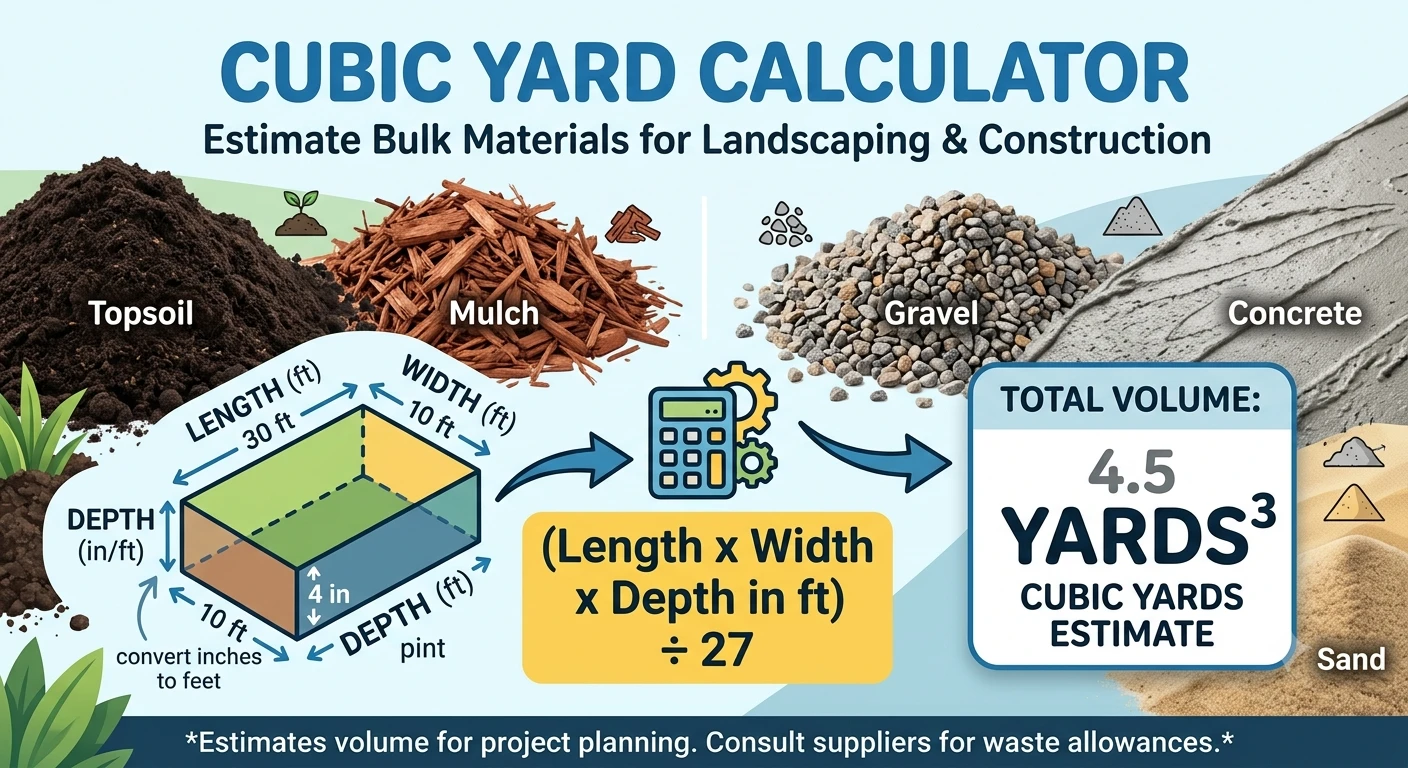
Important: The calculator provides an estimate based on the dimensions entered. Actual material requirements can vary because of compaction, uneven ground, settling, moisture, waste, and differences in how materials are delivered.
If your project involves roof construction, you can also calculate roof measurements with our Rafter Calculator.
A cubic yard is a unit of volume commonly used in the United States for measuring large quantities of materials.
One cubic yard represents a space that is
1 yard × 1 yard × 1 yard
Since one yard equals 3 feet:
1 cubic yard = 3 ft × 3 ft × 3 ft
Therefore:
1 cubic yard = 27 cubic feet
This conversion is especially useful when buying materials such as
A Cubic Yard Calculator is an online tool that calculates the volume of an area and converts the result into cubic yards.
For a rectangular area, the basic volume formula is
Volume = Length × Width × Depth
If the measurements are entered in feet, the result is initially in cubic feet.
To convert cubic feet to cubic yards:
Cubic Yards = Cubic Feet ÷ 27
Give feedback.
For example, if an area is 10 feet long, 5 feet wide, and 0.5 feet deep:
10 × 5 × 0.5 = 25 cubic feet
Then:
25 ÷ 27 ≈ 0.93 cubic yards
Using the calculator is simple.
Measure the length of the area in feet or another supported unit.
Measure the width of the area.
Measure how deep the material will be.
For example, a mulch bed might require a depth of 3 inches.
Enter the dimensions into the calculator.
The calculator determines the volume and converts it into cubic yards.
Use the result to estimate how much material you need to order.
For real projects, consider adding a reasonable allowance for waste, settling, and uneven surfaces.
For a rectangular area, use:
Cubic Feet = Length × Width × Depth
Then convert cubic feet into cubic yards:
Cubic Yards = Length × Width × Depth ÷ 27
When all three dimensions are measured in feet.
Suppose you have:
Calculate:
20 × 10 × 0.5 = 100 cubic feet
Convert to cubic yards:
100 ÷ 27 ≈ 3.70 cubic yards
You would therefore need approximately 3.70 cubic yards based on the mathematical volume.
There are:
27 cubic feet in 1 cubic yard.
This is because:
1 yard = 3 feet
and:
3 × 3 × 3 = 27
Therefore:
| Cubic Yards | Cubic Feet |
|---|---|
| 0.5 yd³ | 13.5 ft³ |
| 1 yd³ | 27 ft³ |
| 2 yd³ | 54 ft³ |
| 3 yd³ | 81 ft³ |
| 4 yd³ | 108 ft³ |
| 5 yd³ | 135 ft³ |
| 10 yd³ | 270 ft³ |
This conversion is useful when comparing supplier quantities or checking material estimates.
If your measurements are already in feet, calculating cubic yards is straightforward.
Use:
Cubic Yards = (Length × Width × Depth) ÷ 27
Length = 30 ft
Width = 12 ft
Depth = 0.25 ft
First calculate cubic feet:
30 × 12 × 0.25 = 90 ft³
Then:
90 ÷ 27 = 3.33 yd³
So the area requires approximately:
3.33 cubic yards
before allowing for waste or settling.
Depth is often measured in inches rather than feet.
To use the cubic-yard formula with feet, convert inches to feet first.
The formula is
Feet = Inches ÷ 12
For example:
6 inches ÷ 12 = 0.5 feet
Therefore:
6 inches = 0.5 ft
Other common conversions:
| Depth | Feet |
|---|---|
| 1 inch | 0.0833 ft |
| 2 inches | 0.1667 ft |
| 3 inches | 0.25 ft |
| 4 inches | 0.3333 ft |
| 6 inches | 0.5 ft |
| 8 inches | 0.6667 ft |
| 12 inches | 1 ft |
This conversion is particularly useful for landscaping projects.
If you're working with property measurements, use our tool to calculate property portions.
A cubic yard calculator is commonly used to estimate mulch requirements.
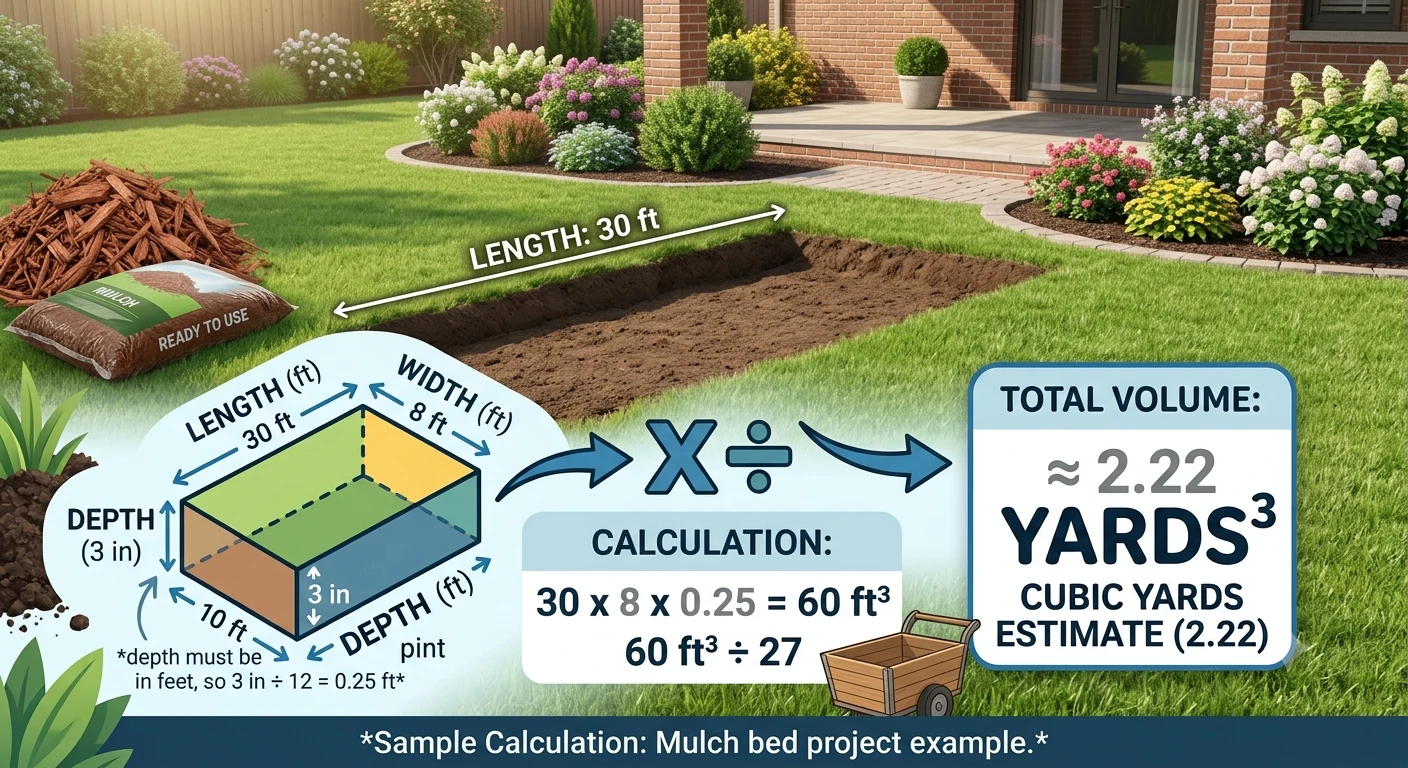
Suppose a garden bed is
Convert the depth:
3 ÷ 12 = 0.25 ft
Calculate volume:
30 × 8 × 0.25 = 60 cubic feet
Convert:
60 ÷ 27 ≈ 2.22 cubic yards
So the mathematical requirement is approximately 2.22 cubic yards of mulch.
Depending on the material and installation conditions, please order slightly more than the calculated amount.
Topsoil is often sold by the cubic yard.
To estimate the required quantity, calculate:
Length × Width × Depth
and then divide by 27 when the dimensions are in feet.
Suppose you want to cover:
40 ft × 15 ft
with:
4 inches of topsoil
Convert 4 inches:
4 ÷ 12 = 0.3333 ft
Calculate:
40 × 15 × 0.3333 ≈ 200 cubic feet
Then:
200 ÷ 27 ≈ 7.41 cubic yards
You would need approximately 7.41 cubic yards based on the calculated volume.
Gravel is commonly purchased by the cubic yard for driveways, paths, drainage areas, and landscaping.
For a rectangular gravel area:
Cubic Yards = Length × Width × Depth ÷ 27
Suppose:
Convert depth:
4 ÷ 12 = 0.3333 ft
Volume:
50 × 10 × 0.3333 ≈ 166.67 ft³
Convert:
166.67 ÷ 27 ≈ 6.17 yd³
The calculated volume is approximately 6.17 cubic yards.
Actual gravel requirements can differ depending on compaction and the condition of the surface.
Concrete can also be estimated by volume.
For a rectangular slab:
Volume = Length × Width × Depth
If dimensions are in feet, divide the cubic-foot result by 27 to obtain cubic yards.
A concrete slab is:
Convert thickness:
4 ÷ 12 = 0.3333 ft
Calculate:
20 × 10 × 0.3333 ≈ 66.67 cubic feet
Convert:
66.67 ÷ 27 ≈ 2.47 cubic yards
The mathematical volume is approximately 2.47 cubic yards.
For concrete projects, ordering and structural requirements should be checked carefully because actual site conditions can affect the required amount.
Sand is another material frequently purchased by the cubic yard.
For a rectangular area:
Cubic Yards = Length × Width × Depth ÷ 27
For example:
Length = 15 ft
Width = 10 ft
Depth = 6 in
Convert:
6 ÷ 12 = 0.5 ft
Then:
15 × 10 × 0.5 = 75 ft³
Finally:
75 ÷ 27 ≈ 2.78 yd³
The estimated requirement is approximately 2.78 cubic yards.
Not every project has a rectangular shape.
For a circular area, calculate the volume using the cylinder formula:
Volume = π × r² × depth
where r is the radius.
If the measurements are in feet, the resulting volume is cubic feet.
Then:
Cubic Yards = Cubic Feet ÷ 27
Suppose a circular garden has:
Volume:
π × 5² × 0.5
≈ 39.27 cubic feet
Convert:
39.27 ÷ 27 ≈ 1.45 cubic yards
So the estimated volume is approximately 1.45 cubic yards.
Some yards, gardens, driveways, and construction areas are irregularly shaped.
In these cases, divide the area into smaller sections.
For example, divide an irregular garden into:
Calculate the volume of each section separately, then add the results.
Total volume = Volume A + Volume B + Volume C
This approach can produce a better estimate than treating an irregular area as one simple rectangle.
The amount of material you need depends on:
The calculator determines the mathematical volume, but the amount you actually order may need to be higher.
For example, if the calculated requirement is
4.2 cubic yards
You may need to discuss ordering approximately 4.5 cubic yards or another suitable amount with your supplier depending on the material and project conditions.
Avoid automatically adding a fixed percentage to every project because material behavior varies.
A cubic yard measures volume, not weight.
Different materials have different densities.
For example, one cubic yard of:
will not necessarily weigh the same.
If you need to convert cubic yards to tons, you need the material's density or the supplier's stated weight-per-volume information.
A cubic-yard calculation alone cannot determine the exact weight.
To estimate weight from volume, you need a material-specific conversion.
A general relationship is
Weight = Volume × Density
For example, if a supplier provides a density in tons per cubic yard, you can multiply:
Cubic Yards × Tons per Cubic Yard
However, densities vary significantly based on:
For accurate ordering, use the density information provided by your material supplier.
These units measure different things.
A square yard measures area.
1 square yard = 9 square feet
A cubic yard measures volume.
1 cubic yard = 27 cubic feet
If you are buying bulk material, you generally need a volume measurement such as cubic yards.
If you're measuring surface coverage, you may first calculate square yards and then account for the required depth.
Both are units of volume.
1 cubic yard = 27 cubic feet
Therefore:
Cubic Yards = Cubic Feet ÷ 27
and:
Cubic Feet = Cubic Yards × 27
For example:
81 cubic feet ÷ 27 = 3 cubic yards
If length and width are in feet but depth is in inches, convert the depth to feet before using the basic formula.
When converting cubic feet to cubic yards, divide by:
27, not 9.
Square feet measure area, while cubic feet and cubic yards measure volume.
An uneven area may require multiple measurements for a more accurate estimate.
Some materials can settle after installation.
A cubic yard is a volume measurement. Material weight depends on density.
The mathematical result may not account for waste, compaction, settling, or site variations.
A cubic yard calculator can make bulk-material calculations much easier.
It can help you:
It is particularly useful when materials are sold by cubic yard.
For material waste allowances or other percentage calculations, use our tool to calculate percentages.
A cubic yard is a unit of volume equal to a space measuring one yard long, one yard wide, and one yard deep.
There are 27 cubic feet in one cubic yard.
For a rectangular area measured in feet:
Cubic Yards = Length × Width × Depth ÷ 27
100 ÷ 27 ≈ 3.70 cubic yards.
Divide inches by 12.
For example:
6 inches ÷ 12 = 0.5 feet.
Measure the length and width of the area and determine the desired depth. Convert the depth to feet, calculate cubic feet, and divide by 27.
Use:
Length × Width × Depth ÷ 27
when measurements are in feet.
Yes. You can calculate the volume of a rectangular concrete slab and convert the result into cubic yards.
It can calculate volume, but converting cubic yards to tons requires the density of the specific material.
No. A square yard measures area, while a cubic yard measures volume.
There is no single weight for a cubic yard. Weight depends on the material's density and moisture content.
Often, some allowance may be appropriate because of waste, settling, compaction, or uneven surfaces. The appropriate amount depends on the specific material and project.
Yes. Divide the area into smaller regular sections, calculate each section separately, and add the volumes together.
The appropriate depth depends on the project and material. Follow the recommendations applicable to your specific landscaping or construction application.
The Cubic Yard Calculator is intended for general educational, planning, and estimation purposes. Results are based on the measurements entered and represent mathematical volume rather than a guaranteed quantity of material required at a job site.
Actual material requirements can vary due to compaction, settling, moisture, waste, uneven surfaces, material characteristics, and installation practices.
For concrete, structural work, excavation, drainage, or other projects where inaccurate quantities could create safety or construction problems, verify the measurements and material requirements with a qualified professional or supplier.

Zain Bin Shabbir is a content creator and website publisher with 2 years of experience in SEO, web content, and practical online tools. He focuses on creating clear, useful, and user-friendly resources that simplify everyday calculations.
Guides that go deeper into this topic