
Use our free Inheritance Portion Calculator to divide an inheritance among multiple beneficiaries based on percentage shares. Enter the total inheritance, select a currency, add beneficiaries, and calculate each person’s portion.
Calculate each beneficiary’s share of an inheritance by percentage.
Use our Inheritance Portion Calculator to calculate a person’s percentage-based share of an inheritance amount. Enter the total inheritance value and the applicable percentage share to estimate the corresponding monetary portion.
This calculator is designed for mathematical estimation. It can be useful when a valid will, agreement, court order, professional advice, or applicable inheritance rules have already determined the inheritance shares.

Important: Inheritance laws and entitlement rules vary significantly by country and situation. This calculator does not determine who is legally entitled to inherit or what percentage applies. It only calculates the mathematical value of a percentage that you enter.
An inheritance portion is the share of an estate or inheritance assigned to a particular beneficiary.
An inheritance may consist of:
When an inheritance is expressed as a percentage, the percentage can be applied to the relevant total amount to calculate its mathematical value.
For example, if an estate has a value of $200,000 and a beneficiary has a 25% share:
$200,000 × 25 ÷ 100 = $50,000
The calculated inheritance portion is therefore $50,000.
The actual distribution of an estate can be more complicated because assets, debts, taxes, expenses, valuations, and legal rules may need to be considered separately.
Using the calculator is straightforward.
Enter the total inheritance or estate value that you want to use for the calculation.
For example:
$500,000
Enter the percentage associated with the beneficiary.
For example:
20%
The calculator applies the percentage to the total amount.
For:
$500,000 × 20%
The result is
$100,000
The calculator provides the mathematical portion corresponding to the percentage entered.
If several beneficiaries are involved, calculate each percentage separately and check the overall allocation.
The basic mathematical formula is
Inheritance Portion = Total Inheritance × Inheritance Percentage ÷ 100
For example, if the total amount is $300,000 and the applicable share is 15%:
$300,000 × 15 ÷ 100 = $45,000
Therefore, the mathematical value of the 15% portion is $45,000.
Another way to express the same formula is
Inheritance Portion = Total Amount × Percentage
where the percentage is converted to a decimal.
For example:
25% = 0.25
So:
$400,000 × 0.25 = $100,000
Both methods produce the same result.
It is important to understand the difference between a share and an amount.
A share describes the percentage or fraction assigned to a beneficiary.
An amount represents the monetary value of that share.
For example:
| Beneficiary | Share | Mathematical Amount |
|---|---|---|
| Beneficiary A | 50% | $100,000 |
| Beneficiary B | 30% | $60,000 |
| Beneficiary C | 20% | $40,000 |
| Total | 100% | $200,000 |
The percentage tells you the relative share, while the total inheritance value determines its monetary equivalent.
If you already know the percentage, calculating the monetary share is simple.
Suppose the estate is worth:
$750,000
and a beneficiary has:
10%
The calculation is
$750,000 × 10 ÷ 100 = $75,000
The calculated share is $75,000.
This same method can be used for different percentages.
For a $750,000 estate:
The calculator can make these calculations faster and reduce manual arithmetic.
Sometimes an inheritance is divided into equal mathematical portions.
For example, suppose 4 beneficiaries are each entitled to an equal share of a $400,000 amount.
The percentage for each person would be
100% ÷ 4 = 25%
The monetary amount would be
$400,000 ÷ 4 = $100,000
Therefore, each equal share corresponds to:
25% = $100,000
However, whether beneficiaries are legally entitled to equal shares depends on the applicable inheritance arrangement or law.
Inheritance portions do not necessarily have to be equal.
For example, suppose a $500,000 amount is mathematically divided as follows:
The calculated amounts are
40%:
$500,000 × 40% = $200,000
35%:
$500,000 × 35% = $175,000
25%:
$500,000 × 25% = $125,000
Total:
$200,000 + $175,000 + $125,000 = $500,000
This demonstrates how different percentages can be converted into monetary portions.
If you are calculating the distribution of the entire amount, the intended shares should generally account for the complete amount.
For example:
40% + 35% + 25% = 100%
means the entire amount has been allocated mathematically.
If the shares total only 90%, then 10% remains unallocated.
If they total 110%, the percentages exceed the total amount.
This does not necessarily mean that the underlying legal arrangement is incorrect, because estates can involve deductions, separate asset classes, reserved portions, debts, or other considerations. It simply means the percentages entered into a basic percentage calculator do not represent a complete 100% allocation.
One of the most important concepts in inheritance calculations is the difference between the gross estate and the amount actually available for distribution.
The gross estate may include the total value of assets before certain deductions.
Depending on the jurisdiction and circumstances, an estate may also involve:
The amount available for distribution may therefore be different from the initial asset value.
For example:
Gross estate: $500,000
Allowable deductions: $50,000
Amount remaining: $450,000
If a particular percentage is then applied to the $450,000 distributable amount:
$450,000 × 20% = $90,000
This is why users should carefully determine the appropriate total amount before using a percentage-based inheritance calculation.
The calculator itself does not determine which deductions are legally applicable.
An inheritance may involve property rather than cash.
For example, a family property may be valued at $300,000, and a beneficiary may have a mathematically calculated 25% share.
The percentage calculation would be
$300,000 × 25% = $75,000
However, this does not automatically mean the beneficiary receives $75,000 in cash.
The beneficiary might instead have an ownership interest in the property, depending on the legal arrangement.
Property division can involve additional factors such as
For mathematical property-share calculations, you can also use a Property Portion Calculator.
Land can also form part of an estate.
Suppose an inherited parcel contains 20 acres, and a mathematically determined share is 25%.
The corresponding mathematical area would be
20 × 25% = 5 acres
But a 25% ownership interest does not necessarily mean that the beneficiary automatically receives a specific 5-acre physical parcel.
A physical subdivision may require a survey, legal documentation, access arrangements, minimum plot requirements, and approval from relevant authorities.
For area-based calculations, our Land Portion Calculator can help calculate percentage-based land portions.
Inheritance shares may sometimes be expressed as fractions instead of percentages.
For example:
1/4 = 25%
1/2 = 50%
3/4 = 75%
If you have a fractional share and need to convert it into a percentage, the general formula is
Fraction × 100 = Percentage
For example:
1/5 × 100 = 20%
You can then use that percentage to calculate the mathematical monetary portion.
If your share is expressed as a ratio, our Ratio to Fraction Calculator can help with the mathematical conversion.
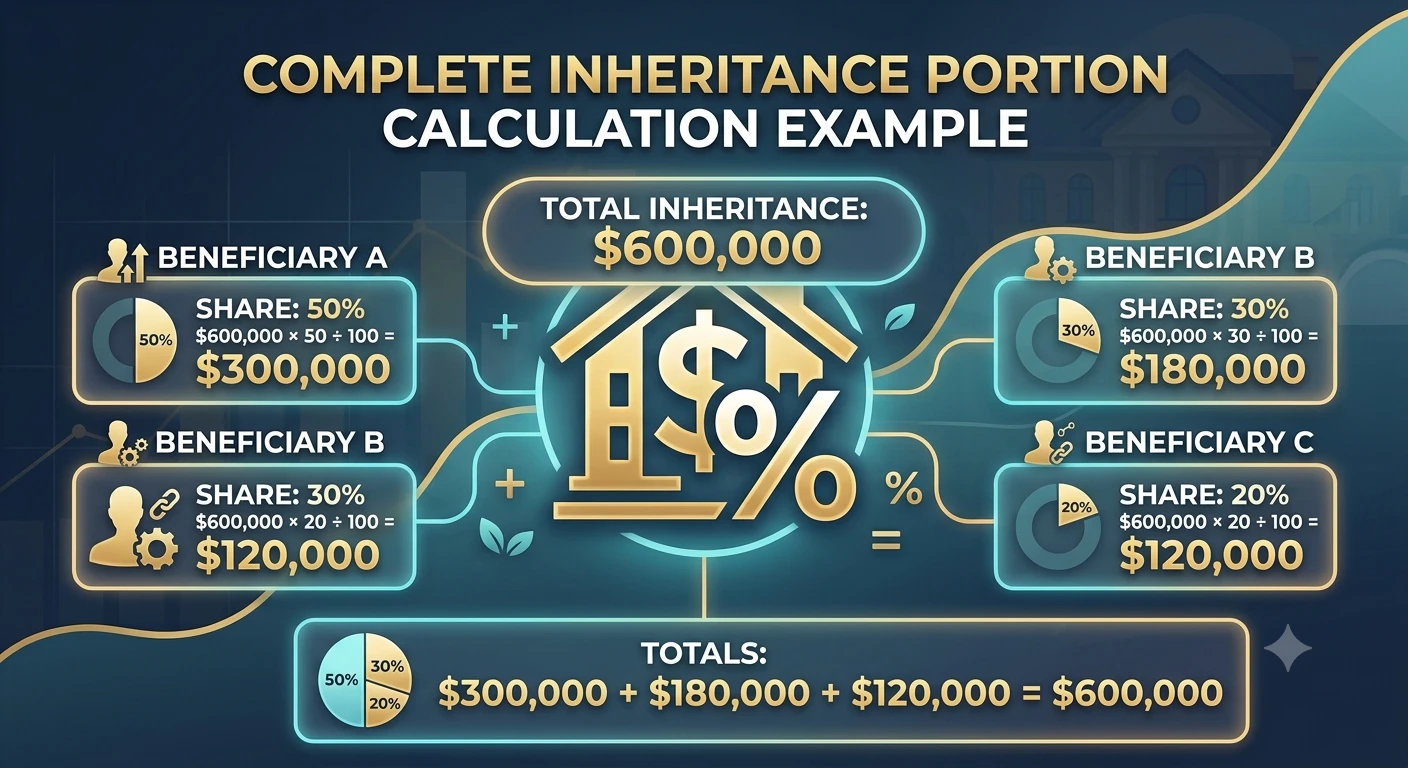
Suppose an amount of $600,000 is being considered for a percentage-based calculation.
The entered shares are
$600,000 × 50% = $300,000
$600,000 × 30% = $180,000
$600,000 × 20% = $120,000
$300,000 + $180,000 + $120,000 = $600,000
This confirms that the entered percentages mathematically represent the full amount.
A person may calculate a percentage from the gross estate when the relevant calculation should be based on a different amount.
Always determine what amount is actually intended for the calculation.
A 25% share is not the same as $25.
The percentage must be applied to the total amount.
If multiple shares are being calculated, check the complete allocation rather than looking at only one beneficiary.
Rounding individual values too early can create a small difference when the portions are added together.
Keep sufficient decimal precision during the calculation and round the final results appropriately.
A mathematical calculator cannot determine who legally inherits or what share the law assigns to a person.
That requires the relevant legal and factual information.
A percentage-based inheritance calculation can become difficult when multiple beneficiaries or different shares are involved.
An inheritance share calculator can help you:
It can be useful for preliminary calculations and understanding percentage-based distributions.
No.
This is an important limitation.
An inheritance calculator can calculate the value of a known percentage, but it cannot independently determine the legally correct percentage.
For example, if you enter 25%, the calculator can determine 25% of the amount.
It cannot determine whether the beneficiary should receive 25%, 50%, 10%, or another share.
The applicable share may depend on:
Therefore, the calculator should be treated as a mathematical tool rather than a legal inheritance adviser.
An inheritance portion is the share of an estate or inheritance assigned to a beneficiary. It may be expressed as a percentage, fraction, monetary amount, or interest in an asset.
If the percentage is already known, multiply the total relevant amount by the percentage and divide by 100.
Formula:Total Amount × Percentage ÷ 100
25% of $200,000 is:
$200,000 × 25 ÷ 100 = $50,000
If there are equal shares, divide the relevant total amount by the number of beneficiaries.
For example, $300,000 divided equally between 3 people is $100,000 per person.
Yes. The mathematical calculation can accommodate different percentages. Whether different shares are legally applicable depends on the relevant inheritance arrangement and law.
You can use it to calculate the monetary value corresponding to a known percentage of a property’s value. It does not determine legal property ownership.
Yes, mathematically. If you know the total land area and percentage, you can calculate the corresponding area. Physical subdivision may require additional legal and surveying procedures.
No. It only performs mathematical calculations based on the information entered.
Not necessarily. The correct calculation base can depend on debts, expenses, taxes, liabilities, and applicable rules. Determine the appropriate amount before applying the percentage.
If your calculator accepts percentages, convert the fraction first.
For example:
1/4 = 25%
and:
1/2 = 50%
The mathematical formula can be used with any percentage, but the calculator does not interpret country-specific inheritance laws. Legal entitlement should be verified using applicable local rules and professional advice.
No. The basic calculator applies the entered percentage to the entered amount. Taxes, debts, expenses, and other deductions need to be considered separately.
The Inheritance Portion Calculator is provided for general mathematical and educational purposes. It does not provide legal, tax, financial, estate-planning, or inheritance advice.
Inheritance rules vary by jurisdiction and individual circumstances. The calculator does not determine legal heirs, entitlement, mandatory shares, distribution rights, or the legally appropriate calculation base.
Before making decisions about an estate, inheritance, property, taxes, or beneficiary rights, verify the relevant information with official documents and an appropriately qualified professional.
If you need to divide an inheritance amount between beneficiaries, our calculate money shares tool can help with the percentage calculation. For inherited land, use our calculate land portions calculator to determine the mathematical area associated with a known percentage.

Zain Bin Shabbir is a content creator and website publisher with 2 years of experience in SEO, web content, and practical online tools. He focuses on creating clear, useful, and user-friendly resources that simplify everyday calculations.
Guides that go deeper into this topic