
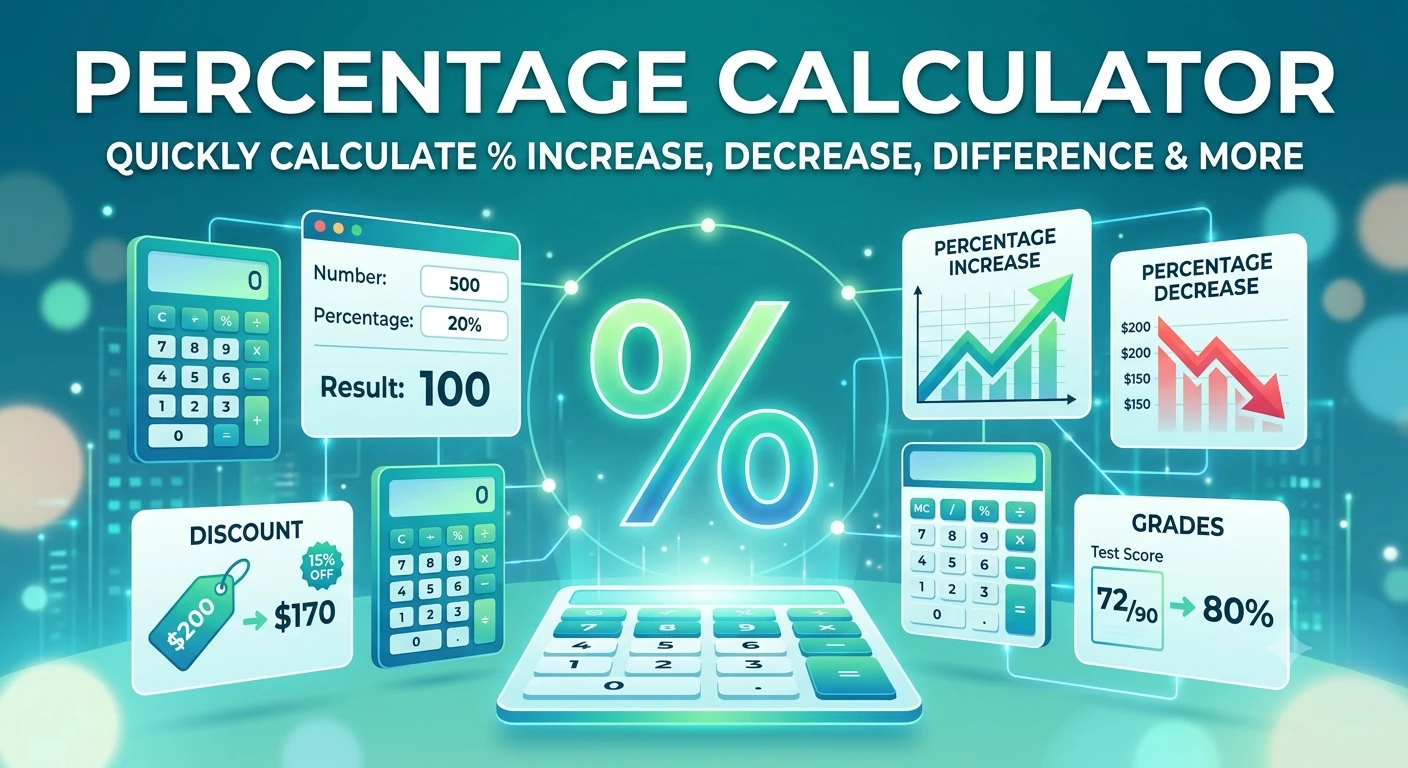
Use our free Percentage Calculator to quickly calculate percentages, find what percentage one number is of another, and calculate percentage increases or decreases. Enter your values and get accurate results instantly.
Calculate percentages, percentage changes, and find what percentage one number is of another.
Use our Percentage Calculator to quickly calculate percentages, percentage increases and decreases, percentage differences, and other common percentage calculations. Enter the numbers you know, choose the type of calculation, and get an accurate result without doing the math manually.
Percentages are used in everyday situations such as discounts, taxes, grades, business calculations, price changes, budgets, statistics, and financial planning. This calculator makes these calculations easier and faster.
Important: Results are mathematical calculations based on the numbers entered. For financial, tax, legal, academic, or business decisions, verify the result with the appropriate source or professional where necessary.
If you need to divide a total amount according to different percentages, use our calculate money portions tool.
A percentage is a way of expressing a number as a fraction of 100.
The word "percent" literally means "per hundred." The symbol used for percentage is %.
For example:
You can also write a percentage as a decimal or fraction.
For example:
25% = 25/100 = 0.25
This relationship lets you use percentages in many different mathematical calculations.
Our percentage calculator supports several common types of percentage calculations.
Depending on the calculation you need, enter the relevant numbers and select the appropriate calculation method.
If you want to find a percentage of a number, enter:
For example:
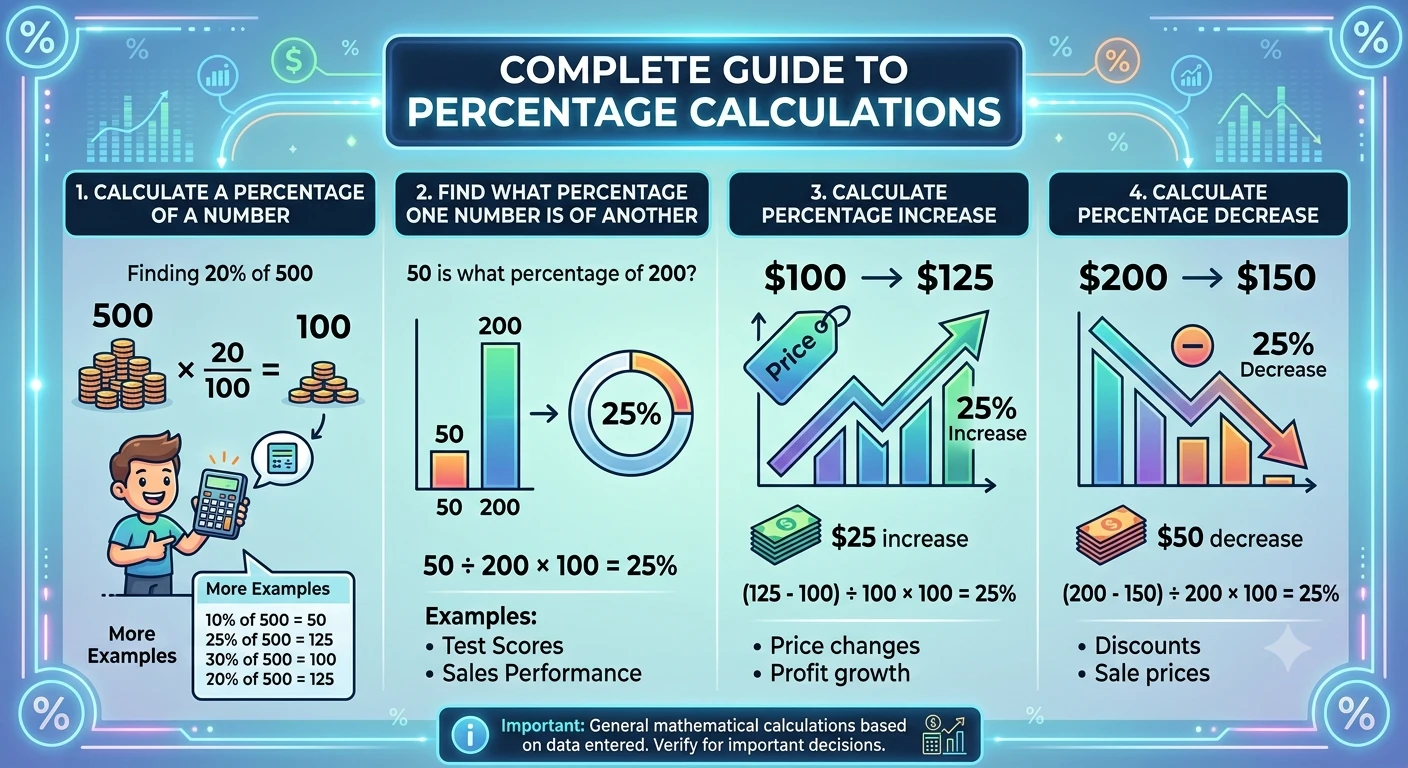
20% of 500
The calculator gives:
100
because:
500 × 20 ÷ 100 = 100
Suppose you want to know what percentage 50 is of 200.
Use:
50 ÷ 200 × 100 = 25%
Therefore, 50 is 25% of 200.
Suppose a price increases from $100 to $125.
The increase is
$125 − $100 = $25
Then:
$25 ÷ $100 × 100 = 25%
The price increased by 25%.
Suppose a price falls from $200 to $150.
The decrease is
$200 − $150 = $50
Then:
$50 ÷ $200 × 100 = 25%
The price decreased by 25%.
The most common percentage formula is
Percentage = Part ÷ Whole × 100
For example, if you have 30 out of 120:
30 ÷ 120 × 100 = 25%
So 30 represents 25% of 120.
To calculate a percentage of a number, use:
Percentage Value = Original Number × Percentage ÷ 100
For example, to calculate 15% of 800:
800 × 15 ÷ 100 = 120
Therefore:
15% of 800 = 120
10% of 500 = 50
20% of 500 = 100
25% of 500 = 125
50% of 500 = 250
75% of 500 = 375
This basic calculation is useful for discounts, commissions, taxes, tips, budgets, and many other situations.
Sometimes you know the part and the total, but you need to find the percentage.
Use:
Percentage = Part ÷ Total × 100
You scored 45 points out of 60.
Calculate:
45 ÷ 60 × 100 = 75%
Your score is therefore 75%.
This type of percentage calculation is commonly used for:
A percentage increase measures how much a value has increased relative to its original value.
The formula is
Percentage Increase = (New Value − Original Value) ÷ Original Value × 100
A product price increases from $80 to $100.
First, find the increase:
$100 − $80 = $20
Then:
$20 ÷ $80 × 100 = 25%
The price increased by 25%.
A percentage decrease measures how much a value has fallen compared with its original value.
The formula is
Percentage Decrease = (Original Value − New Value) ÷ Original Value × 100
A price decreases from $250 to $200.
The decrease is
$250 − $200 = $50
Then:
$50 ÷ $250 × 100 = 20%
The price decreased by 20%.
These two calculations are often confused.
Percentage change compares a new value with an original value.
For example, if a price changes from $100 to $120:
($120 − $100) ÷ $100 × 100 = 20%
The percentage change is 20%.
Percentage difference is often used when comparing two values without treating either one as the original value.
A common formula is
Percentage Difference = |Value 1 − Value 2| ÷ ((Value 1 + Value 2) ÷ 2) × 100
For example, compare 80 and 100:
Difference:
100 − 80 = 20
Average:
(80 + 100) ÷ 2 = 90
Percentage difference:
20 ÷ 90 × 100 ≈ 22.22%
So the percentage difference is approximately 22.22%.
The correct formula depends on what you are measuring.
Percentage points and percentages are not always interchangeable.
Suppose an interest rate changes from 5% to 7%.
The increase is
7% − 5% = 2 percentage points
But the relative percentage increase is
2 ÷ 5 × 100 = 40%
Therefore:
This distinction matters most when working with statistics, interest rates, survey results, and performance measurements.
For percentage-based ownership calculations, you can also calculate property shares using our Property Portion Calculator.
Percentages are commonly used to calculate discounts.
Suppose a product costs $200 and has a 15% discount.
First calculate the discount:
$200 × 15 ÷ 100 = $30
Then subtract the discount:
$200 − $30 = $170
The final price is $170.
Discount Amount = Original Price × Discount Percentage ÷ 100
Sale Price = Original Price − Discount Amount
You can use the percentage calculator to check these calculations quickly.
Suppose an item costs $500 and the applicable tax rate is 10%.
Tax:
$500 × 10 ÷ 100 = $50
Total:
$500 + $50 = $550
The calculator can help determine the percentage amount, while the actual tax rate and applicable rules depend on the relevant jurisdiction.
Suppose a restaurant bill is $80 and you want to leave a 15% tip.
Tip:
$80 × 15 ÷ 100 = $12
Total:
$80 + $12 = $92
You can use the same percentage formula for different tip percentages.
Percentages are widely used to represent academic scores.
Suppose a student receives 72 points out of 90.
Use:
72 ÷ 90 × 100 = 80%
The score is therefore 80%.
For educational calculations that involve GPA or grade points, you can also use our SRM GPA Calculator.
Businesses use percentages in many areas, including:
For example, if a business generates $50,000 in revenue and spends $35,000 on expenses, the difference is
$50,000 − $35,000 = $15,000
If you want to express that difference as a percentage of revenue:
$15,000 ÷ $50,000 × 100 = 30%
The result is a 30% difference relative to revenue.
For more specialized financial calculations, use the appropriate financial calculator and verify the assumptions.
To convert a percentage into a decimal, divide by 100.
Examples:
10% = 0.10
25% = 0.25
50% = 0.50
75% = 0.75
125% = 1.25
This is useful when applying a percentage directly in a mathematical formula.
For example:
25% of 400
can be written as:
0.25 × 400 = 100
To convert a decimal into a percentage, multiply by 100 and add the percentage symbol.
Examples:
0.10 = 10%
0.25 = 25%
0.50 = 50%
0.75 = 75%
1.00 = 100%
For example:
0.35 × 100 = 35%
Therefore, 0.35 equals 35%.
To convert a fraction into a percentage:
Fraction ÷ Denominator × 100
For example:
1/4 × 100 = 25%
Another example:
3/5 × 100 = 60%
Yes.
A percentage can be greater than 100% when the amount being compared is greater than the reference amount.
For example:
150% of 100 = 150
Similarly, if a value increases from 100 to 250:
Increase:
250 − 100 = 150
Percentage increase:
150 ÷ 100 × 100 = 150%
Therefore, the value increased by 150%.
Percentage calculations are simple in principle, but errors can occur when working with several numbers, decimals, increases, decreases, or multiple steps.
An online percentage calculator can help you:
It can be useful for students, shoppers, employees, business owners, and anyone who regularly works with percentages.
If the percentage relates to land ownership, use our calculate land shares calculator for area-based portions.
Percentage change is normally calculated relative to the original value.
For example, when a price changes from $100 to $120, the increase is measured against $100, not $120.
An increase from 5% to 7% is a 2 percentage-point increase, not simply a 2% relative increase.
When manually calculating a percentage amount, remember that:
25% = 25 ÷ 100 = 0.25
Rounding intermediate results can sometimes create a small difference in the final answer. Keep additional decimal places until the final step when accuracy matters.
"20% of 500," "500 is what percentage of 2,000?" and "500 increased to 600 by what percentage? "are different questions and use different formulas.
For a percentage of a number, multiply the number by the percentage and divide by 100.
Example:
20% of 300 = 300 × 20 ÷ 100 = 60
Divide the part by the total and multiply by 100.
Percentage = Part ÷ Total × 100
Subtract the original value from the new value, divide by the original value, and multiply by 100.
Percentage Increase = (New − Original) ÷ Original × 100
Subtract the new value from the original value, divide by the original value, and multiply by 100.
Percentage Decrease = (Original − New) ÷ Original × 100
20% of 500 is 100.
25% of 1,000 is 250.
A percentage describes a relative proportion or change, while percentage points describe the direct difference between two percentages.
For example, moving from 40% to 50% is an increase of 10 percentage points, while the relative increase is 25%.
Yes. For example, 200% of 50 is 100.
Multiply the original price by the discount percentage, divide by 100, and subtract the resulting discount from the original price.
Yes, the calculator can determine percentage scores. For GPA or grade-point calculations, use a dedicated GPA calculator.
Yes. You can calculate percentages using whole numbers, decimals, and other numerical values.
Divide the numerator by the denominator and multiply by 100.
For example:
1 ÷ 4 × 100 = 25%
The calculator can perform percentage calculations. However, you should use the appropriate profit-margin or profit-percentage formula depending on whether you are measuring profit against cost, revenue, or another base.
The Percentage Calculator is a general mathematical tool intended to make common percentage calculations easier. The result depends on the numbers and calculation method entered.
For financial, tax, legal, academic, business, or other important decisions, verify the calculation and make sure you are using the correct underlying formula and reference value.
For academic calculations involving grade points rather than simple percentages, use our tool to calculate GPA and grade points.

Zain Bin Shabbir is a content creator and website publisher with 2 years of experience in SEO, web content, and practical online tools. He focuses on creating clear, useful, and user-friendly resources that simplify everyday calculations.
Guides that go deeper into this topic